Homophobic persecution
My PolicemanHomophobic persecution in the novel is not confined to the courtroom or the prison cell: it shapes what Patrick Hazlewood dares to hope for, how he understands police power, and what he can expect from the people closest to him. His prosecution turns a private relationship and an alleged encounter into grounds for punishment, while the threat of exposure reaches beyond him to Tom Burgess and their associates. The resulting silence, separation, and confinement make persecution both a legal process and an intimate condition.
Social Risk and the Reach of the Law
Before his arrest, Patrick imagines getting closer to Tom slowly, through friendship rather than a hurried encounter. He knows that quicker pleasures are available, but wants something more substantial. His hopes depend on reading Tom’s caution and proceeding without frightening him away: intimacy is already a matter of calculation. The passage does not reduce that caution to a single cause, but Tom’s position as a policeman makes the risks surrounding their connection especially consequential.
The danger becomes explicit when a major scandal involving the Brighton Criminal Investigation Department breaks in October 1957. The Chief Constable and a detective inspector face conspiracy charges. Patrick initially welcomes the public disgrace of senior officers, but his satisfaction gives way to concern that ordinary members of the force will also be put under pressure. The scandal does not itself establish that Tom is implicated; rather, it makes Patrick fear that an already compromised institution may bring new scrutiny and consequences for people like him.
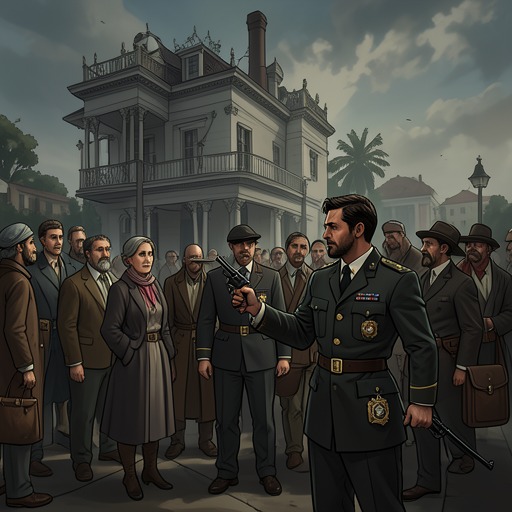
The later arrest brings that institutional threat directly to the home. Patrick remembers a forceful knock at a quarter past one in the morning, one that seemed designed to alert the neighbours as well as summon the person inside. The visitor is a policeman, not Tom. The scene makes the law’s arrival public before the charge is even explained: the hour, the persistence of the knock, and the presence of neighbours turn arrest into an exposure as well as a legal action.
Pressure Before and During Trial
At the police station, Slater urges Patrick to plead guilty, presenting a plea as a way to spare trouble not only for Patrick but also for his associates. His appeal to the welfare of family and friends changes the pressure’s scale. Patrick fears that the interview may concern Tom, and reads the suggestion of leniency as possibly coming from a colleague’s wish to protect another policeman. The exchange shows how the threat of prosecution can make silence or submission seem like protection for other people, even before the case reaches court.
The trial is small and unceremonious, but its opening makes social shame part of the proceedings. The public gallery is warned that the evidence may offend women, and the women present leave. Patrick watches the prosecution build its case around Laurence Cedric Coleman, who appears shaken and avoids meeting his eye. Under cross-examination, Coleman’s involvement in petty theft becomes apparent; Patrick concludes that the accusation may have helped Coleman escape trouble of his own. Yet Patrick’s suspicion does not undo the case. He remains dazed as the court proceeds toward a decision that will determine his future.
The questioning of Marion Burgess exposes another reach of the prosecution. Counsel asks whether Patrick had an indecent relationship with her husband, Tom, and whether she denies that Patrick is homosexual. Marion cannot affirm the accusation, but the question places her marriage and her own knowledge under public examination. Patrick notices her composure giving way in her trembling gloves, and regrets the distress the questioning causes her. The prosecution thus presses beyond the accused man: it asks a wife to make a public statement about her husband’s private life and Patrick’s identity.
Imprisonment and Continuing Humiliation
Patrick’s account of prison shows persecution continuing after the courtroom. A guard, Burkitt, taunts him about being homosexual and implies that men like him have opportunities in prison. The remark is not presented as a formal charge, but it makes the stigma part of ordinary institutional contact: a guard can use Patrick’s identity to degrade him while escorting him through the prison.
The contrast between the ordinary prison and the hospital wing is sharply drawn. After locked doors and the conditions of D Hall, Patrick enters a newly built, bright corridor that feels almost impossibly clean. The relief is temporary and conditional, not an escape from confinement. Elsewhere he describes waking before the doors are unlocked, watching the dim outline of thirty-two dirty windowpanes, and hearing another prisoner call out at night. In this environment, distress is shared through silence or through the sounds prisoners make; staff respond by threatening discipline. The account locates suffering in specific routines and restrictions rather than treating prison as a mere symbol.
Thirteen weeks into his sentence, Patrick has begun to follow the routine with an accepting, blank expression. His day includes an early buzzer, a chamber pot, cold water and a blunt shaving blade, limited meals, and work in a poorly supplied library. He has gained access to paper and pens there, but the books are filthy and obsolete, and the few available paperbacks offer little choice. The detail matters because confinement is not a single dramatic punishment: it accumulates through controlled movement, restricted reading, and the repeated management of basic needs.
Relationships Under Persecution
Patrick’s imprisonment is intensified by his separation from Tom. He tries to avoid thinking about him, yet finds that Tom occupies much of his mind. In memory, the difficulties of their relationship recede and Tom’s sweetness remains. Patrick returns in particular to their night journey by water taxi in Venice, recalling the brief privacy of the cabin and Tom’s hand resting against his. The remembered tenderness stands against the silence that follows the arrest: Patrick has heard nothing from Tom.
A short, formal letter from Marion asking permission to visit offers a possible link to Tom. Patrick first considers refusing her, then changes his mind because she may be the only connection through which he can learn anything about her husband. He even imagines that Tom might visit the prison or send a message through her. Neither possibility is assured. The correspondence underlines how punishment isolates Patrick while leaving him dependent on someone whose marriage has itself been placed under scrutiny.
Narrative Significance
Patrick’s first-person prison recollections set the expectation of immediate correction against the reality of a sentence that becomes routine. During the arrest, trial, and first days inside, he expects someone to announce a mistake and reopen the doors. Thirteen weeks later, the imagined apology has not arrived; instead, he has adapted outwardly to the timetable and keeps looking back toward Tom. This change gives the persecution a duration: it is not over when the verdict is delivered, but persists in daily life and in the emotional work of waiting.
The final perspective broadens the account without making it uncomplicated. A neighbour reports that Graham Vaughan has been taken away by police and says that the country can be brutal, while also describing the local presence of homosexual men as familiar. The moment places individual arrests within a wider atmosphere of surveillance and public knowledge, but sympathy from a neighbour does not prevent state action. Across Patrick’s case, the novel shows how criminal accusation, public embarrassment, institutional treatment, and the possibility of further arrests can reinforce one another, leaving love and loyalty to survive largely through memory, guarded contact, and silence.