Isle of Wight
My PolicemanThe Isle of Wight is the setting for a week-long holiday that brings Marion Taylor and Tom Burgess together in the privacy of marriage, then admits Patrick Hazlewood into their shared space. The island’s modest cottage, holiday routines and walks offer Marion a brief hope of closeness with Tom; Patrick’s arrival changes the emotional balance of the trip. In retrospect, the holiday also becomes a source of knowledge and shared experience that later reaches beyond the island.
Setting and accommodation
Patrick Hazlewood offered the couple the use of his cottage on the Isle of Wight instead of the four days in Weymouth they had expected. Marion Taylor accepted despite misgivings. She and Tom Burgess were staying at Tom’s parents’ house while they waited for a police house, where the lack of room for a double bed had left Marion in Sylvie’s old room. The island offered four nights alone with Tom before Patrick was due to join them for the final three days and show them around. For Marion, the appeal was not simply a change of scenery: the arrangement promised an escape from separate beds and a rare stretch of time in her husband’s company.
The word cottage had led Marion to imagine something far grander than the place they found. Patrick’s home stood down a gloomy, narrow lane in Bonchurch, near the sea but without a coastal view. It had two bedrooms; the double room’s ceiling sloped above a sagging bed. An overgrown garden occupied the front, while a privy stood at the back. The tiny kitchen had no electricity, though the cottage had gas, and its small, grubby windows reinforced the sense of enclosure. The accommodation is not a picturesque retreat in Marion’s account. Its closeness and discomfort make the couple’s physical proximity difficult to avoid, while its unpolished reality sharply contradicts her expectations.
The approach to the cottage made an equally strong impression. Wild garlic grew along the lane, its smell, in the heat, following Marion indoors and mingling with the damp rugs and gas. Her retrospective disgust at the odour contrasts with her later fondness for garlic, making the lane a marker of how sharply her responses have changed with time. The island is recalled not as a distant panorama but through immediate, sometimes unpleasant details: the close air, the bed, the kitchen, and the scent that clung to the house.
A holiday for two
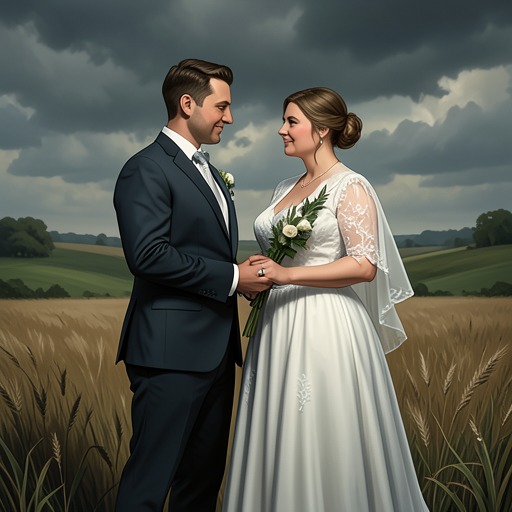
During the first part of the stay, Marion and Tom took up familiar holiday activities. They walked along Blackgang Chine, watched a Punch and Judy show at Ventnor, and visited the model village at Godshill. Tom laughed particularly hard when the policeman appeared in the show. Each morning he cooked bacon and eggs and suggested what they would do that day; Marion agreed to his plans. He also bought her a coral necklace, whose colour she remembered as resembling peaches and cream. These small routines give the holiday the outward shape of a conventional newly married couple’s escape: meals, excursions, a gift and the daily negotiation of plans.
The cottage’s sagging bed became central to Marion’s account of their physical life together. Its unevenness rolled them towards one another, so that they slept close. Marion describes lying awake with her body pressed against Tom’s back and shoulders, and sometimes blowing softly on his neck to wake him. The deliberate tenderness of these moments sits beside her description of their attempt to repeat their wedding night on the evening they arrived. It was less painful, she recalls, but ended quickly. Rather than treating the experience as a settled success, Marion thought they might improve their intimacy by encouraging Tom without instructing him. She connected that hope to what he had told her earlier about his limited experience. The island therefore gives her a private interval in which she tries to understand and shape the marriage, though the closeness she longs for is not proof that their sexual relationship has become easy.
Patrick’s arrival and the shared landscape
The couple’s time alone ended when Patrick arrived in a green Fiat sports car, carrying matching luggage. Marion watched from the bedroom window as he got out in a light brown suit and loose red cravat. She noticed his slight frown dissolve into a smile when Tom came down the path to meet him. That brief change in expression makes the arrival a turning point in her view of the holiday: Patrick is no longer an anticipated guest but a presence whose attention to Tom is visible to her.
Patrick brought provisions, including olive oil, red wine and fresh asparagus, which he said he had bought at a roadside stall. The boxes and their contents brought him directly into the domestic space Marion and Tom had occupied alone. After tea, Patrick apologized for the bed, comparing its movement to a shifting sandpit. His remark acknowledged the cottage’s discomfort but also drew attention to the intimate sleeping arrangements that had shaped Marion’s account of the first part of the stay. The visitor’s practical familiarity with the house, and his easy reunion with Tom, sit alongside Marion’s effort to make a marriage of her own there.
The island’s later trace
The Isle of Wight remains present in Marion’s later recollection not only as a holiday destination but as a place where knowledge was acquired together. In early summer 1958, while planning a school nature trip to Castle Hill with Julia Harcourt, Marion recalls that the plants and wildlife she had learned to notice were inspired in large part by things Patrick had pointed out to her and Tom during their walks on the island. The holiday’s shared landscape thus travels into her work as a teacher: observations made on walks become part of the children’s preparation for their own excursion.
This later reference broadens the island’s significance without erasing the tensions of the visit. The same stay contains Marion’s hopeful attention to married closeness, Tom’s everyday care and the unmistakable pleasure of greeting Patrick. Its landscape gives the trio a history of shared walks that Marion can draw on later, even as the circumstances of the holiday reveal that the couple’s private retreat was never simply separate from Patrick. The Isle of Wight is remembered through ordinary places and acts, but those details hold the changing relationships that make the holiday consequential.