Julia Harcourt
My PolicemanJulia Harcourt is a teacher at St Luke’s School whose brisk confidence and frankness make her an important friend and counterpoint to Marion Taylor. She first helps Marion through the terror of her new job; later, her independence and political convictions show Marion a life beyond the expectations that have narrowed her choices. When Marion turns to her over Tom Burgess, Julia offers sympathy but does not soften the truth as she sees it.
Identity and First Meeting
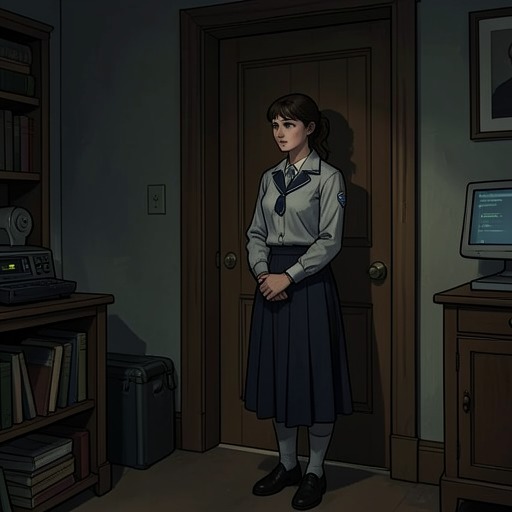
Marion first encounters Julia while lost and trembling in the school corridor on her first day. Julia, whom Marion estimates to be in her late twenties, is tall, with straight black hair cut in a rounded, bowl-like shape and vivid red lipstick. Her green frock and brown lace-up shoes strike Marion as old-fashioned, yet Julia’s bright expression gives her a jaunty air. Unlike many of the other teachers, she does not wear spectacles. Her presence is immediately practical: after learning that Marion is Miss Taylor, she explains that the infants’ department is elsewhere in the building, then offers to lead the way.
Julia also recognizes the fear behind Marion’s silence. She says that the first day is frightening and recalls that she herself was a mess when she started, reassuring Marion that people do survive it. Marion follows her out of the junior school and toward the infants’ entrance. The encounter begins with a simple act of orientation, but it gives the distressed new teacher someone who understands how overwhelming the school can feel.
A Friendship Built on Ease and Candour
The friendship develops through small gestures and shared humour. On a later walk along Queen’s Park Road, Julia remembers how petrified Marion looked on that first day. Marion admits she had feared being sick on Julia’s shoes. Julia answers gravely that this would have been a disaster because they were her best teaching shoes; she has fitted metal taps to the heels to warn the children she is coming and calls them her hooves. The joke lets Marion laugh at a memory that had first seemed humiliating. When they reach Marion’s street, Julia squeezes her arm and proposes meeting again.
Marion is drawn not only to Julia’s humour but to the confidence with which she occupies unfamiliar settings. At a pub, Julia stands at the bar without lowering her clear voice, despite appearing out of place in that environment. Marion imagines that Julia may have come from a different background, but says the difference does not trouble her. What matters is Julia’s apparent independence and her refusal to be afraid of looking or sounding different—qualities Marion wants for herself. In Marion’s account, Julia’s striking appearance and assured manner make her visible, but it is the freedom those qualities seem to express that gives their friendship its particular force.
Political Engagement
Julia’s independence also has a public dimension. Over drinks, she asks Marion about her politics, and Marion responds that mothers should be able to work and that she supports equality between the sexes. Marion then says that hydrogen-bomb testing frightens her and that she is considering joining a campaign against it; as she acknowledges, the conviction becomes real to her in the act of saying it. Julia has already attended a march at Easter and tells Marion that the local Campaign for Nuclear Disarmament holds regular meetings in town, inviting her to join.
When Marion attends a meeting at the Friends’ Meeting House, Julia is easy to pick out in a jade-green dress and orange beads. The gathering is small, with no more than about thirty people in the lecture room. Julia spots Marion, gestures for her to sit beside her, and pats her arm before turning her attention to the speaker. This welcome makes political involvement another space in which Julia draws Marion in rather than leaving her to find her place alone. For Marion, the meeting is also a step away from the conventional future she fears: she has worried that an unmarried woman who works for her living and reads too much will be regarded as a cautionary example. Julia’s example makes independence more imaginable, even as Marion remains anxious about it.
Counsel About Tom
Julia becomes a confidante when Marion’s unease about her marriage grows harder to contain. After a difficult evening, she invites Marion for a drink at her flat and walks with her through Queen’s Park. She links her arm through Marion’s as they cross the quiet park. In that companionship, Marion finally says that she does not know what to do about Tom and tries to raise what Julia has said about Patrick Hazlewood. The conversation brings Marion’s personal uncertainty into the open; Julia is not merely a companion for walks but someone to whom Marion can begin to speak about the facts she has avoided confronting.
After listening to Marion, Julia sits beside her and places a hand on hers. She calls Marion pitiable, then looks directly at her and tells her that Tom will not change. Her manner is sympathetic, but her words are deliberately clear: she presents painful candour as the kindest response she can offer. Julia’s advice does not resolve Marion’s situation, but it removes the reassurance that waiting might be enough. Her steadiness contrasts with Marion’s shifting fear and hope, and gives their friendship its most consequential moment.
Departure and Significance
Julia later tells Marion that she has found a new job at a school in Norwood and wants to be nearer to London. She has been planning the move for some time and says she wanted Marion to be the first to know. The news establishes that Julia is making a deliberate change in her own life, rather than waiting for circumstances or another person to determine her direction. Marion begins to apologise for something she has said, but the available account does not establish how the exchange is resolved.
Julia’s role in Marion’s story rests on this combination of welcome and challenge. She helps Marion enter a daunting workplace, makes room for laughter, invites her into political activity, and offers a friendship in which difficult truths can be spoken. Her independent life also exposes the pressure Marion feels to marry and avoid the stigma attached to a woman who supports herself. Julia does not simply stand for a freedom Marion has already achieved: she makes that freedom visible while Marion is still struggling to imagine it for herself.