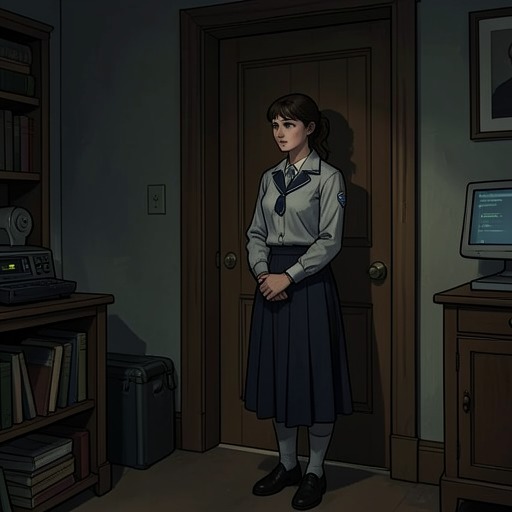
Marion hears the word “homosexual” at Castle Hill and confronts Tom’s sexuality
My PolicemanMarion hears the word “homosexual” at Castle Hill and confronts Tom’s sexuality during a school outing in early summer 1958. Julia Harcourt’s question turns an unspoken suspicion into something Marion must reckon with: she has glimpsed the closeness between Tom Burgess and Patrick Hazlewood, but has been trying to keep its meaning beyond examination. The encounter does not resolve what Tom feels or what has happened between the men. Its force lies in making that uncertainty newly unavoidable.
Setting and Pressures
By early summer, Marion and Tom were newly married. Their engagement had lasted less than a month, and Marion had experienced the rush towards marriage as thrilling and flattering. Looking back, she would suspect that Tom had hurried because he wanted to marry before he changed his mind. At the time, however, she was also conscious of her own narrowing choices: she feared becoming one of the women judged to have been left on the shelf, expected to work for herself and treated as conspicuously unmarried. That pressure helps explain why she had invested so much in marriage as the next necessary stage of life, even as aspects of her relationship with Tom remained difficult to interpret.
The occasion was a nature trip for the schoolchildren to Castle Hill, arranged by Julia and Marion. The children had spent the week drawing the plants and animals they hoped to see and learning the spellings of words such as bugle, orchid and primrose. Marion’s preparations had partly been inspired by the plants Patrick had pointed out to her and Tom on walks during their Isle of Wight holiday. The outing thus carried an unobtrusive connection to Patrick before Julia named the question that would change how Marion understood him.
The group travelled by bus towards Woodingdean and then crossed the downs to Castle Hill. Julia moved confidently among the children, touching a shoulder, guiding a child with a hand on their back, or kneeling to speak at eye level. Marion admired this ease and privately resolved to be more physically open with her own pupils. The scene’s ordinary school business—the walk, the children, the plants and the shared lunch—forms a sharp contrast with the private recognition taking shape between the two teachers.
The Question
In their conversation about Marion’s honeymoon, Julia asked whether Tom and Marion had stayed on the Isle of Wight. Marion described it as lovely, then explained that the cottage belonged to Tom’s friend Patrick, who had been best man at the wedding. Julia said that she had liked Patrick and wondered whether he was homosexual. She asked directly, “He’s homosexual, isn’t he?” Her manner seemed so casual that Marion was shocked by the ease with which the word had been spoken. She felt as if the smoked salmon in her mouth had turned rancid.
Julia did not present her impression as certainty. She added that she had wondered when she met Patrick but might be wrong. That qualification left room for Marion to deny the implication, yet the question itself had already made denial harder. Marion stood up and redirected attention to the afternoon, telling the children to get ready to leave. Julia led them down the hill, pointing out and naming birds and plants. Marion could not look at her or at the landscape; she concentrated on her feet moving through the grass. The practical interruption ended the exchange without answering it, but could not restore the earlier silence.
From Suspicion to Recognition
In her later account, Marion distinguishes what she could admit at the time from what she can see in retrospect. She says that she had not been entirely unaware of the possibility, but had pressed it down and kept it somewhere she could not examine. The public language available to her was shaped by newspaper reports: she recalls the Montagu case and recurring headlines about men charged with gross indecency or accused of unnatural acts. Such stories had become familiar enough to seem like a routine part of the news, yet they offered Marion no understanding of gay life beyond scandal and prosecution.
Castle Hill is therefore a turning point, not the first clue. Marion later connects it with Sylvie’s earlier insistence that Tom was not like that and, more decisively, with having seen Tom and Patrick standing together outside Osborne House. Those earlier moments had not produced a conscious conclusion. Julia’s question joined them into a pattern that Marion could no longer dismiss as inadmissible. The change is both intellectual and bodily: she is overwhelmed at the lunch table, then withdraws her gaze and fixes on the ground as she walks. The word does not settle the facts, but it alters what she can allow herself to ask.
Aftermath and Narrative Significance
On the walk home, Marion rehearsed how she might begin speaking to Tom: Julia had said something awful about Patrick. She told herself that she only wanted to give her husband the chance to deny it and clear up the matter. Yet she could not imagine what she would say after that opening sentence, or how far she might go. The event thus produces an immediate intention to confront Tom while revealing how little language Marion has available for carrying the confrontation through.
The later narration gives this moment its full significance by showing both its delay and its persistence. Writing to Patrick in 1999, Marion can identify the Castle Hill conversation as the point after which she could no longer avoid thinking about Patrick and, through him, Tom in a new way. The outing itself has not supplied proof or a confession. Instead, a word spoken by Julia breaks the seal on what Marion had tried not to examine. The ordinary landscape of a school trip becomes the setting for a change in what can be thought—and, eventually, for the difficult questions Marion will take home to her husband.