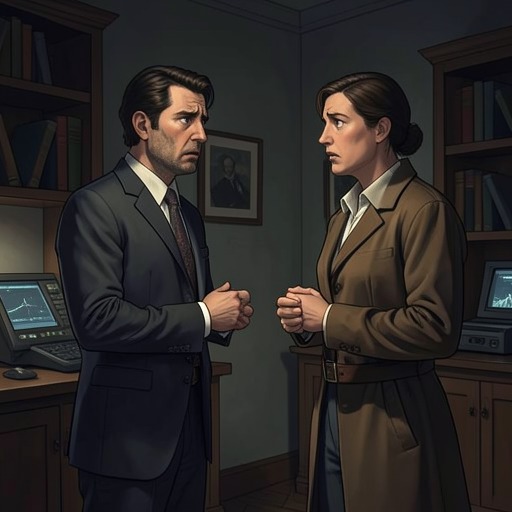
Marion meets Patrick for the first time
My PolicemanMarion’s first meeting with Patrick Hazlewood takes place at Brighton Museum and Art Gallery, when Tom brings her to meet the man with whom he already has a customary meeting place and an established cultural life. For Marion, the encounter joins two discoveries: Patrick is not a stranger casually attached to Tom’s circle, and the museum’s unfamiliar world is also a doorway into a friendship among the three of them.
The museum visit
Marion remembers that she had only recently become a teacher at St Luke’s Infants’ School and had never before entered an art gallery. That inexperience shapes her attention as she and Tom pass through the heavy glass-panelled doors. The museum seems to her less like a place of easy cultural pleasure than a private, masculine domain: its moss-green tiles, mosaic floor, mahogany staircase and cases of displayed objects call to mind a butcher’s shop. Women may visit, she thinks, but the institution still feels as though its serious work belongs to men.
Her own appearance intensifies her sense of being out of place. She has worn a new lilac dress with a full skirt and kitten heels, despite the December frost. The other visitors are dressed in subdued wool and serge, and her shoes tap conspicuously across the mosaic. This is not simply a picturesque first visit. Marion is entering an environment whose codes she does not know, and she registers the gap between her expectation of a grand, formally dressed occasion and the quiet, sober reality of the gallery.
Tom introduces Patrick
In the Western Art department, Patrick is looking at Tom with concentrated attention before he turns to Marion. She recalls a crisply ironed white shirt, a well-fitting navy waistcoat, dark curls kept under control and a thick moustache. His expression changes when he reaches Tom: a professional composure gives way to a small, boyish grin. The remembered contrast makes Patrick seem both assured in his role as the person in charge of Western Art from 1500 to 1900 and unexpectedly youthful in his greeting.
Tom clears his throat and introduces Patrick to Marion as a teacher at St Luke’s Primary. Patrick takes her hand and meets her gaze. His greeting is warm and courteous, and he immediately proposes that they have lunch. The encounter is framed through Marion’s retrospective observations: Patrick’s attention to Tom, the long handshake between the men, and the quick adjustment of his manner when Marion is brought into the exchange. She notices their closeness without yet knowing what it means, while the reader can see that Tom is introducing her to someone who already matters to him.
The customary café
Tom announces that they will go to their usual place, the Clock Tower Café. The word usual astonishes Marion more than the choice of venue. She had imagined that Tom would take them somewhere grander, perhaps the restaurant in the Old Ship Hotel, with white tablecloths and a formal meal. Instead, the destination is a modest café familiar to her through her brother Harry, who has described its strong tea. The contrast brings the extent of Tom and Patrick’s established routine into focus: Marion has arrived expecting a special introduction, only to discover that she is joining a pattern of meetings already in progress.
That small revelation also sets the tone for the connection that follows. Patrick does not keep Marion at a distance or make her ignorance a joke. Over the next few months, she, Tom and Patrick become a regular trio. Marion is uncertain how often Tom sees Patrick alone, estimating that police duties leave room for perhaps one or two meetings a week, but she recognizes that their relationship has its own history and rhythm. The café is therefore more than a lunch stop; it is the first visible sign that Tom and Patrick have a shared life beyond Marion’s prior knowledge.
From introduction to friendship
Patrick’s welcome develops into an invitation to learn. He encourages Marion and Tom’s curiosity without laughing at what they do not know, and the three attend a range of performances and films. They hear Elgar’s cello concerto at the Dome, see French films at the Gaiety Cinema, and go to a performance of Chicken Soup with Barley at the Theatre Royal. Patrick introduces them to American poetry, although Marion and Tom do not share his enthusiasm for e. e. cummings.
In January he takes them to London to see Carmen, chosen because he thinks its story of lust, betrayal and murder will make a compelling introduction to opera. Marion remembers the white gloves she bought for the occasion and how their tight rayon made her flex her fingers on the train. She also notices the familiar disagreement over money: Patrick usually insists on paying, while Tom protests and searches his pockets for change. Patrick sometimes lets Tom pay, but not without showing his displeasure. The repeated negotiation makes their closeness legible through ordinary conduct rather than explanation.
The meeting at the museum thus begins a friendship that is genuinely shared but not evenly transparent. Marion is welcomed into the outings and receives Patrick’s patience as a companion and teacher; at the same time, the customary café and the men’s established habits show that she has entered a relationship already under way. The scene’s lasting significance lies in that double movement: Patrick opens a cultural world to Marion, while the details of his familiarity with Tom quietly reveal the private bond around which their new trio forms.