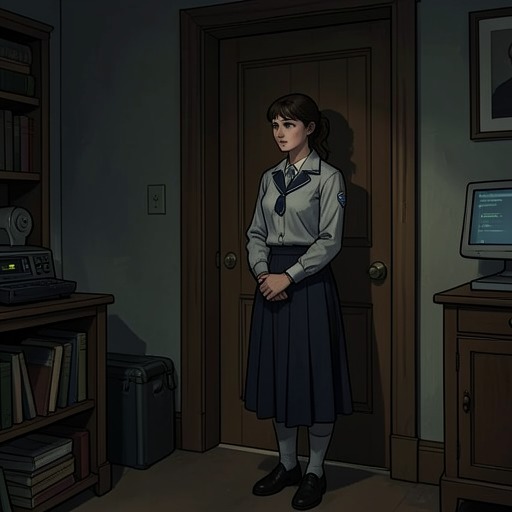
Marion tears apart the house after learning of the Venice trip
My PolicemanMarion tears apart the house after learning of the Venice trip, turning a private marital grievance into a physical reckoning with the home she shares with Tom Burgess. In her account, the destruction begins while Tom is absent and ends not with an explanation or resolution, but with Marion crying against his chest and asking why he kept the trip from her. The episode makes visible the force of a conflict that, until then, has not been spoken between them.
The Outburst Begins
Marion arrives home to find Tom gone. In the kitchen, she throws a tea plate against the back door, choosing one given to them by Tom’s mother on their wedding day. The plate’s blood-red pattern and its wedding provenance make the object more than replaceable crockery: in the moment of anger, a gift associated with the couple’s shared life becomes the first thing she deliberately destroys. She throws two more plates. When the last narrowly misses the window and breaks in a single impact rather than the two she had expected, the disappointment briefly calms her.
The sequence is described as a bodily release as well as an act of destruction. Marion realizes that she is sweating and that her clothes are uncomfortable; she takes off her shoes, unbuttons her blouse, and opens the windows, as if the movement of air might let her anger out. The detail does not resolve what has upset her. Instead, it shows the emotion spreading through the house: she moves from breaking objects in the kitchen to searching the bedroom, while the opened windows and scattered belongings register the disturbance in the domestic space.
Searching Tom’s Things
In Tom’s half of the wardrobe, Marion pulls shirts, trousers, and jackets from their hangers. She shakes out his shoes and unfolds his socks, looking for something that could intensify her anger. The search is not presented as a calm investigation. She is unsure both what she hopes to find and what she fears finding, and she considers the possibility of a magazine or a love letter while recognizing that Tom would not have taken such risks. Her search therefore exposes a gap between suspicion and proof: the possibility of evidence occupies her mind, but no such evidence turns up.
The objects she does find are ordinary and incomplete clues to Tom’s separate life. Among them are old receipts, cinema tickets, a half-read John Galsworthy novel, an old watch strap, sunglasses, a newspaper clipping about the sea-swimming club, and a photograph of Tom outside the Town Hall after joining the police. The photograph shows him with his parents, his mother in a floral dress and his father not scowling for once. Only one cinema ticket is for a film Marion and Tom did not see together; she pockets it in case she needs evidence later. Even that small discrepancy cannot substantiate the fear driving her search. She keeps looking under the bed, moving aside socks and an unopened box of handkerchiefs, but finds nothing that will fuel her rage.
Tom Comes Home
The sound of Tom’s key in the front door stops the search. Marion remains kneeling beside the bed as she hears him call her name, then imagines his reaction to the broken plates in the kitchen. He takes the stairs slowly, and when he enters the bedroom he finds the aftermath: clothes, books, photographs, and the contents of the bedside cabinet scattered across the floor, with the wardrobe emptied and the windows open. The scene’s disorder has become impossible to disguise, but Marion cannot yet explain it. She considers inventing a story about a break-in and an intruder, then abandons the thought without speaking.
Tom’s response changes the emotional direction of the encounter. Seeing Marion on the floor with her blouse held closed, he asks whether she is all right. He kneels beside her, and she cannot form words. Instead, she begins to cry. Tom helps her onto the bed and puts his arm around her; she leans against him and cries into his shirt. He says nothing, resting his chin on her head and rubbing her shoulder. The comfort does not undo the destruction or explain what has brought her to it. For the moment, however, it gives her a way to remain close to her husband without having to speak.
The Question of Venice
After Marion has calmed somewhat, Tom asks what is going on. She tells him that he is going to Venice with Patrick and asks why he did not tell her. Her disclosure identifies the immediate source of the outburst: the trip has reached her as something Tom intends to do with Patrick, not as something he has shared with her. The confrontation is thus not settled by the objects she searched or the ticket she kept. It turns instead on what Tom has left unsaid and on Marion’s demand that he account for that silence.
The scene closes at the point where the hidden grievance becomes direct speech. Marion’s destructive actions have not yielded the proof she was seeking, but they have made the household’s underlying conflict visible to Tom. The wedding plate, the scattered belongings, and the single ticket each carry different weight: the plate is tied to the marriage, the clothing and keepsakes to the private life she cannot fully read, and the ticket to a clue too slight to answer her fears. Against that debris, her question about Venice is the first clear statement of what she knows and what she wants from him.