Michael
My PolicemanMichael is the man whose death continues to shape Patrick Hazlewood’s private life and understanding of love. Recalled through Patrick’s diary and later memories, he emerges not as a figure with an independent narrative voice but as a presence held in letters, photographs, remembered music, and the circumstances of his suicide. Their relationship offered tenderness and domestic intimacy; its destruction left Patrick with a loss that he struggled both to record and to approach.
Identity and Relationship with Patrick
Patrick remembers Michael as his lover over a relationship he describes as lasting eight years. The surviving account does not supply a full biography of Michael, but it makes clear that their attachment was sustained through private meetings and established routines. They met every Wednesday, when Patrick prepared dinner and arranged the room for an evening together. Michael liked rich food, including French dishes, and Patrick recalled setting out a bottle of claret, fresh sheets, a towel, and a newly pressed suit. These preparations made their time together resemble a shared domestic life, even though it remained carefully bounded and hidden.
Music was part of that weekly ritual. Patrick began with Caruso, whose singing he disliked but endured for Michael, then played Sarah Vaughan’s The Nearness of You. He also remembered humming Danny Boy. They danced for hours, moving together in the sitting room. Patrick’s account emphasizes the repeated shape of these Wednesdays: food, music, dancing, and the effort to make a private evening feel complete. The routine was an expression of affection, but also a measure of how much of their relationship had to fit into concealed time.
Michael had a girlfriend as well. Patrick remembers her as someone who brought him sandwiches, an ordinary detail that places a socially legible courtship beside the less visible relationship between the two men. The account does not establish the precise nature or timing of Michael’s relationship with her. Instead, the remembered girlfriend underscores the divided circumstances in which Patrick and Michael loved one another: their meetings were intimate, while other parts of Michael’s life could appear conventional to an outside observer.
Blackmail and Death
Patrick’s memories connect Michael’s death to blackmail. The first letter threatened exposure and demanded money. Patrick and Michael went together to the address given in the letter, but found the house empty. That absence made the threat seem harder to confront: there was no identifiable person with whom they could argue or whom they could challenge. Michael paid, despite Patrick’s objections and their shared indignation. He did not want to discuss the matter further.
Some weeks later, Patrick found another note in Michael’s flat, and the amount demanded had doubled. Michael died by suicide within two months of the first letter. The account establishes this sequence without identifying who sent the letters. Patrick knows only Michael’s suggestion that the sender might be a professional blackmailing operation; the writer’s identity remains unresolved.
Michael’s landlady, Esme Owens, had offered him discretion. A widow living downstairs, she asked no questions and made him fish pie on Fridays. Patrick recalls that Michael regarded her as discreet and wonders whether she had noticed his regular Wednesday absences. After Michael’s funeral, Patrick remembers Esme wearing an expensive-looking fur stole and appearing unusually distraught. Those details prompt his suspicion, but they do not prove that she was involved in the blackmail. The unresolved question becomes part of the burden of remembering: Patrick can reconstruct the threat’s progression, but cannot confidently assign responsibility for it.
Memory, Writing, and Grief
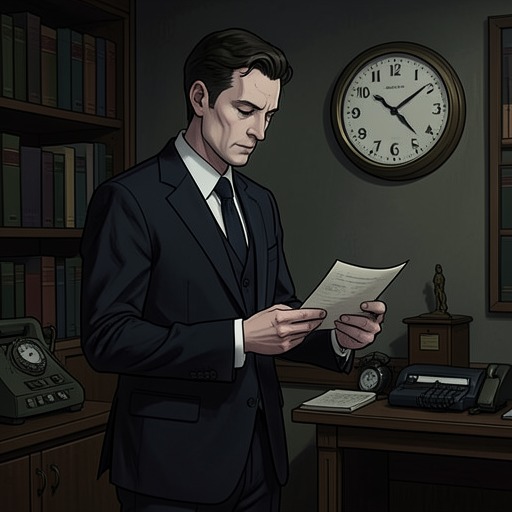
In a diary entry dated 30 September 1957, Patrick considers destroying his latest writing but cannot bring himself to do so. He has already burned Michael’s letters during one of his periodic clear-outs and now regrets losing them. Writing, he reflects, is a poor substitute for lived experience, yet it is also what allows him to sustain a record of Michael and of his own feelings. The diary thus serves both as a fragile memorial and as evidence of how difficult it is for Patrick to speak openly about a relationship that others cannot know.
Patrick measures his new attachment to Tom Burgess against the earlier loss. Five years after Michael’s death, he is determined not to return to the despair associated with that period. He insists to himself that Tom is unlike Michael, and that this difference is among the reasons he loves him. Yet the comparison also reveals how completely the earlier relationship continues to organize his emotional life: a new intimacy brings delight, but also fear of another loss and of the dangers attached to being discovered.
Patrick’s recollection of Michael becomes most stark when he tries to explain what experience has taught him. Rather than offering a general lesson, his mind returns to the end of their relationship and the discovery of Michael’s death. He breaks off that line of thought, turning away from the memory before it can become a fuller account. The interruption conveys a grief that remains difficult to narrate even years later. Michael is not only someone Patrick loved; his death is the event against which Patrick measures loneliness, secrecy, and the limits of what he can tell another person.
Photographs and Narrative Significance
Michael’s presence also survives in a photograph of Patrick outside Merton. The picture hangs opposite Patrick’s desk. Tom notices it and asks whether the figure is Patrick; Patrick answers that it is him in another life. The photograph was taken by Michael before the two men became lovers. For Patrick, it preserves more than his younger appearance: when he looks at it, he remembers Michael behind the camera, concentrating on the act of photographing him. In that image, the future relationship seems to hold both promise and danger, though neither man had yet become the other’s lover.
The novel gives Michael significance through this pattern of traces rather than through scenes narrated from his own perspective. His letters are gone, his photograph remains, and Patrick’s diary supplies the memories that connect their Wednesday evenings to the blackmail and death that followed. The contrast between the tenderness of their private rituals and the faceless threat that enters their lives makes the cost of secrecy concrete. Michael’s absence persists in Patrick’s attempts to preserve him in writing and in the caution with which Patrick approaches love afterward.