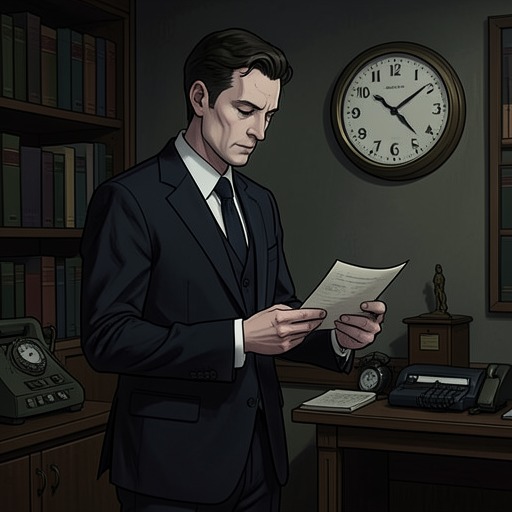
Michael’s suicide after blackmail
My PolicemanMichael’s suicide after blackmail is recalled by Patrick as the outcome of a faceless threat that grew more costly while offering no clear person to confront. His account traces the campaign from its first demand to Michael’s death within two months, while leaving unresolved whether Esme Owens knew more than she let on.
The First Demand
Patrick says that Michael described the blackmailers as people neither of them would know, perhaps a professional outfit that made a living targeting homosexual men. The first letter demanded five pounds by Friday in return for silence. Its stated address was a house in West Hove.
Patrick and Michael went there together on a Sunday afternoon, driven by indignation but without a plan or a clue about what to do. After walking past the door several times, they found the house empty. For Patrick, that emptiness sharpened the danger: the threat had no visible face and seemed impossible to confront. They returned home in silence.
Patrick urged Michael not to pay, though he understood that Michael felt he had no choice. Michael sent the money and refused to discuss the matter further. The payment did not end the campaign. Some weeks later, Patrick found another note in Michael’s flat, this time demanding twice as much for silence.
Michael’s Death and the Unanswered Suspicion
Within two months of the first letter, Michael had killed himself. Patrick presents the short interval between the initial demand and the death as the stark measure of the campaign’s consequences, without identifying who sent the letters or claiming that their author was discovered.
The account also returns to Esme Owens, Michael’s widowed landlady, who lived downstairs. She asked no questions, knitted socks for the poor, and made Michael fish pie on Fridays. Patrick believed she must have noticed his regular visits and wondered what kept him away from home each Wednesday night. In return for his company, she appeared to offer silence. Her discretion had seemed consistent with the account of someone whom nothing shocked.
At Michael’s funeral, however, Esme wore a very expensive-looking fur stole and appeared, to Patrick, more distraught than a landlady needed to be. He wonders whether her silence was as uncomplicated as it had seemed. The detail raises suspicion but resolves nothing: Patrick supplies no proof that Esme wrote the letters or knew who did.
Form and Significance
The episode is told retrospectively in Patrick’s first-person journal voice, not as a scene that identifies the blackmailer or directly narrates Michael’s final act. Its knowledge arrives in fragments: a demand, an empty address, a second note, and an observation at the funeral. The gap between those clues sustains uncertainty around the source of the threat even as the outcome is explicit.
The letters make silence something that can be priced, first at five pounds and then at twice that amount, while the empty house leaves the person or organization behind the demand beyond reach. Michael’s death gives that escalating pressure its consequence; Esme’s apparent discretion and later funeral behavior leave a separate question open rather than supplying an answer.