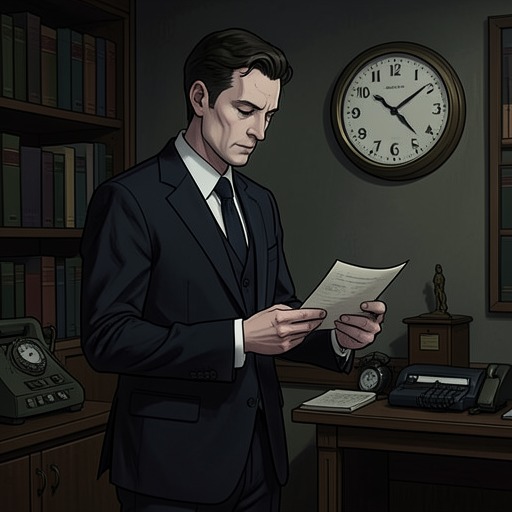
Patrick Hazlewood and Michael’s past relationship
My PolicemanPatrick Hazlewood and Michael’s past relationship is a formative intimacy recalled in Patrick’s diary, not a fully narrated history. Its surviving details are domestic and precise: Wednesday evenings arranged around food, music, and dancing, and a photograph that preserves Michael’s presence even when he is no longer there. Five years after Michael was lost, Patrick tries to keep the past from drawing him back into grief, yet his diary shows how thoroughly that relationship remains part of his inner life and how it shapes his understanding of a new attachment.
Identity and Background
The relationship emerges in a diary entry dated September 30, 1957. Patrick writes that five years have passed since Michael was lost. The account does not explain the circumstances of that loss; its emphasis is instead on the effort to live with absence. Patrick has tried to make a clean break with the past, burning his old writings during annual clear-outs and even destroying Michael’s letters. In retrospect, he regrets having burned the correspondence. The letters had been tangible records of a relationship that could not otherwise be openly shared, and their destruction leaves memory and the diary to carry what remains.
Patrick describes writing as an imperfect substitute for lived experience, but also as the means by which he can persuade himself that Michael and his own feelings were real. This tension defines the relationship’s presentation: the record is self-conscious and incomplete, yet necessary. Patrick wants not to dwell on the past, while also fearing that without words on paper its reality might disappear. The diary therefore preserves both his wish to move on and the persistence of what he is trying to put behind him.
The Wednesday Evenings
Patrick’s clearest account of life with Michael is a recurring ritual. Every Wednesday, he prepared the home for their time together: a fire, dinner, clean sheets, a towel, and a freshly pressed suit. He chose rich dishes Michael liked, opened a bottle of claret, and put on music. Patrick disliked Caruso but endured the records for Michael; he also recalls humming along to a song Michael loved. These preparations make affection visible as repeated work: Patrick organized the room, food, and evening around the pleasure of being together.
They danced for hours, moving slowly around the rug like a married couple. Patrick remembers Michael’s cheek against his and the physical closeness of their dancing. When the records had finished and the candles had burned down, they continued dancing together in silence. The account establishes the intimacy of their relationship without supplying a broader chronology or explaining how it began. Instead, its repeated Wednesday setting gives the relationship a private rhythm, distinct from ordinary public life. The evenings were an indulgence for both men, as Patrick understood it, and the care invested in them made that private time feel like a life they could briefly inhabit together.
Objects, Memory, and Loss
A photograph in Patrick’s office connects Michael to a different point in their story. It shows Patrick outside Merton, squinting in the sun; Michael took it, and his shadow remains just visible in the foreground. Patrick recalls not only his own awkward pose and hound’s-tooth jacket but Michael behind the camera, concentrating on the act of taking the picture. The image was made before they became lovers. In hindsight, Patrick sees in it both the promise of what followed and the threat implicit in that future. The photograph thus records Michael’s presence at the edge of the frame, while Patrick’s memory restores the person the image only partly shows.
That photograph also becomes a point of contact between the past and a later relationship. When a younger policeman examines it, Patrick identifies the pictured man as himself in another life. The remark places the photograph at a distance from the present, but the memory attached to it is vivid enough to shape the encounter. Patrick’s past with Michael is not simply recounted as finished history: it remains active in how he presents himself, and in the contrast he draws between Michael and the policeman. Patrick says the new man is nothing like Michael, and that this difference is among the things he loves about him. The comparison acknowledges the earlier bond without making the two relationships interchangeable.
The Past in Patrick’s Present
Patrick’s effort to resist returning to grief does not mean that Michael has become insignificant. The diary’s domestic detail gives the lost relationship a durable form, while Patrick’s regret over the burned letters marks what cannot now be recovered. His description of the new policeman as a source of light and delight stands against the dark room he fears returning to. At the same time, Patrick recognizes that the new attachment is dangerous for him. The diary holds these ideas together: a desire for a more hopeful present, an unresolved loss, and the knowledge that intimacy can reopen what he has tried to contain.
The wider chronology gives this private history a further contrast. Marion Taylor feels increasing pressure to marry as spring approaches, and on March 29, 1958, she marries Tom Burgess after an engagement of less than a month. That marriage belongs to a different relationship, but its publicly recognized form throws the privacy of Patrick and Michael’s remembered evenings into relief. Decades later, Marion’s solo visit to Venice and her decision to seek Patrick out and bring him back show how the past continues to shape lives beyond Patrick’s diary. The relationship with Michael is not revived as a plot in the later account; rather, Patrick’s preserved memories help establish the depth of a history that cannot be reduced to its disappearance. Its lasting presence lies in the rituals Patrick remembers, the evidence he destroyed and regrets destroying, and the emotional distinctions he continues to make.