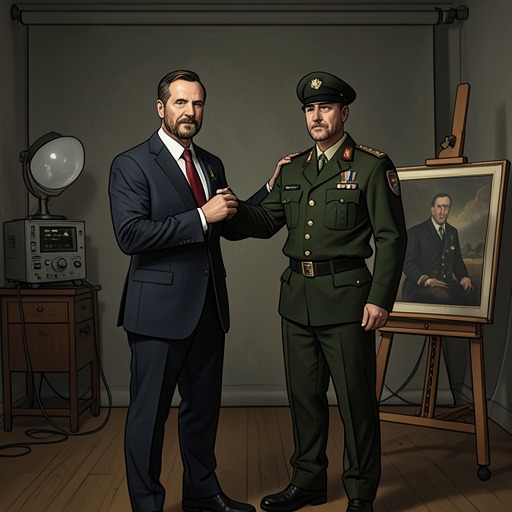
Patrick visits Tom for a tryst in the police box
My PolicemanPatrick visits Tom for a tryst in the police box, a meeting that makes the relationship’s central contradiction tangible: Tom’s place of work offers a brief refuge for intimacy, but it also embodies the rules and risks that constrain him. The encounter moves beyond Patrick’s earlier strategy of waiting and hoping. At the box, he offers Tom access to his private home; Tom, in turn, asks whether Patrick can accept that he is not exclusively his. Patrick agrees, making the meeting a turning point in how they negotiate their attachment.
Setting and Approach
The police box stands on Patrick’s route through Brighton, on Burlington Street near Bloomsbury Place. From the seafront he turns toward it, exhilarated by the thought that Tom might be there. The box is small, its blue light weak in the sun, and its frosted windows conceal whoever is inside. The sea can be heard in the distance, while the street itself appears empty. Patrick treats the absence of a bicycle outside as important evidence: Tom has told him that a bicycle means a visit from the sergeant. The empty space outside therefore suggests not only that Tom may be alone, but that the meeting may be possible without immediate interruption.
The location promises a carefully balanced kind of concealment. A police box is a public workplace, yet its enclosed interior can hide the men from view. Patrick sees it as both secluded and exciting: the setting offers neither complete privacy nor ordinary openness. That combination sharpens the scene’s stakes. They are meeting in a place connected to Tom’s professional authority, even as their private relationship must remain out of sight.
From Pursuit to Encounter
Patrick’s visit follows an earlier period of deliberate patience. After a previous encounter, he had resolved not to rush Tom or frighten him away, believing that friendship might give him a way to offer Tom what he wanted. He contrasted this long approach with the quicker pleasures available in Brighton’s gathering places, where men compete for attention. His preference was for something more lasting than a brief encounter. When he later catches only a distant glimpse of Tom on Burlington Street, he does not run after him; he continues at a more restrained pace. The visit to the police box marks a change from watching and waiting to taking a personal risk.
At the door, Patrick apologizes before entering. Tom first checks that the street is clear, then pulls him inside and challenges his decision to come. His reaction makes the danger more than theoretical: Tom is alert to the exposure that Patrick’s unannounced arrival could cause. Patrick recognizes that the rules operate differently for them. Tom cannot simply disregard the obligations attached to being a policeman, even when Patrick can choose to take a chance. Their brief exchange establishes an imbalance in what each can safely do, without diminishing the attraction that draws them together.
The Key and the Negotiation
Patrick has come with a set of keys to his flat. He keeps the spares at the museum, and he presents them as a practical invitation: Tom could visit even when Patrick was not home. Tom does not take them. Patrick places them on a shelf beside Tom’s flask, leaving the offer physically present but not accepted. The keys make Patrick’s desire concrete, while Tom’s hesitation preserves the uncertainty between invitation and commitment.
Rather than leave immediately, Patrick holds the top button of Tom’s jacket and gradually moves his hand lower as he tells him that he cannot stop thinking about his beauty. The exchange is intimate, but its decisive turn comes when Tom asks whether Patrick can share him. Patrick agrees. The question changes the terms of the encounter: closeness is possible, but not on the assumption of exclusivity. Patrick’s answer accepts a condition he may not have chosen for himself, because he wants the relationship to continue. The scene thus joins desire to negotiation, and gives Tom a say in defining what their connection can be.
Significance and Later Exposure
The meeting contrasts Patrick’s hopes with the pressures surrounding Tom’s life. Patrick is willing to approach the police box and offer his own home; Tom is more constrained by his job and the possibility of being discovered. Their different degrees of freedom appear in the scene’s small details—the empty street, the check outside the door, the keys left beside the flask—and in Tom’s insistence that the rules are not the same for him. The box makes intimacy possible without making it safe.
Later developments place this private encounter within a wider climate of scrutiny. In October 1957, a scandal involving senior officers in Brighton CID breaks in the papers, and Patrick worries that ordinary members of the force, including Tom, may face pressure because of their superiors’ conduct. Still later, Patrick’s trial brings an accusation concerning an indecent relationship with Tom into the courtroom. These later events do not establish that the police-box meeting caused the scandal or the prosecution; they show how a relationship kept private could nevertheless become subject to institutional and public judgment. The tryst matters both as a moment of mutual intimacy and as an early instance of the secrecy imposed on that intimacy.