Patrick’s diary read at trial
My PolicemanPatrick’s diary read at trial turns private observation into evidence. Its entries trace Patrick Hazlewood’s recognition of Tom Burgess and his later meetings with Tom, including the moment Tom introduced Marion Burgess as his wife. Seized when Patrick is arrested, the journal eventually reaches the courtroom, where passages are read to Marion and force the hidden relationship into public speech. Its significance lies not only in what it records, but in the reversal of audience: words once kept in a personal journal become a legal instrument and a lasting source of pain for the people they describe.
Private record and seizure
The diary’s movement from private possession to public evidence begins during the police search of Patrick’s flat. Taken quietly to the station, Patrick realizes that his journal is open on the desk in his bedroom and expects the officers who enter the flat to find it. The narrative does not describe the journal’s full contents at that moment, but its open pages make its vulnerability immediate: a record written for private use is exposed to the same authorities who are questioning its author.
The journal later supplies a detailed account of Patrick’s connection with Tom. At the trial, the court hears that it contains passages describing their relationship and that Patrick referred to Tom by a private name. That record is incriminating, but the evidence does not show that it leads to a separate investigation of Tom. Before the case reaches court, Tom resigns from the police force; by the time of the trial, he is near the end of his notice period and escapes investigation. Marion suspects the force preferred to let him leave quietly, with the police already under scrutiny after a corruption scandal.
The dated entries
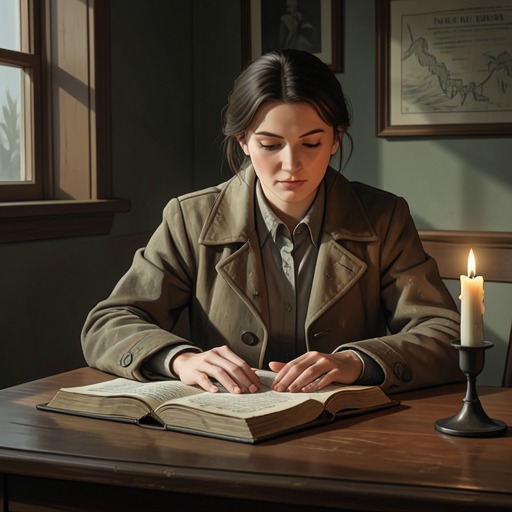
At trial, the entries read aloud are identified by their dates, giving the journal’s disclosures a clear chronology. An extract from October 1957 records Patrick seeing Tom in the museum, standing before a painting by Sisley. Patrick’s account presents the encounter as the arrival of someone he had already pictured in his mind. The entry makes the museum meeting more than a passing sighting: it records the moment when an imagined figure is recognized as physically present.
A second extract, dated December 1957, advances the account. Patrick writes of meeting Tom at lunchtime when Tom could take a long break, and notes that Tom had not forgotten the schoolteacher. The entry then records Tom bringing Marion with him. Patrick describes the couple as visibly mismatched and acknowledges that his judgement may be coloured by his own feelings. That combination of observation and self-awareness matters: the journal preserves not just the fact of the meeting, but Patrick’s perspective on the marriage and his place beside it.
The two passages establish a progression without making the diary a complete account of the relationship. The October entry centres on recognition; the December entry records recurring meetings and Tom’s introduction of Marion. Together, they reveal that Patrick’s feelings and his contact with Tom were present before the courtroom disclosure, while also showing that Tom’s marriage was part of the situation Patrick observed. The journal’s dated form lets the court arrange these private moments into a sequence, even though the passages themselves remain partial glimpses rather than a full history.
The diary in court
During Marion’s testimony, counsel asks whether she trusted Patrick with her pupils. She answers that she did. The questioning then turns to the journal: an extract is read aloud, and Marion is asked to identify the person Patrick called by his private name for Tom. She says she has no idea. Her answer sounds convincing to Patrick, who is narrating the trial, but the exchange places her denial beside material that points directly toward the truth.
The December passage is then introduced as a further aid to her memory. When it reaches Patrick’s description of the couple as mismatched, Patrick winces. In his later account, Marion remembers that sentence in particular. Its casualness hurts her, as does her recognition that Patrick’s judgement was right. The journal therefore affects her in two distinct ways: it provides evidence about the concealed relationship, and it gives her a line she continues to hear long after the trial has ended.
Aftermath and significance
For Patrick, the diary is an intimate record made dangerous by the circumstances in which it is discovered and used. For Marion, it becomes an unwelcome encounter with a version of her marriage written from outside it. The courtroom does not simply expose facts; it makes her listen while another person’s private account names the connection she has struggled to face. The trial’s public reading gives the journal an audience it was not shown to have been written for.
Marion says that Patrick’s passages have remained with her like a persistent ringing. After the trial, she visits Patrick in prison once, largely from remorse over what she has done, while acknowledging that part of her also wants to witness his suffering. She does not tell Tom about the visit. In her account, their life continues only through silence: she avoids mentioning Patrick because she fears Tom would leave. The diary’s disclosure thus produces no simple resolution. Its words survive in Marion’s memory, even as the marriage continues under the condition that neither of them speaks of what those words revealed.