Secrecy
My PolicemanSecrecy is not merely a veil over private relationships in the novel; it is something the characters actively keep, exchange, and sometimes turn into action. Marion Burgess first describes a small secret of her own, then sends an anonymous letter that exposes Patrick Hazlewood to institutional scrutiny. When she eventually tells Sylvie, the secret becomes a bond between them. Across these moments, concealment offers a measure of privacy but also allows fear, guilt, and harm to gather unseen.
Private knowledge and withheld affiliation
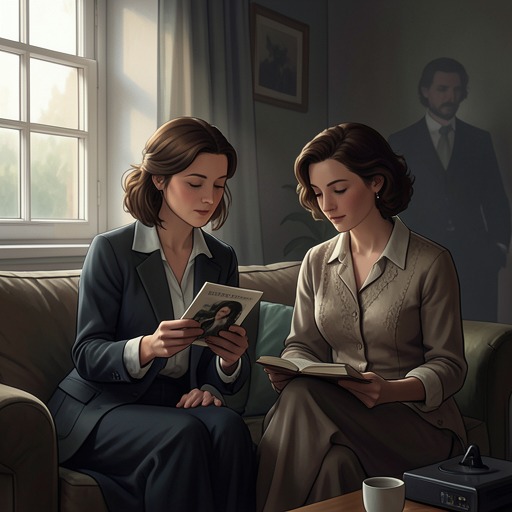
After attending a gathering at the Friends’ Meeting House, Marion reflects that Patrick would have been pleased to know she had listened to a speech among writers and artists and taken a small stand for her beliefs. She imagines his approval, but immediately recognizes that she cannot share the experience with him. The understanding she longs for is unavailable, and the day becomes her own secret. She distinguishes it from the secrets Patrick and Tom Burgess share: hers seems harmless, but its importance lies in belonging to her alone.
The contrast gives secrecy more than one emotional register. Marion’s withheld participation is not a plot to injure anyone; it marks an area of independent conviction in a life organized around other people’s knowledge and needs. Yet even this modest privacy is shaped by a relationship in which honest exchange feels impossible. The secret preserves something of Marion’s separate self, while the recognition that she cannot tell Patrick makes that independence feel lonely as well as chosen.
The anonymous letter as concealed action
Marion’s later letter is also hidden, but its purpose and consequences are radically different. At four thirty on a Sunday morning, with Tom absent, she writes to Mr Houghton at Brighton Museum and Art Gallery, seals the letter in a plain envelope, addresses it, stamps it, and posts it before she can reconsider. The sequence is deliberate in its physical particulars: a private accusation leaves the house as ordinary mail, with no public declaration of who sent it.
The letter identifies Patrick as the museum’s Keeper of Western Art and draws attention to his art-appreciation afternoons for schoolchildren. It accuses him of same-sex conduct and frames disclosure as a concern for the children and the museum’s reputation. Marion’s anonymity lets her present the message as civic warning rather than personal intervention. But the narrative makes clear that she knows more than her later self-exculpation admits: she knows of sex cases in the newspapers and that local police are trying to recover their standing after a corruption scandal. She tells herself over the years that she meant only to frighten Patrick, imagining a warning from his employer, loss of access to children, or, at worst, loss of his job. The gap between that account and what she understands about the risks makes secrecy a form of self-protection as well as concealment from others.
Secrets exchanged between women
Marion keeps the letter from Tom, and her silence continues until she can no longer bear the suspicion that Patrick’s arrest may be connected to her. She tells Sylvie that she wrote anonymously to Patrick’s employer and describes the accusation only indirectly. Her confession changes the secret from an isolated act into shared knowledge, but it does not bring certainty: Sylvie initially reassures her that people are not arrested merely because of a letter. Marion’s distress persists even as Sylvie tries to limit the consequences she imagines.
Sylvie’s response draws on a secret of her own. She tells Marion that Tom does not know she is working as a security guard at Allan West’s, and calls it time to have secrets of her own. The novel does not disclose every aspect of what she has kept private; it establishes the job and Tom’s ignorance of it. Sylvie has already referred to Marion having kept her little secret, so their exchange is reciprocal rather than a simple act of consolation. She asks whether Tom knows about Marion’s letter, advises her not to tell him, and promises to keep the confession. Their pact gives Marion immediate shelter from disclosure, while also leaving the letter and its consequences outside Tom’s knowledge.
Concealment, guilt, and public roles
The narrative’s attention to the letter’s making and later confession shows how secrecy changes over time. Initially it is a hidden act Marion can attribute to an anonymous sender; when she speaks to Sylvie, it becomes a burden she can name but still cannot share with Tom. The letter’s placement before a section headed HMP Wormwood Scrubs, February 1959, gives the concealed act a grave narrative context without making Marion’s own explanation a complete account of what followed.
After confessing, Marion goes to school and sits beneath a print of The Annunciation, wishing she could pray for forgiveness. She cannot do so, and weeps before preparing for the children’s arrival. She then resumes the recognizable role of Mrs Burgess: a teacher who can answer questions, reward or scold, and help with small matters. This return to routine does not resolve her guilt. Instead, it places private remorse beside the work through which she continues to find purpose. Secrecy has protected her from an immediate confrontation with Tom, but it has not made the act disappear; it remains present in the classroom, beneath the ordinary tasks of the day.