Secrecy and silence
My PolicemanSecrecy and silence are not merely absences of speech in the novel: they are practical strategies for navigating a society in which private relationships can invite surveillance, blackmail, and prosecution. They give Patrick Hazlewood and Michael room to meet, and help Marion Burgess sustain an outwardly ordinary marriage, but the same habits of concealment leave people isolated when they need help. Across bars, a police box, a home, and a courtroom, silence shifts between chosen discretion and a pressure imposed by fear.
Practical Secrecy and the Risk of Exposure
For Patrick Hazlewood, discretion is an everyday calculation. After taking a curator’s job, he says he has needed to be careful about his visits to places where men meet. Even approaching Argyle Hotel feels risky: Jackie Butters, Mr Houghton, or one of the women from the museum might see him. He describes the precautions such visits require: going after dark and alone, avoiding other people’s eyes, and staying away from an establishment near home. In a small city, anonymity is not something a person can assume. It has to be arranged, and even a walk to a door becomes part of that arrangement.
The contrast with Patrick’s nights in London with Charlie makes the local pressure clearer. London offers him a greater chance of being anonymous; Brighton’s cosmopolitan appearance cannot conceal its small-town visibility. Patrick’s secret meetings with Michael had followed an even narrower timetable. Wednesday was their one full night together, while daytime visits had to end by eight, before Michael’s landlady might grow suspicious. Their time together was shaped not only by desire but by the need to manage who might notice, when, and where.
Secrecy also governs Patrick’s approach to Tom Burgess. The day after what Patrick calls the accident, he passes Tom’s police box and finds no sign of him. He remains buoyant, believing that a friendship may grow if he does not rush or frighten Tom away. Rather than pursuing a brief encounter, Patrick thinks in terms of patience and a longer courtship. The restraint is hopeful, but it is also attuned to risk: closeness must be allowed to develop without exposing either man before Tom is ready.
Discretion, Blackmail, and Michael
The novel distinguishes protective silence from silence that leaves someone vulnerable. Michael’s landlady, Esme Owens, is remembered as a widow who asked no questions, knitted socks for the poor, and made Michael fish pie on Fridays. Michael regarded her as discreet. Patrick believes she must have noticed his regular visits and the absence of Michael on Wednesday nights, yet she did not challenge them. Her silence appears to offer a rare shelter for their relationship within the house.
That shelter does not protect Michael from the anonymous letters. The first demanded five pounds for silence and referred to seeing him at Plummer Rodis with another man. Patrick and Michael went together to the address in West Hove, but found the house empty. The absence of anyone to confront made the threat feel faceless and impossible to fight. Although Patrick tried to dissuade him, Michael paid; Patrick understood that Michael felt he had no choice, even as he wanted to object. When a later note doubled the price, the secret had become a means of coercion rather than a refuge. Michael died by suicide within two months of the first letter.
Patrick never learns who wrote the letters. He recalls that Michael described the sender as a professional blackmailing outfit, but the evidence does not establish the identity of the perpetrators. He also wonders about Esme Owens: at Michael’s funeral she wore a fur stole that looked very expensive and appeared, to Patrick, more distressed than a landlady needed to be. His suspicion remains a question, not a resolution. The uncertainty matters: in a world where secrecy makes victims reluctant to seek help, the person who knows and the person who exploits that knowledge can be difficult to distinguish.
Silence Within the Home
Years later, silence has settled into the daily life of Marion and Tom. Their retired routine is regular and reassuring: Marion prepares supper, they eat and talk a little about the dog or the news, she washes up while Tom walks Walter, and they watch television before Marion goes to bed. The routine makes deviation difficult and real conversation less likely. Its comfort and its constraint exist together; familiar tasks preserve a shared household while leaving important matters untouched.
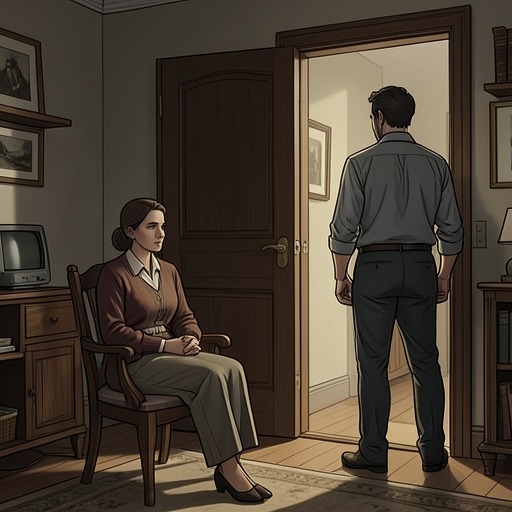
After Patrick comes to stay, that pattern acquires a more deliberate omission. Marion feeds him separately by spoon, then eats with Tom, but neither spouse speaks of Patrick’s presence, though he is in the room down the hall. Later, Marion sits at Patrick’s bedside and reads aloud while Tom watches television. Patrick cannot speak, but Marion believes he understands and describes his stillness and relaxation as she reads Anna Karenina. The reading creates a quiet form of companionship; at the same time, it takes place alongside the household’s refusal to name the person they are caring for.
Marion’s silence about Tom’s relationship with Patrick becomes a conscious response to a truth she can no longer avoid. Julia Harcourt’s naming of Tom’s disposition brings his relationship with Patrick into sharp focus for her. Marion tries to continue ordinary life without looking directly at what she now understands, and judges herself to lack the dedication and backbone needed to confront the marriage. She chooses silence rather than another confrontation. The choice is presented as painful avoidance, not as ignorance: she knows what she is refusing to discuss.
Public Disclosure and the Cost of Speech
Secrecy also protects those exposed to institutions that can punish them. When a scandal breaks involving the Brighton Criminal Investigation Department, Patrick initially feels satisfaction that senior police officers face public disgrace and possible imprisonment. That reaction falters when he considers the consequences for Tom. Patrick fears that ordinary, honest officers will also be placed under pressure as their superiors’ conduct comes to light. The scandal turns police respectability into a source of uncertainty for the people within the force, including a man whose private relationship already carries danger.
The later knock at a flat door, at a quarter past one in the morning, makes official power audible before it is fully visible. Patrick describes it as the kind of knock that announces to the neighbours that someone has come for a person and will not leave without them. He had slept through the downstairs buzzer; Tom could not be the visitor because Tom had his own key. Instead, another policeman is outside. The scene gives secrecy a material limit: private life may be guarded, but arrest can force its way into the home and make a person’s exposure public to the neighbours.
At Patrick’s trial, disclosure is staged as something improper for women to hear. Before the prosecution begins, the public gallery is warned that the proceedings will contain material offensive to ladies, and every woman leaves. The prosecution then puts the allegation that Patrick had an indecent relationship with Tom directly to Marion. She answers no when asked whether Patrick was having such a relationship with her husband. Her denial is brief, but its position in the trial makes visible the conflict between what she privately understands and what she will affirm in court.
The Function of Silence
The novel gives silence no single moral meaning. Esme Owens’s discretion may offer Michael and Patrick temporary safety; their inability to identify or confront the blackmailer leaves Michael exposed. Patrick’s cautious courtship gives Tom room to approach a relationship gradually, while Marion’s refusal to confront what she knows prolongs the concealment within her marriage. At the police station and in court, silence is no longer simply a personal choice: the risk of disgrace and punishment shapes what can be said, and who is willing to hear it.
The recurring contrast is between the comfort of an unspoken arrangement and the damage it can conceal. Routine can keep a household functioning, a landlady can refrain from asking questions, and a visit can be planned to avoid notice; none of these forms of quiet dissolves the underlying danger. By following secrecy from private meetings to blackmail, arrest, and testimony, the novel shows how a social demand for discretion can make intimacy possible while also providing the conditions in which coercion and isolation thrive.