St Luke’s Infants’ School
My PolicemanSt Luke’s Infants’ School is the setting of Marion Taylor’s first teaching post and the place where her imagined future begins to meet the routines of working life. The school is at once a workplace she initially feels unprepared to enter and a space she gradually shapes through teaching, classroom preparation, and story time. Its separate entrances and unevenly claimed staff-room seats also make visible the small hierarchies through which a newcomer must find her place.
Arrival and first impressions
Marion’s life as a teacher begins after training college, which she has completed while imagining how Tom Burgess might react to her success. The scene she invents is not a memory of Tom’s approval: she pictures him returning to his family home, greeting his relatives, and eventually asking how she is getting on. In that fantasy, Sylvie tells him that Marion has become a schoolteacher, and Tom recognises her ability. The imagined recognition accompanies Marion as she walks to her new job, making the school’s first morning inseparable from her hope that Tom will be proud of her.
She arrives early on her first day and is nervous enough to fear that she may be physically ill. The school’s size and unfamiliarity intensify her sense that the appointment might have been meant for someone else. In the corridor she notices a tapestry of St Luke, but the figure offers her no reassurance; her thoughts turn instead to Tom and to the possibility of going home. The names on the classroom doors belong to teachers she does not know and cannot yet imagine herself resembling. Her passage through the building is therefore also a passage into an unfamiliar professional identity.
The classroom and its routines
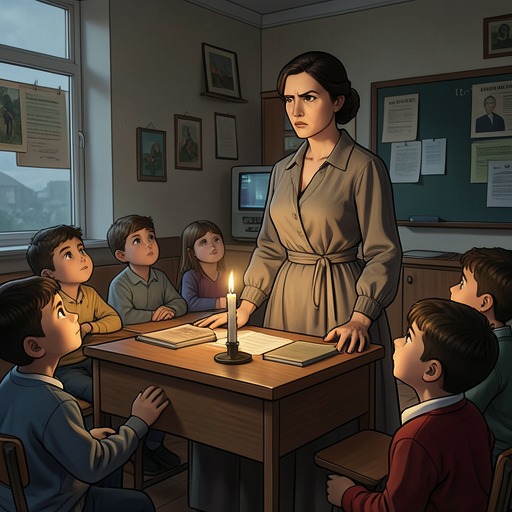
Miss Julia Harcourt leads Marion from the junior school into the infants’ department, which has its own entrance at the back of the building. Marion’s classroom is bright, though its flowered curtains partly screen the windows. A blackboard still bears the trace of the previous school year, with July 1957 visible in one corner. The room is otherwise plainly equipped: a large desk and chair, a wire-encased boiler, and rows of low desks with chipped wooden seats. Its most distinctive feature is a reading corner tucked behind the door, furnished with a rug and cushions. Miss Harcourt explains that Miss Lynch, the teacher before Marion, used it for story time.
Marion makes that inherited corner part of her own daily practice. After lessons, she straightens the desks, cleans the blackboard, and plumps the cushions in preparation for the next morning. The quiet after the other teachers and children have gone gives her time to feel organised and in control of the work ahead. Her confidence remains tentative: she tries to reassure herself that the children like her, even imagining that some may love her. But the recurring story time gives that hope a concrete form. She reads aloud from The Water-Babies while the children sit cross-legged on the rug, and the reading corner becomes the setting for a connection she can observe rather than merely imagine.
A newcomer among the staff
The school’s social order is apparent in the staff room, where Marion has not yet acquired a regular chair even after several months. Newer staff sit on the chairs near the door, some with worn cushions or uneven legs; more established teachers appear to have customary seats that others do not use. Mrs Brenda Whitelady’s embroidered cushion, decorated with purple orchids, makes that possession especially visible. Marion wonders whether a newcomer has to wait for a colleague to retire or die before claiming a usual place. The contrast between her temporary seat and Whitelady’s marked territory turns an ordinary room into a small map of seniority and belonging.
One staff-room conversation also shows how teachers exchange news and judgments about events beyond the school. Mr R.A. Coppard and Whitelady discuss a newspaper report concerning a man called Henry and his wife, while Marion remains at the edge of the conversation. They do not address her. Her position is defined not only by where she sits but by the limits of her inclusion: she hears the discussion without being treated as one of its participants. The moment also connects the school’s seemingly ordinary routines with the wider public climate surrounding private lives, without making Marion’s colleagues aware of her own feelings about Tom.
Work, care, and significance
In February 1958, the classroom’s boiler becomes a practical focus of Marion’s working day. She keeps close to it, and, when the classroom grows cold, wraps a scarf around her neck and shoulders and puts on a bobble hat. In the playground she urges the children to keep moving; many lack proper coats, and their knees are visibly affected by the cold. These details place her authority alongside the everyday conditions of the children’s lives, rather than presenting teaching as an abstract profession.
The end-of-day preparation and the story corner mark a quieter development. Marion does not claim that every child listens attentively: Alice Rumbold fidgets, while other pupils occupy themselves with one another or their hands. Yet Caroline Mears sits at Marion’s feet and watches her as though the story opens a world she wants to enter. The scene gives Marion an observable measure of the work’s effect, even as she remains unsure of her standing among adults. St Luke’s thus becomes the setting where her professional role takes shape through repeated tasks and relationships: a new teacher learns the building, negotiates its hierarchies, and makes a modest corner of the classroom her own.