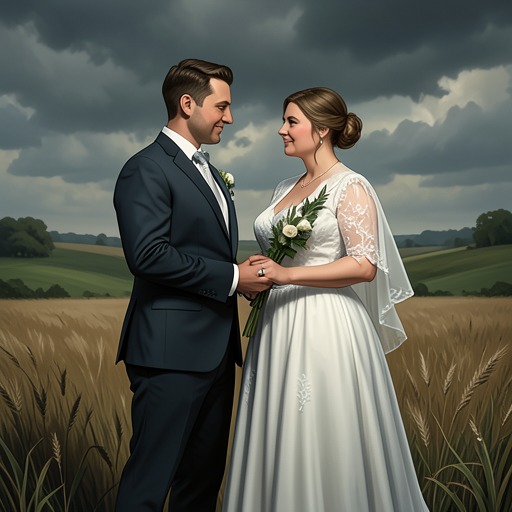
Tom and Marion marry on 29 March 1958
My PolicemanTom and Marion marry on 29 March 1958, an event remembered by Marion Taylor from Peacehaven in November 1999. The wedding brings her into the social role she has been urged to seek, but the ceremony also places Patrick Hazlewood, Tom Burgess’s close companion, at the centre of the day. In retrospect, its promise of a new life is inseparable from the silences and divided loyalties that endure through the marriage.
Background and Expectations
As spring approached, Marion had grown impatient with the limits of her courtship with Tom. He had kissed her cheek and held her hand, and they saw one another at least weekly, usually with Patrick present; to Marion, this was no longer enough. Her mother’s reminders that it was not too late for her sharpened an anxiety shaped by the prospect of being judged an unmarried woman. Marion feared the future assigned to a woman who worked for her living, read too much, and seemed in no hurry to marry or have children. She describes the pressure as a clock ticking toward the moment when a woman might be considered left on the shelf.
The engagement was brief: less than a month. At the time, Marion experienced the rapid move toward marriage as thrilling and flattering. Looking back, she wonders whether Tom’s haste came from wanting to marry before he changed his mind. Her later suspicion complicates the excitement of the wedding preparations without erasing what she felt then.
The Wedding Day
The wedding took place on 29 March 1958 in relentless rain. Marion initially read the downpour as a kind of baptism into a new life, imagining the past washed away and a new beginning ahead. The path outside the church was slippery under her sateen shoes; her pillbox hat and short veil offered little protection, and the daffodils were battered by the weather. Her father hurried toward the shelter of the porch, but Marion walked slowly. She remembers that moment as the last in which he might have claimed to be the most important man in her life. He said nothing, and his hand shook as he adjusted her veil. Marion, meanwhile, could think only of Tom waiting inside.
At the ceremony Patrick stood as best man in place of Roy, a change that had caused some trouble. Tom wore a grey suit Patrick had bought for him rather than his police uniform. The ring Patrick passed to Tom made Marion Mrs Tom Burgess. She recalls that the soaked shoes and muddy stockings, and even the choice of best man and suit, mattered less to her than reaching Tom at the altar. That recollection preserves the force of her anticipation while revealing how much of the occasion was already shaped by Patrick’s presence.
Reception and Patrick’s Speech
After the ceremony, the guests gathered in the church hall for beer and sandwiches. Sylvie, pregnant at the time, sat smoking and watching Roy, who seemed drunk even before the reception began. Julia Harcourt attended in a jade-green two-piece and tried to talk with Marion’s brother. Tom’s father moved among the guests, slapping them on the shoulder; Marion noticed in hindsight a resemblance between that manner and Tom’s. Tom’s mother welcomed Marion to the family and dabbed at her eyes. Marion remembers wanting only to leave with her new husband.
Patrick gave the speech despite the guests’ initial attention to the food and drink. His resonant voice eventually drew them in. He told the story of how he and Tom had met, including Tom’s description of the woman on the bicycle as a batty old bird—a story Marion had not heard before. He presented Tom and Marion as a respectable, civilised pairing: a policeman and a teacher, each serving the people of Brighton in his or her own way. Marion felt a small measure of pride, though she was unsure how seriously Patrick meant the praise. He drank his stout, said something quietly to Tom, patted his arm, kissed Marion’s hand, and left. The public toast to the newlyweds thus included an intimate gesture and a private exchange between the two men.
Retrospective Significance
The wedding is narrated from a later moment, as Marion watches rain in Peacehaven and wonders whether Patrick remembers the storm on the day she and Tom married. That distance changes the meaning of the ceremony: the rain that once suggested cleansing and a brave new life becomes part of a memory revisited after more than forty years of marriage and long periods of silence. In the later household, Tom avoids breakfast with Marion and Patrick; she hopes that bringing Patrick to the family table will make Tom look at him and break his silence. The wedding’s promise of a shared life has not removed the separation within it.
Marion’s later journey to Venice makes the wedding and its expectation of a conventional future newly present. Travelling alone on an organised opera trip, she imagines the earlier visit Tom and Patrick made together and recognizes how much of their past remains unspoken between herself and Tom. She describes the journey as a catalyst: soon afterward she seeks Patrick out and brings him back. In this retrospective structure, the wedding is both a beginning Marion once welcomed and a point of contrast for the long history of secrecy, distance, and care that follows.