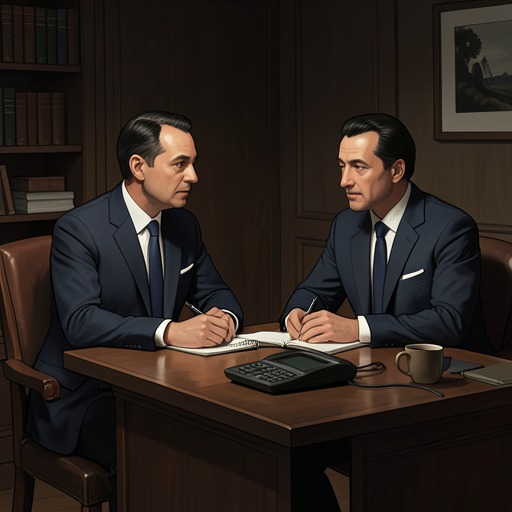
Tom tells Patrick he is considering marriage and introduces him to Marion
My PolicemanTom tells Patrick he is considering marriage and introduces him to Marion is a turning point in Patrick Hazlewood’s diary: Tom’s private relationship with Patrick is suddenly set against the prospect of a respectable marriage, and Patrick must meet the woman Tom may marry. The encounter reveals that the choice is not simply personal. Police expectations are pushing Tom toward marriage, while Patrick, determined not to lose him, agrees to face the prospect of Marion Taylor’s place in his life.
The Disclosure and Its Pressures
Patrick’s account gives the marriage conversation an earlier emotional context. After an encounter with Tom, Patrick describes himself as buoyant and convinced that patience could bring them closer. He believes they can be friends and that he can give Tom something he wants; his preferred course is a long one, not a quick pleasure. That confidence makes the news of marriage more than a change in Tom’s plans: it threatens the future Patrick has been quietly imagining.
Before telling Patrick he is considering marriage, Tom had been discussing the pressure placed on him at work. His superior had asked when he would make some girl a respectable policeman’s wife, and Tom says that the subject has come up before. He also reports the warning that bachelors may find it difficult to rise through the ranks in the division. Marriage is thus presented as a condition of occupational respectability as well as a personal decision. The expectation reaches into Tom’s private life through the institution that employs him.
Tom’s first formulation is deliberately tentative: “I’m planning to marry,” he says, then clarifies that he is not engaged but is thinking about it. Patrick responds that thinking and doing are different propositions and reaches toward Tom’s knee. Tom, however, wants to continue talking. Patrick understands the casualness of Tom’s tone as a disguise for a decision already taking shape. In his reading, Tom has someone in mind—the teacher he mentioned on an earlier occasion—and Patrick recognizes that he has been foolish to treat her as incidental.
Patrick’s Response and Marion’s Introduction
Patrick does not openly challenge Tom’s plan. He asks whether the woman is the teacher, and Tom says they are friends and that nothing serious is happening. Patrick judges this answer to be a lie. His own response is to say that he would like to meet her. The diary makes the invitation a compromise: Patrick cannot pretend the woman does not exist without risking the loss of Tom altogether, so he chooses contact, even though he expects it to hurt. He also entertains the possibility that he might persuade Tom away from her.
By 13 December 1957, Patrick and Tom have been meeting at lunchtime when Tom can take a long break, but Tom has not forgotten the teacher. On this occasion he brings Marion with him. Patrick records the effort he makes to be welcoming, while privately deciding that the pair look mismatched. He notices Marion’s height, her heels, and her conspicuous copper-red hair; he also remarks on her willingness to meet his gaze rather than look away. These observations register both Patrick’s scrutiny of a possible rival and his recognition that Marion has a presence of her own. His judgment that she is less handsome than Tom is explicitly qualified by his awareness of his own partiality.
Patrick turns the introduction into a proposed shared outing. He asks Tom whether their next Tuesday evening meeting will go ahead as usual, then invites both Tom and Marion to the opera in the new year, offering to pay for Carmen at Covent Garden. Tom beams, while Marion says they could not possibly accept such an expensive invitation. Patrick insists that Tom tell her she can. The invitation is a practical gesture of welcome, but it also keeps Patrick in the arrangement: he continues to claim time with Tom even as he makes room for the woman Tom may marry.
What the Event Reveals
The disclosure joins private desire to public respectability without resolving the conflict between them. Tom does not announce an engagement, and Patrick’s diary does not establish that the marriage decision has been made. Instead, the scene records a pressure-filled possibility: a policeman is being urged to acquire a respectable wife, and the man with whom he has a concealed relationship is asked to accept the woman under consideration. Patrick’s insistence on meeting Marion is therefore neither simple approval nor a refusal. He tries to preserve access to Tom while confronting the evidence that Tom’s future may be organized around marriage.
Patrick’s earlier memory of Alice Rumbold adds a pointed parallel. He recalls having considered marriage to her as a way to escape his minority status and gain easy respectability, although his relationship with Michael intervened. That recollection makes respectability a strategy Patrick himself once contemplated, not merely an external rule he observes in Tom’s case. The comparison does not make their circumstances identical, but it places both men’s thoughts of marriage within a world where social acceptance could be sought through a conventional match, while their intimate attachments remained elsewhere.
Later Reverberations
The introduction does not settle the triangle; it establishes the terms on which it will continue. Patrick’s willingness to host the meeting and invite Marion to the opera contrasts with his private hope of changing Tom’s mind. The courtesy is genuine as conduct, but it cannot remove the fear beneath it: Patrick believes he may lose Tom and accepts a limited place in his life rather than risk losing him altogether.
The later trial gives the introduction a harsher retrospective significance. In court, the prosecution puts to Mrs Burgess that Patrick was having an indecent relationship with her husband and asks whether she denies that the accused is homosexual. Marion answers the first allegation with “No.” The earlier meeting, in which Patrick tried to be charming and offered an outing, thus stands against a later public setting where the relationship is framed as an accusation. The scene’s importance lies in that contrast: a private attempt to accommodate Tom’s contemplated marriage is eventually shadowed by the legal and social consequences surrounding the relationship.