Traditional gender-role expectations in marriage
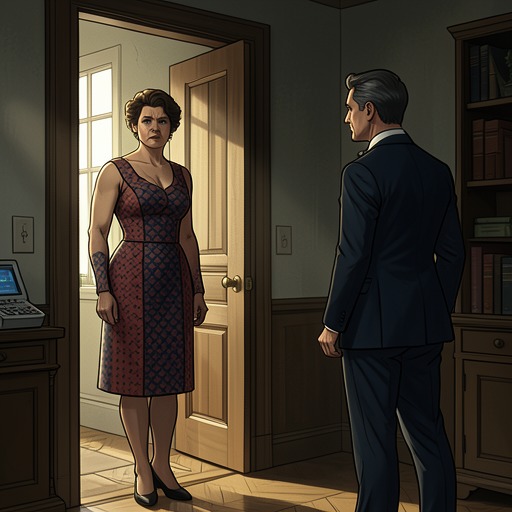
My PolicemanTraditional gender-role expectations in marriage organize both the private life of Marion and Tom and the public standards by which Tom is judged as a policeman. They teach Marion to make herself a modest bride, assign mothers domestic responsibility, and present the husband as breadwinner and guardian of respectability. The novel shows these expectations not as abstract rules but as pressures shaping what the spouses feel permitted to want, say, and do.
Courtship and the Expected Bride
In 1958, Marion understands that a bride is supposed to appear timid. Before her first night as Tom’s wife, she believes she should act nervous rather than show eagerness, because reserve is part of the part a good bride is expected to play. Her uncertainty is not simply about what will happen between them: she also feels that marriage does not give a wife the right to initiate or demand physical closeness. The ideal of feminine modesty has already taught her to treat her own desire as something she must conceal.
The contrast between that script and Marion’s actual feelings makes the expectation visible. She anticipates a romantic transformation drawn from novels, but in the hotel room she waits for Tom to make the first move and worries that he may turn away. Her marriage has been formalized, yet she still experiences initiative as his prerogative. The scene presents marital intimacy through an unequal permission: Tom may act, while Marion believes that asking would make her unacceptable.
Earlier that evening, at the Palace Pier, the expected roles briefly shift. When Tom admits that he is afraid of heights, Marion sees a vulnerability in the man who had seemed composed and capable. She offers to help him down the slide and understands the moment as an opportunity to care for him. Later, when she kisses him and he responds, the scene gives her a small measure of initiative, but it does not erase the broader script that has made her feel she should be passive. Her attentiveness to Tom also shows how care can become a way for her to approach intimacy within the limits she has absorbed.
Work, Motherhood, and Provision
The conflict over whether Marion might continue working makes the household division of roles explicit. When the possibility of her employment arises, Tom asks why she would want to carry on working. He soon argues that children need their mothers at home and that he could provide for a family: earning belongs to the father, while care belongs to the mother. His opposition is categorical, not a neutral discussion of practical arrangements. Marion’s work is treated as something that needs justification, while Tom’s authority as provider is presented as the natural basis of family life.
Julia Harcourt offers a counterargument, asking why mothers should not work, especially when their children are at school, and recalling that a profession might have given her own mother purpose. Tom responds that Julia’s experience is different because she had a nanny and spent much of her childhood at boarding school. That distinction exposes the class conditions beneath the disagreement, but it does not alter Tom’s stated rule for his own household. When Julia returns the discussion to what Marion wants, Tom insists that mothers should not work. Marion’s preference is therefore present in the conversation but subordinated to a model in which the husband decides that his income makes a wife’s employment unnecessary.
Respectability Beyond the Home
The same gendered ideal operates in Tom’s workplace. He tells Marion that a senior officer has asked when he will make a girl a respectable policeman’s wife. The officer has also warned that some bachelors have found it difficult to advance in the division. Marriage is thus more than a private choice: a wife is made part of a policeman’s public image, and remaining unmarried may carry professional consequences for a man seeking promotion.
This pressure becomes sharper while the police leadership is under scrutiny. Tom says that the force is coming down hard on its members and that everyone must be beyond reproach. In that context, the demand for a respectable wife belongs to a wider effort to display conformity. The expectation does not merely prescribe women’s behavior inside marriage; it makes the marriage itself evidence of a man’s suitability and standing. Tom is both subject to that standard and someone who asserts conventional authority within his own household.
Care, Voice, and the Later Household
In 1999, the household’s routines give the question of women’s domestic responsibility a different form. Patrick is living in Marion’s home after his health has seriously declined, and she writes that she is responsible for regular care, including bathing him on weekends. Although Pamela has offered to arrange someone else to help, Marion refuses the replacement and says she will manage. The account presents care as sustained practical work, not simply as a wife’s abstract duty. Marion’s decision shows her taking responsibility, though it also places much of the labor of care on her.
The narrative complicates the conventional division of marital roles by making Marion the writer and Tom the eventual reader of her account. She records the history for Patrick, whose speech is almost gone, and plans to read it aloud because he can no longer answer. At the end, she leaves the manuscript for Tom to read to him. This exchange does not undo the domestic labor or resolve the marriage, but it changes who holds the account: Marion has put her own version of events into writing, and Tom is asked to give it a voice.
After Tom agrees to read, Marion packs a small case and prepares to leave the bungalow in Peacehaven. She considers Norwood as a place to begin again and hopes to speak with Julia Harcourt and listen to another person’s story. Her departure remains measured rather than triumphant: she does not claim forgiveness from Patrick, and she cannot be certain where she will go. Yet the final arrangement—her words left behind, Tom reading beside Patrick, Marion choosing to step away—marks a change from the young bride who believed that a wife had no right to make demands. The novel’s account of marital gender roles is therefore not only about prescribed conduct; it is also about the difficulty and cost of finding a voice within, and eventually beyond, those prescriptions.