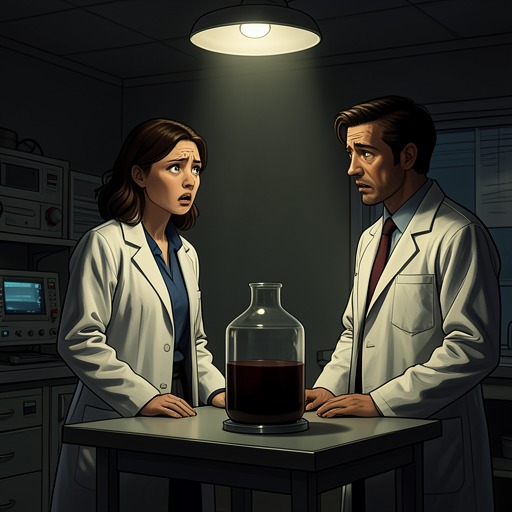
Harper Wilson
My Vampire Love (Completed)Harper Wilson is the Wilson family physician and scientist whose treatment of Jenifer Kate Lawrence is inseparable from the family’s larger project of power, bloodline preservation, and control. He helps keep Jenifer alive from birth by supplying the medication that conceals its true nature, yet that same treatment makes her part of an artificial pure-blood experiment and supports the arrangement that may require her to marry Eric Wilson. Harper therefore embodies the story’s central ambiguity about care: his intervention is life-saving, but it also places a vulnerable child inside a system that claims authority over her future.
Identity and Position
Harper is first encountered through the titles and names others use for him: Mr. Wilson in the explanation of Jenifer’s childhood arrangement, Dr. Wilson in medical and family scenes, and Harper when he asks Jenifer to address him more personally. Outside the family, the Wilsons are known as one of the most powerful families in the world, associated with enormous wealth, major companies, and social influence. Harper is also described as having been one of the world’s leading brain surgeons before he stopped practicing. His medical reputation gives the family’s authority a public, human face, while his knowledge places him at the center of the hidden supernatural order.
His importance is not limited to professional status. Harper belongs to a family whose history is preserved in a secret chamber filled with hundreds of bookcases, glass showcases, and a wall recording millions of connected names reaching back to Lilith. The family tree turns ancestry into architecture, and Harper’s position within that lineage helps explain why medical treatment, marriage, experimentation, and succession are never merely private matters for him. They are connected to the survival and dominance of the Wilson bloodline.
Medical Intervention and the Experiment
Harper’s decisive action occurs before the main events of Jenifer’s life. Doctors had given her only days to live, but Harper helped her survive on the condition that, when she reached seventeen, she would marry his son if Eric chose to do so. He also supplied her medication from birth. Jenifer’s parents understood the arrangement as an impossible bargain: without Harper’s help, their child would have died; with it, she would grow up bound to a stranger and potentially to a marriage she might hate.
The medication initially appears to be an ordinary medical treatment, but Eric later explains its actual composition. The pills contain Harper’s family’s vampire blood in a confined and weaker form. In that state, the blood heals Jenifer and keeps her alive without transforming her. The treatment thus performs two functions at once: it compensates for her failing blood production and gradually introduces vampire material into her body.
Jenifer’s condition is aplastic anemia, a severe disorder in which her bone marrow cannot produce blood. She cannot make red blood cells, white blood cells, or platelets, leaving her vulnerable to infection and potentially fatal bleeding from injuries that would not normally be deadly. Harper’s treatment makes ordinary life possible, but its success also supplies the biological foundation for the experiment. Because Jenifer cannot produce blood cells herself, the vampire blood can become the source from which her body develops them.
The experiment is intended to create a living pure-blood vampire and thereby preserve vampire supremacy. Pure-blood vampires are rare, and the ruling vampires feared that witches, shifters, or another supernatural species might regain control if the balance of power shifted. Earlier attempts to create pure bloods from humans had ended in death or worse outcomes. The amount and timing of vampire blood had to be controlled: too much and too often produced a made vampire, while too little could result in a coma or a zombie-like state. Harper’s treatment is therefore part of a carefully regulated process rather than a simple cure.
The method developed around pregnant mothers had also failed. Vampire blood injected into fetuses or transferred to mothers during the first three months of pregnancy produced hybrids instead of pure-blood children. The experiment changed direction when its designers realized that a newborn unable to create any blood cells might be able to generate vampire blood cells instead. Jenifer’s aplastic anemia made her uniquely suitable. She becomes the first living subject with the possibility of awakening as a true pure blood, which makes her simultaneously the experiment’s most valuable result and its most endangered human subject.
Relationship with Jenifer
Harper’s relationship with Jenifer is defined by protection that cannot be separated from ownership and expectation. His assistance prevents her death at birth, but the condition attached to it gives the Wilson family a claim over her adult life. The arrangement is presented as the only available choice, yet its moral cost becomes clear when Jenifer recognizes that her survival has been exchanged for the possibility of being married to a stranger at seventeen.
His medical work also shapes how Jenifer understands her own body. For much of her life, she has believed that fainting, vomiting, unexplained nosebleeds, and related symptoms belong to her illness, even though the pills make her seem like everyone else. The later revelation that the medication is weakened vampire blood changes the meaning of every ordinary day she has survived. Her body has not merely been treated; it has been monitored, supplied, and prepared for a transformation whose purpose she did not know.
Harper nevertheless shows personal sympathy when Jenifer confronts the family’s violence and secrecy. After she fights Eric and apologizes, he asks her to call him Harper and tells her that he understands why she reacted as she did. He acknowledges that Eric’s words were horrible and that the entire situation was horrible. When Jenifer worries that striking Eric means she has become someone unrecognizable, Harper insists that the behavior was not simply her ordinary self. He explains that the large quantity of vampire blood Katalin had given her intensified and strengthened her emotions, making her an emotional danger to herself and others without her understanding why.
That explanation does not erase his responsibility for the system that made the event possible, but it gives Jenifer a framework for understanding her altered reactions. Harper acts as a translator between bodily change and emotional experience, showing how supernatural blood can function as both medicine and a force that destabilizes identity.
Family Mediation and Moral Ambivalence
Within the Wilson household, Harper often works as a mediator rather than an overt enforcer. When he and Mrs. Wilson catch Eric and Jenifer together, Harper interrupts the awkward discovery by drawing Mrs. Wilson away for a walk. At the doorway, he whispers that she should be glad she is not using Eric as a punching bag, then winks before leaving. The intervention turns a potentially punitive scene into comic relief and protects the younger pair from immediate embarrassment or confrontation.
This gesture reveals a warmer, more playful side of Harper, but it also reinforces his place as someone who manages the family’s emotional pressure from inside the system. He can deflect danger, excuse tension, and make the household feel briefly safe, while the larger structures of bloodline law and arranged marriage remain intact. His gentleness is genuine within the scene, yet it does not cancel the coercive conditions surrounding Jenifer’s life.
Harper’s family loyalties also intersect with the fate of Daren. When Jenifer later sees Dina, she believes for a moment that Daren is alive because the twins look and sound exactly alike. The revelation that Dina is Daren’s sister confirms that the apparent return was a painful misunderstanding. Daren had broken Katalin’s command by developing a relationship with Jenifer rather than remaining only her friend, and he would likely have pursued marriage with her even if doing so required breaking with the Underworld. Harper belongs to the family that benefits from the rules Daren defied, yet the story’s emotional consequences show the human cost of those rules more forcefully than any formal explanation.
Narrative Role and Significance
Harper functions as a threshold figure between the visible world of medicine and the concealed world of vampires. His former career as a celebrated brain surgeon makes him legible as a human authority, while his connection to the blood experiment places him within the supernatural hierarchy. Through him, treatment becomes transformation, and family assistance becomes a mechanism of political reproduction.
His role also complicates the distinction between healer and experimenter. Harper gives Jenifer what she needs to live, but the treatment is designed to produce a future pure-blood vampire and to help keep vampires in power. Jenifer is not only a patient; she is a biological possibility being cultivated by a dominant species. The story’s medical imagery therefore becomes political: blood is medicine, inheritance, experimental material, and a means of maintaining supremacy at the same time.
Harper’s most sympathetic actions do not resolve that contradiction. He comforts Jenifer, explains the effects of vampire blood, preserves her from social humiliation, and participates in a family capable of love and humor. At the same time, his intervention begins the chain that places her under medical, familial, and marital control. His significance lies precisely in that unresolved mixture. Harper is neither reduced to a cold scientist nor cleared as an innocent benefactor; he is the character through whom the narrative shows how protection can save a life while quietly determining what that life is allowed to become.