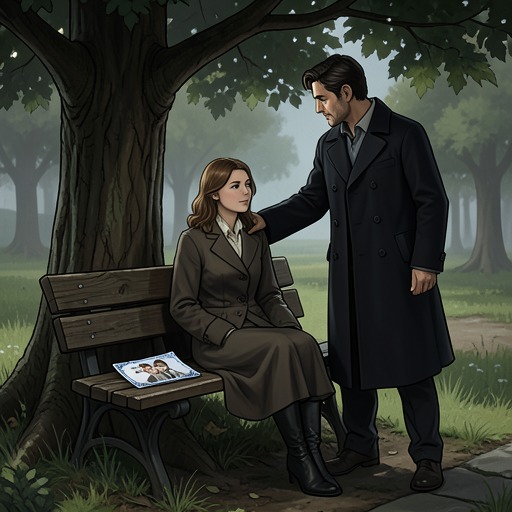
Moving on is not replacing those we've lost
My Vampire Love (Completed)“Moving on is not replacing those we've lost” names the emotional and ethical distinction at the center of Kris’s conversation with Jenifer. Jenifer treats any love for Eric as a betrayal of Daren, while Kris argues that a future relationship can coexist with enduring loyalty to the person who died. The expression therefore transforms moving on from an act of substitution into an act of survival, memory, and healing.
Meaning Within Jenifer’s Grief
Jenifer has not merely lost Daren; she has lost the future they had planned together. Because they wanted a wedding and an entire life together, she understands happiness with anyone else as taking the place of a life Daren never received. Her refusal to love Eric is consequently framed as fidelity: saying that she loves Eric would mean admitting that she has moved beyond Daren, replaced him, and accepted a future without him.
Jenifer states this position to Kris with certainty, insisting that she loves Daren and will always love him. The steadiness of her voice gives the expression its opposing pressure: grief has hardened into a rule that forbids emotional change. In her understanding, remembrance requires continued suffering, because relief or new love would seem to insult Daren and the relationship they shared.
Kris’s Reframing of Loss
Kris does not deny the permanence of Jenifer’s love for Daren. Instead, she compares Daren’s continuing place in Jenifer’s heart with Brandon’s continuing place in her own. Both deceased men remain emotionally marked into the women’s identities, and time cannot remove that mark. This parallel establishes Kris’s credibility as someone who speaks from grief rather than from distance or easy optimism.
Her argument then shifts from memory to responsibility. Kris tells Jenifer that Daren died so she could live, grow old, fall in love again, attend college, obtain a legal job, and start a family. These possibilities do not diminish Daren’s death; they give his sacrifice a consequence beyond loss. The future Jenifer fears as betrayal is recast as the life Daren would have wanted her to have.
The Expression in the Scene
Kris applies the principle directly to Eric, who is waiting outside. Although she has known him for only a few hours and has barely spoken two sentences with him, she recognizes in the way he looks at Jenifer an echo of the way Daren looked at her. The comparison does not claim that Eric is Daren. Its force lies precisely in preserving the difference between the two men while identifying a continuity of care.
The scene makes the expression a form of persuasion built from emotional appeal, personal testimony, and practical hope. Kris presents moving on not as forgetting, but as learning to live with absence. That formulation allows two truths to stand together: Daren remains irreplaceable, and Jenifer may still have a life that includes love.
Bodily Witness and Immediate Resistance
The argument affects both women physically before Jenifer accepts it intellectually. Goosebumps rise on Jenifer’s skin as she listens. Kris wipes tears from her face, an unusual break in the composure Jenifer has associated with her, and Jenifer discovers that silent tears have also been running down her own face. She immediately copies Kris’s movement, creating a visible exchange in which grief passes between them without needing further explanation.
Yet the scene does not end with a declared conversion. When Kris begins to continue, Jenifer stops her by saying that she is hungry and abruptly jumps off the bed. She does not want to hear any more about moving on. The expression therefore marks an opening rather than a completed resolution: Kris has made an alternative understanding of grief imaginable, but Jenifer still retreats from its consequences and follows her into the kitchen instead of answering the question of a future with Eric.