Ryan
My Vampire Love (Completed)Ryan is introduced as a short, blonde, well-built student with the polished appearance of a wealthy, attractive boy. Jenifer encounters him in psychology class after Mr. Mano directs her to the back of the room beside him. Although she initially expects that someone resembling Eric might be shallow or foolish, her experience with Eric has already complicated that judgment. Ryan’s immediate significance, however, lies less in his appearance than in his unsettling familiarity with Jenifer: his piercing dark-blue eyes remain fixed on her, and he insists that he has seen her somewhere before.
Identity and Introduction
Ryan’s first scene establishes him as both socially recognizable and narratively disruptive. He appears to belong to the same affluent, attractive social world that Jenifer associates with Eric, yet he does not behave as a passive background classmate. His persistent staring makes the lesson feel torturous to Jenifer, who reacts with open irritation and mocks the romantic convention of the mysterious observer. Ryan apologizes and explains that she simply looks familiar, but his explanation only deepens the unease because Jenifer has recently moved there and believes he should have no reason to know her.
The encounter gives Ryan an investigative function without making him an investigator in any formal sense. He notices a resemblance that Jenifer wants hidden, and his ordinary memory becomes the mechanism through which her carefully maintained separation from the past begins to fail. The scene is filtered through Jenifer’s anxious, defensive perception, so Ryan is first presented less as a rounded confidant than as an intrusive gaze—someone whose recognition threatens the emotional numbness she has used to survive.
Recognition and the Magazine Photograph
Ryan’s suspicion becomes public in the cafeteria. He takes a magazine from his friends’ table and approaches Jenifer after announcing that he will prove his recognition. The approach triggers an immediate physical warning in Jenifer: she feels an urgent need to run, while Eric reads Ryan’s mind and realizes that the encounter is dangerous before Ryan reaches the table. The threat is not physical violence but exposure. Ryan carries an image capable of breaking through the silence and concealment surrounding Jenifer’s former life.
He places the open magazine before her and asks whether she will tell the others that the pictured person is her. His certainty confirms that the familiarity from psychology class was genuine. The photograph leaves Jenifer unable to look away; she picks it up with shaking hands and begins to cry as the cafeteria’s ordinary noise returns around her. Ryan therefore becomes the accidental agent of a revelation he does not understand emotionally. He recognizes Jenifer, but he does not initially grasp the scale of the grief attached to being recognized.
The scene also clarifies the difference between Ryan’s knowledge and Jenifer’s experience. For him, the photograph solves a puzzle: he has seen her before and now has proof. For Jenifer, it collapses the protective numbness that has kept her alive since the night connected with overwhelming guilt and loss. Ryan’s act is not presented as deliberate cruelty, but its consequences are severe because recognition converts a private wound into a public spectacle.
Misjudgment, Apology, and Limited Repair
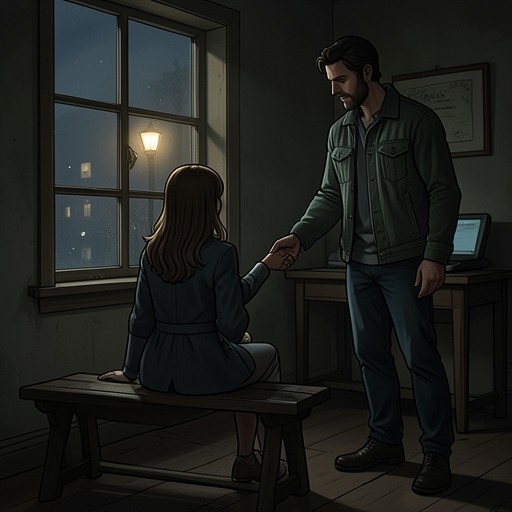
After the photograph’s damaging effect becomes clear, Ryan remains near Jenifer’s bed without speaking. His silence suggests discomfort rather than indifference, and when Jenifer finally addresses him, he offers a direct apology. He says that he is glad she is safe and that he did not know the picture would upset her. Jenifer answers that it is fine and claims to be over it, but her earlier collapse makes that response read as social containment rather than genuine recovery.
Ryan’s apology does not undo the exposure, nor does it establish a deep friendship with Jenifer. Its importance is narrower and more credible: he recognizes that his certainty about the photograph did not equal understanding of its meaning. The movement from staring, challenging, and displaying the image to remaining awkwardly beside her and apologizing marks a modest change in his relation to her. He begins as someone who treats recognition as proof; he ends as someone forced to acknowledge the emotional cost of what he has revealed.
Narrative Role and Significance
Ryan’s role is concentrated around the tension between visible identity and concealed history. He is not responsible for Jenifer’s illness, her experimental origins, her refusal of medication, or the despair that makes survival itself difficult. Those conditions belong to Jenifer’s larger crisis, in which numbness, physical weakness, vampire blood, and the pressure of other people’s love all intersect. Ryan’s contribution is different: he punctures the social disguise that allows her to move through school without explaining who she was.
Because Ryan sees only an image and a resemblance, his knowledge is incomplete. That incompleteness produces the scene’s dramatic irony. He is correct that Jenifer is the person in the magazine, yet he is wrong about what recognition permits him to do with that fact. The photograph becomes more than an object of identification; in Jenifer’s hands, it becomes an instrument that exposes the material reality of a past she has tried not to feel. Ryan’s accidental discovery consequently links everyday school life to the concealed supernatural and medical history driving the larger plot.
Ryan remains a limited but effective character: memorable for his piercing attention, blunt proof-seeking, and eventual apology. His apparent familiarity with Eric’s privileged social type initially invites comparison, but his decisive action is not romantic pursuit or physical intimidation. It is recognition. By forcing Jenifer’s past into the open and then witnessing the damage without knowing how to repair it, Ryan embodies the ordinary world’s power to injure hidden grief simply by looking closely.