Underworld
My Vampire Love (Completed)Underworld is both a realm and a governing order within the supernatural world. Katalin describes it as neither Hell nor purgatory, although its violence makes the comparison understandable. It is ruled by power and brutality, yet she also presents it as extraordinarily beautiful. Survival depends not only on strength but on the will to use power decisively, and its governing ethic rewards self-preservation, suspicion, and selfishness. Underworld therefore functions as a political environment as much as a place: its inhabitants must constantly negotiate authority, danger, loyalty, and the right to remain alive.
Definition and Structure
Underworld exists because the Midnight Society exists. Katalin explains that the Midnight Society includes all supernatural creatures that do not belong to the human world, including vampires, shifters, witches, dragons, and other beings. Underworld is located within that larger society rather than standing beside it as an entirely separate universe. This relationship makes the realm a concentrated center of supernatural organization, while the Midnight Society provides the broader category of belonging for nonhuman life.
The distinction matters because Underworld is not simply a hidden country with fixed physical borders. Its existence is tied to the social existence of supernatural species and to the institutions that regulate them. The realm contains power structures, armies, laws, bloodline hierarchies, and species classifications, but its influence extends beyond its own territory. Human lives can be monitored, protected, threatened, or used in experiments because the priorities of Underworld politics reach into the human world.
Laws, Hierarchy, and Authority
Underworld society is organized through overlapping forms of authority. Vampires currently rule because pureblood vampires hold the greatest concentration of power, but Eric explains that this dominance was not eternal. Witches once controlled the balance of power; after many witches died during a spell, vampires were able to take control. Eric also acknowledges that power could shift again to witches, shifters, or another supernatural species. The history of Underworld is therefore presented as a succession of unstable regimes rather than a permanently natural hierarchy.
That instability motivates the vampire experiment involving Jenifer. Because pureblood vampires are rare, vampire authorities attempt to create new purebloods from humans so that stronger vampire families can be born and vampire supremacy can be preserved. The experiment has killed every previous human subject or produced worse results, while Jenifer remains the only living subject. Her body is consequently treated as a political resource by Underworld powers: her survival may determine whether the existing order can reproduce itself through naturally born pureblood families.
The realm’s laws also define which species may be protected and which may be destroyed. Werewolves are called the Cursed Species because, after their inherited curse awakens, they transform during the week of the full moon and lose control of their actions. Underworld law requires that werewolves be killed on sight, on the grounds that their bloodlust makes them uncontrollable. Brandon’s identity as a werewolf therefore places him and Kristen’s unborn child under a legal and physical threat, even though Brandon fears harming Kristen and Jenifer believes he would not choose to hurt her.
Underworld authority can also override ordinary protections. Eric argues that Katalin cannot touch him because of vampire law and that she would not dare harm Jenifer because of the blood in Jenifer’s veins. Katalin counters that she is above Eric in rank, is heir to the throne, and can therefore act where he cannot. Her authority demonstrates that law is not applied evenly: rank determines who may invoke a rule, who may suspend it, and who is exposed to its consequences.
Military and Protective Reach
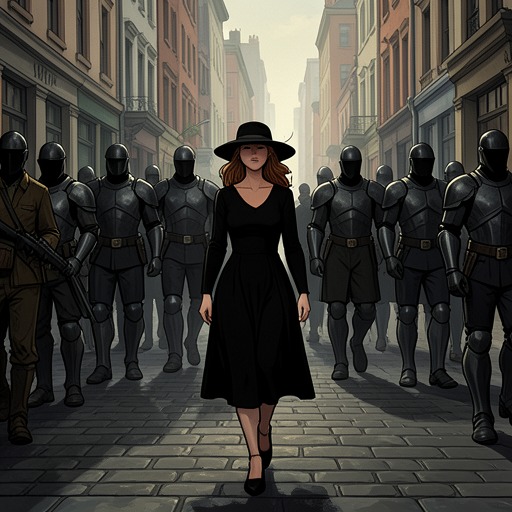
Underworld maintains a military structure capable of operating far beyond its own hidden center. Katalin brings six hundred nonhumans through the Gateway, a feat described as unprecedented, and disperses them throughout the city. Dean’s pack is identified as the largest group, numbering almost seven hundred members, while some members remain behind to protect the tribe. The scale of this movement transforms protection into occupation-like surveillance: the city becomes a network of guarded positions organized around Jenifer’s survival.
Dean and his pack are assigned to watch Jenifer specifically against Underworld matters. Eric objects because Dean is one of the werewolves and might turn against them, but Katalin tells him that he has no choice. The assignment reveals a central contradiction in Underworld governance: groups that are condemned or distrusted by its laws may still be recruited into its security apparatus when their strength is useful. Protection is thus conditional and strategic rather than grounded in equal recognition.
The military chain of command becomes visible when Dean is critically injured. Katalin removes a tribal pendant from around Dean’s neck and places command of Dean’s pack, the army, and Underworld in Dina’s hands until Dean or Katalin makes further contact. Her urgency shows that authority is materialized through insignia and can be transferred during crisis. The pendant is not merely decorative; it acts as a token of command, allowing the political and military order to continue even when its leader is incapacitated.
Underworld also offers advancement through danger. Katalin encourages Jason to join the Underworld army because his rare ability to transfer life force could be developed there. She warns that training will be difficult, that no special treatment will be granted because of his relationships with Jenifer, Eric, or Katalin, and that only survival will earn the promised rewards. Military service therefore becomes both an opportunity and a test: power can produce status, but only if its bearer survives the institution designed to discipline it.
Contact with the Human World
Underworld’s secrecy depends on controlling the boundary between supernatural and human spaces. Eric and Katalin discuss Jenifer’s protection as a matter of life and death, and Katalin threatens to make Eric an example if Jenifer dies under his watch. Dean’s assignment is explicitly limited to Underworld matters, implying a distinction between ordinary human life and supernatural intervention, even though that distinction is repeatedly breached by surveillance, experimentation, and armed deployment.
The Gateway makes this breach physical. Katalin’s movement of hundreds of nonhumans into the city demonstrates that the boundary between realms can be crossed, but only through extraordinary means and with considerable logistical difficulty. The supernatural world is hidden, not isolated. Its forces can enter human territory, position themselves among human buildings, and reorganize human circumstances without making their institutions visible to ordinary people.
The realm’s secrecy also produces fear and confusion for Jenifer. She is repeatedly placed in situations where powerful figures discuss her possible death as an administrative matter, while she remains excluded from the full explanation. Her fear of being led toward death reflects the effect of Underworld power on a human subject who is legally and politically important but not treated as an equal participant in decision-making.
Narrative Significance
Underworld gives the novel’s supernatural conflict an institutional shape. Vampires are not dangerous only because of individual abilities; they belong to a civilization with succession rules, species laws, military forces, experiments, and enforcement mechanisms. The realm’s beauty and brutality coexist, creating a setting in which grandeur does not soften violence. Its magnificence becomes part of the danger because power can appear civilized while still treating lives as instruments.
The realm also exposes the conflict between competing legal orders. Human sympathy, personal loyalty, vampire law, werewolf punishment, bloodline politics, and military necessity do not produce the same judgment. Brandon may be loving and fearful of harming Kristen, yet Underworld law classifies him as an uncontrollable threat. Eric may want to protect Jenifer, yet he remains answerable to Katalin’s authority. Katalin may threaten Jenifer in one setting and later promise not to harm her, revealing how protection and domination can occupy the same relationship.
By the time Katalin names the Midnight Society, Underworld has expanded from a frightening unknown into a structured world with its own categories of belonging. It is the hidden system behind the novel’s revelations about species, blood, law, and power. Jenifer’s life is caught at its center because her body may change the future of pureblood vampires, while the forces surrounding her show that survival in Underworld is never only personal: it is also a question of jurisdiction, succession, and who has the authority to decide which lives are worth preserving.