Victor
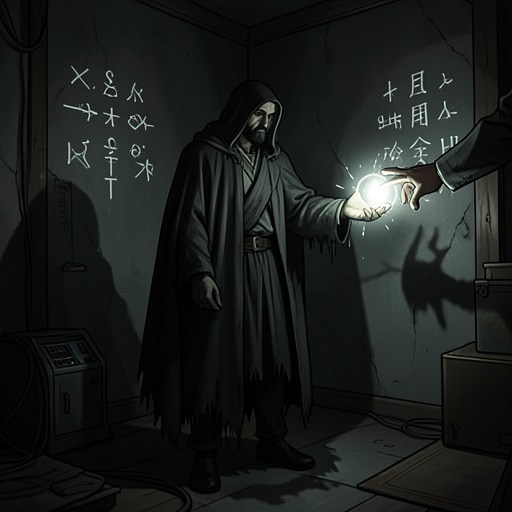
My Vampire Love (Completed)Victor is an unseen but decisive power in the vampire world, defined less by direct appearances than by the control he exerts over Katalin and the lethal consequences of his decisions. He is Katalin’s father, a made vampire rather than a pure-blood vampire, and his relationship with her places private family authority at the center of wider supernatural conflict.
Identity and Position
Victor’s nature is disclosed through Eric’s explanation of Katalin’s unusual birth. Katalin’s mother was human, while Victor was a made vampire; as a result, Katalin is half vampire and half human, and Eric describes her as the only person like her. Victor therefore stands behind a unique hybrid lineage rather than an ordinary pure-blood succession. His status also distinguishes him from the inherited vampire aristocracy suggested elsewhere in the story: he possesses supernatural authority without being a pure-blood himself.
His importance is measured through Katalin’s power. Eric says that Katalin is stronger than all of them and could probably wipe out the vampire community single-handedly if she wished. Yet Eric does not describe her strength as entirely self-directed. He trusts that she will do whatever Victor tells her to do, making Victor’s command more consequential than physical force alone. The possibility that one person could destroy the vampire community becomes inseparable from the fact that this person is answerable to Victor.
Authority Through Katalin
Victor’s influence is repeatedly expressed through images of obedience and delegated violence. At the ruined ball, Zane calls Katalin Victor’s personal puppet and accuses her of being his perfect daughter, someone who carries out everything he wants. The insult is designed to provoke her, but it also identifies the visible structure of Victor’s power: he does not need to stand in the room to shape its balance. Katalin’s presence functions as an extension of his will.
Katalin does not simply deny the accusation. When Jenifer questions how serving Victor can be compatible with selfish survival in the Underworld, Katalin says that she has her reasons for doing what her father says, for now. The qualification matters. It preserves a concealed motive and prevents her obedience from becoming a simple portrait of devotion. Victor commands, Katalin complies, but the arrangement contains an undisclosed purpose of her own. Her silence leaves Victor powerful while making the exact nature of his power uncertain.
Katalin later admits that Victor can use her as he wishes and that she has her reasons for allowing it. She speaks of killing as something that becomes easier with time, especially for vampires, and presents lethal violence as an ordinary instrument of survival. Victor’s authority is thus linked not only to orders but also to the moral conditioning required to carry them out. Through Katalin, the narrative presents him as a figure who converts extraordinary ability into an operational weapon.
Threat Against Dean
Victor’s most direct revealed action is his order that Dean be killed. When Dean holds Katalin back and demands to know what is happening, she tells him that her father wants him dead. She adds that when Victor wants someone dead, that person eventually dies. The statement turns Victor’s wish into an almost inevitable sentence: the threat does not depend on an immediate attack, because his authority can produce death over time.
The danger is confirmed when Katalin explains that Victor knows Dean nearly died. She had to give Dean half of her life force to save him, weakening her abilities and her blood in the process. Victor’s command therefore produces consequences even when Katalin acts against its immediate outcome. Her intervention preserves Dean’s life temporarily, but it costs her power and exposes the strain between her father’s wishes and her own decisions.
This episode also shows that Victor’s influence is not limited to distant political control. His knowledge reaches into the private circumstances of Dean’s near-death, and Katalin’s fear is expressed through tears as she speaks of what happens when Victor chooses a target. The threat against Dean makes Victor’s authority personal, intimate, and physically dangerous.
Family, Power, and Concealed Motives
Victor’s relationship with Katalin is marked by contradiction. She is powerful enough to destroy the vampire community, yet she describes herself as available for her father’s use. She appears to possess the strength to resist, but continues to obey him, at least temporarily. The story does not resolve whether this obedience comes from fear, loyalty, strategy, dependence, or a mixture of motives. Instead, Katalin’s repeated insistence that she has reasons keeps both her and Victor surrounded by uncertainty.
That uncertainty gives Victor a shapeshifting narrative function even though he is not shown acting directly in the supplied scenes. To Eric, Victor is the source of Katalin’s commands and therefore a reason to trust her only conditionally. To Zane, he is the father behind a puppet-master arrangement. To Katalin, he is both the person entitled to use her and the authority whose decisions may eventually destroy those he marks. To Dean, he becomes the unseen cause of a death sentence and of Katalin’s desperate sacrifice.
Narrative Significance
Victor embodies power exercised through allegiance, secrecy, and the threat of inevitable retaliation. His made-vampire identity complicates the assumption that authority belongs only to pure-blood figures, while Katalin’s hybrid existence makes their family bond a challenge to rigid supernatural categories. The story’s revelations about him arrive indirectly, through other characters’ fear, explanation, mockery, and sacrifice; this absence intensifies his reach rather than diminishing it.
The decisive pattern is that Victor’s power becomes visible whenever someone else must act because of him. Eric measures Katalin’s danger by her obedience to Victor. Zane attacks her loyalty by invoking Victor’s control. Katalin accepts being used while withholding the reasons for that acceptance. Dean is marked for death without Victor needing to confront him personally. Victor consequently functions as an offstage center of command: a father whose authority turns Katalin’s exceptional strength into a threat to the vampire community, a source of danger to Dean, and one of the story’s clearest examples of how private domination can govern an entire supernatural order.