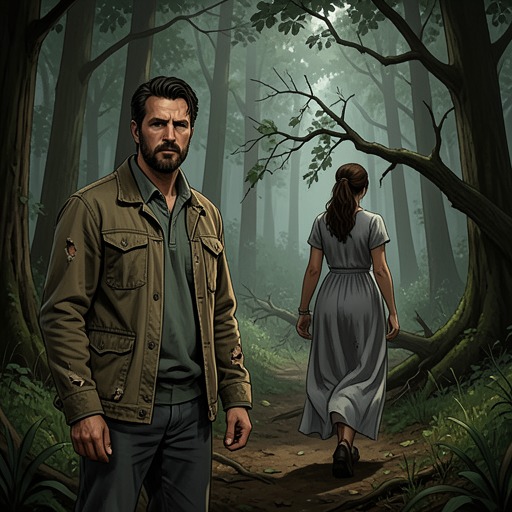
Werewolf curse state
My Vampire Love (Completed)Werewolf curse state is the condition by which a human being, after a hereditary curse awakens, loses ordinary control during the week of the full moon and transforms into a wolf that hunts. Its decisive significance lies in the gap between the person’s human origin and the supernatural society’s refusal to recognize the transformed subject as safely governable: Underworld law classifies werewolves as “The Cursed Species” and orders them killed on sight because they cannot control either the timing of their transformation or their conduct once bloodlust takes over.
Definition and Distinction
The curse is explicitly distinguished from the condition of a lycanthrope and from the abilities of a shifter. A shifter can change completely into an animal while retaining no human appearance, and the ability is inherited through generations; the curse, by contrast, belongs to humans who awaken a condition already carried in their family. A lycanthrope is made when a werewolf bites a human during its first full moon and remains permanently caught between human and wolf, whereas a werewolf under the curse appears as a wolf only during the week of the full moon. This distinction corrects Jenifer’s initial interpretation of the creature she encounters and establishes that the supernatural world contains several nonhuman states whose origins and physical expressions are not interchangeable.
The curse therefore combines inheritance and activation. Its victims are born as humans, but once the curse runs in the family and awakens, it takes control of the body on every night during the full-moon week. The transformation is not presented as a chosen disguise or a disciplined skill. It is a recurring takeover that changes what the afflicted person can do and removes the ability to regulate the resulting violence.
Manifestation and Horror
Jenifer first experiences the curse through an encounter that strips away the protective distance of television or legend. Standing inches from the creature, she cannot determine whether it is human or animal before recognizing it as the species that wants her dead. The being has glowing blood-red eyes with midnight-black pupils, long pointed teeth wet with blood, and drool falling in clumps from its skinned-back lips. Its low, menacing growls communicate a direct intention to kill, while Jenifer’s body becomes so rigid with fear that she cannot move.
The scene makes the curse legible through physical excess rather than exposition. The wolf is not a familiar folkloric image but a lethal presence whose anatomy defeats Jenifer’s ordinary categories. Her terror begins as uncertainty about what she is seeing and becomes horror once the threat is exposed. The curse thus functions both as a supernatural condition and as a narrative revelation: the hidden species of the Underworld becomes real through a body that is visibly neither safely human nor merely animal.
Law, Sovereignty, and Social Consequences
The Underworld’s response to the curse is categorical. Werewolves are called “The Cursed Species,” and Underworld law requires that they be killed on sight because they cannot control when they shift or what they do afterward. Once the curse awakens, they lose control and give in to bloodlust. The law treats involuntary transformation as grounds for permanent suspicion and lethal punishment, making the afflicted person dangerous in the eyes of the ruling supernatural order before any individual act is described.
This legal rule contrasts with the more selective protections operating elsewhere in the Underworld. Eric argues that Katalin cannot touch Jenifer because of the law and because of the blood in Jenifer’s veins, while Dean and his pack are assigned to guard Jenifer from Underworld matters. Those scenes show a layered system in which status, bloodline, species, and official orders determine who may be protected and who may be destroyed. The werewolf curse occupies the harshest position within that system: its bearer is still human in origin, yet the awakened condition places the person outside ordinary protection and under an immediate death sentence.
The rule also exposes the political character of supernatural law. Vampires maintain authority through bloodline power, experiments intended to create more purebloods, and commands enforced by rank. Against that background, the execution rule for werewolves is not simply a neutral safety measure; it is part of a hierarchy that defines which transformations may be protected, controlled, or legitimized. The curse is condemned because it produces uncontrolled power, while other supernatural changes are managed through blood, inheritance, law, or guardianship.
Narrative Function and Psychological Resonance
For Jenifer, the werewolf encounter is one of several moments in which the body becomes the first site of knowledge. Fear arrives before explanation: muscles freeze, breathing becomes dangerous, and recognition comes as an almost physical shock. The same pattern recurs when she is trapped in a dark closet during a school emergency and when an elevator stops in darkness, leaving her banging on the doors and screaming to be released. These episodes connect supernatural danger with enclosed spaces and involuntary bodily reactions, making the curse part of a wider narrative of threatened control.
The condition also resonates with Jenifer’s grief after Daren’s death. She wakes screaming while her mother tries to comfort her, refuses to discuss the event, and remains unable to speak about it for almost three weeks. Later, she avoids school and her friends, repeatedly drives to the old cemetery without entering, and describes herself as empty after watching Daren die. When she finally faces Kris, tears break through the numbness and she acknowledges that Daren is dead. Against this pattern of trauma, the werewolf curse represents a literalized version of what Jenifer fears: an inner force that can seize the body, erase deliberation, and make the self appear monstrous to others.
The curse therefore carries a double meaning without losing its concrete supernatural rules. Within the plot, it explains the creature’s form, its hunting behavior, and the legal order demanding its execution. Within Jenifer’s experience, it intensifies the book’s recurring concern with states in which people are changed by blood, inheritance, awakening, or loss and then judged according to what their altered bodies might do. Its horror comes not only from the wolf’s teeth, but from the possibility that identity can be inherited, activated, and publicly condemned before the person has any meaningful chance to resist.