Wilson family black widow emblem
My Vampire Love (Completed)The Wilson family black widow emblem is the visible sign of the Wilson family’s identity and authority. Its repeated appearance transforms the family’s domestic spaces and formal rituals into a coherent symbolic system: the emblem is beautiful enough to invite fascination, yet associated with a creature whose danger is concealed beneath that beauty. As Jenifer Kate Lawrence enters the Wilson family’s world, the black widow becomes one of the earliest indications that the apparent elegance of the family is inseparable from secrecy, bloodline, and threat.
Appearance and Material Forms
The emblem first appears as part of the Wilson family’s elaborate surroundings. A black widow shapes the fountain outside the house, where it belongs to the same antique, refined, and beautiful visual style as the residence itself. The same spider is engraved on the front door, turning the threshold into a guarded boundary rather than an ordinary entrance. It is also printed on the invitation, linking the family’s public ceremony to its private crest.
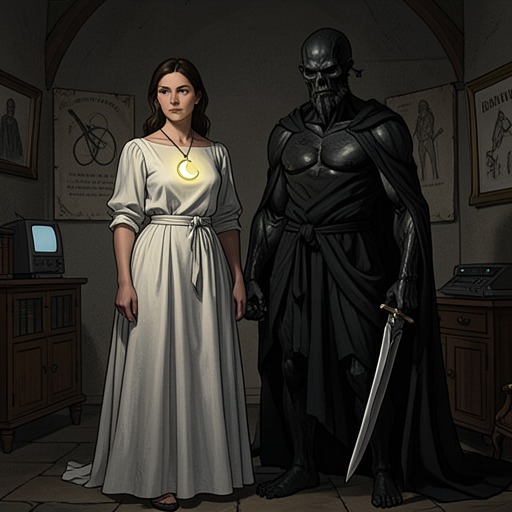
The symbol is not confined to architecture or stationery. While preparing for the wedding, Jenifer finds a simple, extremely thin silver chain bearing a black widow pendant. The object gives the emblem a portable and intimate form: what had previously been seen at a distance on doors, fountains, and paper can now be worn around her neck. Mrs. Wilson fastens the chain onto Jenifer herself, making the family mark part of Jenifer’s appearance at the moment when she is being drawn into the Wilson family’s social and marital structure.
The emblem also belongs to the broader visual atmosphere of the family’s spaces. Eric Wilson’s mother appears almost angelic, with long blonde hair, bright blue eyes, flawless light skin, and exceptional beauty, while the Wilson family’s residence resembles the heightened world of Disney’s Beauty and the Beast. Against that polished, fairy-tale surface, the black widow introduces a darker counter-image: the household is not merely beautiful, but potentially predatory.
Meaning Within the Wilson Family
When Jenifer asks Eric Wilson why the spider is everywhere, he explains that it is the family’s crest. This answer establishes the emblem as an inherited sign rather than a decorative coincidence. Its placement on the house, fountain, invitation, and pendant marks the family’s continuity across property, ceremony, entrance, and personal adornment. The crest therefore operates as a visual shorthand for belonging and descent, announcing that the same authority governs both the family’s public presentation and its private life.
Jenifer’s own interpretation sharpens the symbol’s contradiction. She regards spiders, especially this one, as beautiful and deadly at the same time. Their perfection and beauty draw observers in, but they do not hesitate to strike when necessary. Eric responds with silence, as though Jenifer has unintentionally recognized something ancient and significant about the family. The emblem’s force comes from precisely this doubleness: attraction and danger occupy the same image, and elegance does not cancel violence but helps conceal it.
The Crest and Family Power
The black widow emblem appears in a family environment structured by inherited power. The Wilson family maintains a vast stone room filled with hundreds of bookcases, glass showcases, and a family tree extending back to Lilith. Names are carved into the walls and connected by vines, presenting ancestry as an immense living network. In that setting, the crest is more than a logo. It is the concentrated public face of the lineage represented by the family tree, carrying the suggestion that individuals are enclosed within a history older and larger than themselves.
That inherited structure also governs Jenifer’s position. Her parents reveal that she has been engaged to Eric since birth because Mr. Wilson supplied the medication that kept her alive, with marriage to Eric Wilson as the condition of that assistance if Eric chose it. The arrangement turns care into obligation and family connection into control. The black widow emblem, displayed on the invitation and throughout the Wilson residence, consequently accompanies a marriage that is presented as elegant and ceremonial but rests on an old exchange involving Jenifer’s body and survival.
Eric later explains that Jenifer is the only living subject of an attempt to create pure-blood vampires from humans. Her illness made the experiment possible, and her awakening at eighteen is expected to transform her into a pure-blood vampire. The Wilson family’s interest in marrying her to Eric before that awakening is connected to the prospect of producing stronger pure-blood vampires and preserving vampire supremacy. The emblem’s beauty thus stands beside a system in which blood, reproduction, marriage, and political power are treated as hereditary resources.
The Emblem at the Wedding
The crest is especially prominent as the wedding approaches. Eric Wilson tells Jenifer that his parents will not postpone the ceremony: invitations have already been sent, the venue has been selected, and the event is fixed for just over a month later. When Jenifer reaches the Wilson residence, people in black and white move flowers, furniture, and carpets through the house while orders are shouted around them. The black widow on the fountain and door belongs to this atmosphere of organized excitement, binding the family’s domestic architecture to the approaching public ritual.
At the wedding, the emblem’s protective and threatening qualities become literalized through Katalin’s arrival. The double doors slam shut with an explosive bang, the music stops, and most vampires in the room sink to their knees. Katalin stands before the doors with a blue, pulsing shield surrounding her, looking like a warrior angel ready to begin a bloody attack. Although the evidence does not state that the shield is itself the black widow emblem, the scene repeats the crest’s central visual logic: beauty, ceremony, and protection are inseparable from intimidation and violence. The family’s symbolic order is therefore not passive decoration; it exists within a world where authority can abruptly become force.
Narrative Significance
The Wilson family black widow emblem foreshadows the central tension of the Wilson family’s world. The family offers beauty, protection, medical rescue, aristocratic belonging, and the promise of a future with Eric Wilson, yet those offerings are tied to coercive arrangements, supernatural experimentation, and the demand that Jenifer accept a role chosen before she could consent. The crest makes that contradiction visible before all of its implications are understood.
As an object, the emblem moves from public architecture into Jenifer’s personal space. That movement mirrors her own passage from an ordinary seventeen-year-old girl living in Trinidad into the Wilson family’s supernatural order, where she is treated as a rare pure-blood vampire and as the means of strengthening an entire ruling species. The black widow pendant resting against her body gives material form to this incorporation. It is an adornment, a family mark, and a warning: the Wilson family’s beauty can draw someone inward, but the power behind it remains capable of striking.