Jenifer Lawrence–Kris friendship
My Vampire Love (Completed)Jenifer Lawrence–Kris friendship is one of the clearest measures of Jenifer’s movement between isolation and belonging. Kris first recognizes Jenifer at school, invites her to lunch, and quickly becomes her best friend; later, when Jenifer withdraws after Daren’s death and refuses contact, Kris continues to treat her as family and sets out to find her. Their friendship is not merely social background: it is the relationship that keeps calling Jenifer back to a human community when guilt, grief, illness, and secrecy make disappearance seem easier.
Identity and Introduction
Kris enters Jenifer’s life through a confrontation with Crystal. She dismisses Crystal harshly, then turns to Jenifer and introduces herself, asking whether Jenifer is the new girl she has heard about and inviting her to have lunch with the group. The invitation becomes an immediate turning point. Jenifer accepts, and the narrative identifies Kris as her best friend from that day onward. The friendship is founded on directness rather than ceremony: Kris does not cautiously observe Jenifer from a distance, but makes room for her at once.
Kris also serves as Jenifer’s entrance into Idle Soulz. Through Kris, Jenifer meets Brandon, Kris’s boyfriend, along with Daren and Danny. The group becomes a chosen social family, and Kris occupies a central position within it. In a photograph later examined with Eric, Jenifer identifies Kris as the leader of the group and explains that everyone calls her Red because of her hair. The image preserves the five friends—Brandon, Danny, Daren, Kris, and Jenifer—together around the car, making visible the shared world that Jenifer later loses and tries to avoid.
Friendship Under Grief and Withdrawal
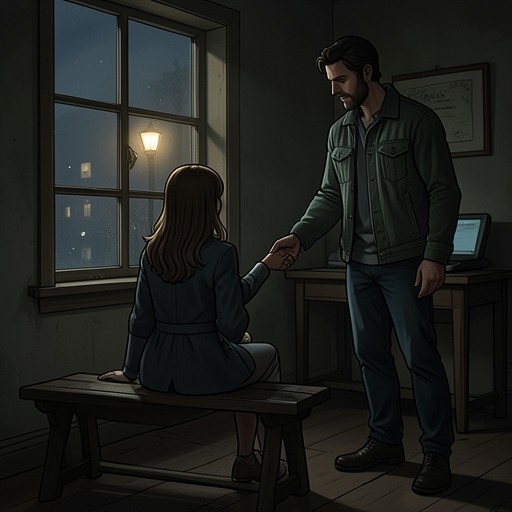
After the funeral, Jenifer does not return to school and avoids Kris as deliberately as she avoids the rest of the group. She ignores calls and messages, runs from friends who come looking for her, and repeatedly ends up outside the old cemetery without being able to enter and say goodbye. Her withdrawal is not caused by indifference to Kris. It is precisely because Kris matters so much that facing her becomes unbearable. Jenifer fears confronting the people who knew Daren and who might force her to acknowledge what has happened.
This separation turns the friendship into a struggle between pursuit and retreat. Jenifer seeks solitude, while Kris refuses to interpret silence as a final answer. The contrast is especially sharp because Jenifer’s physical and emotional collapse is occurring at the same time. She stops taking the brown medication, recognizes that her body is beginning to shut down, and considers death as an escape from pain, guilt, and heartache. Her isolation thus carries a literal danger: withdrawing from Kris and the group accompanies a refusal of the treatment that helps keep her alive.
Kris’s Messages and Search
When Jenifer later checks her email, the inbox is filled with messages from Kris, the one person Jenifer most does not want to face. The first message, sent on the day Jenifer left, asks her to explain what is happening and insists that home is also her family’s home, where they love her and want her to return. Jenifer reads the message through silent tears, but cannot bear to read all the others. The words feel threatening not because Kris is hostile, but because they challenge Jenifer’s effort to make herself unreachable.
The most recent message changes the situation. Kris states that she knows what happened that night and is coming to get Jenifer; wherever Jenifer is, Kris will find her. Jenifer immediately understands that Kris knows the hidden truth and that Kris’s determination is credible. Kris is characterized by persistence: once she makes up her mind, she does not stop. Her pursuit is therefore both emotional and investigative. She is trying to recover her friend, but she is also moving toward the secret Jenifer has treated as too dangerous to disclose.
Loyalty, Violence, and the Burden of Witness
The wider tragedy surrounding Jenifer and Kris is bound to the violence inflicted on their shared circle. Zoryiaa cuts off Brandon’s little finger while Jenifer watches, and the scene places Jenifer in the unbearable position of witnessing the torture of Kris’s boyfriend. Jenifer later attacks Zane with extreme violence, screaming that she hated having to watch her boyfriend die and that Zane made her watch Brandon die. Her rage is therefore inseparable from loyalty to the people Kris brought into her life.
After Zane’s death, however, Jenifer does not experience simple release. She feels more imprisoned than before, horrified by what she has done and convinced that revenge has changed her into something monstrous. This moral collapse clarifies what Kris represents. Kris belongs to the world Jenifer is trying to protect, yet that world also contains the losses and memories that intensify her guilt. The friendship cannot erase the violence, but it gives the violence a human context: Brandon is not an abstract casualty, but Kris’s boyfriend and part of the group that once functioned as family.
Significance and Continuity
Kris’s friendship remains important because it survives Jenifer’s refusal to be comforted. Other relationships attempt to pull Jenifer back through love, guilt, or desperate promises, but Kris’s messages frame return as belonging rather than possession. She tells Jenifer that the group is her family and keeps searching even after Jenifer has made herself absent. The friendship consequently opposes the idea that grief must be endured alone.
At the same time, the relationship is marked by knowledge that Jenifer cannot yet share openly. Kris knows that something happened on the night of the disappearance, while Jenifer responds by hiding, avoiding messages, and retreating into physical danger. Their bond therefore carries both trust and pressure: Kris’s loyalty offers a route back to connection, but her persistence also threatens the isolation Jenifer uses to postpone confession and mourning. In that tension, the friendship becomes one of the book’s strongest recurring images of care—care that does not disappear when it is rejected, and that continues to call a wounded person back from self-erasure.