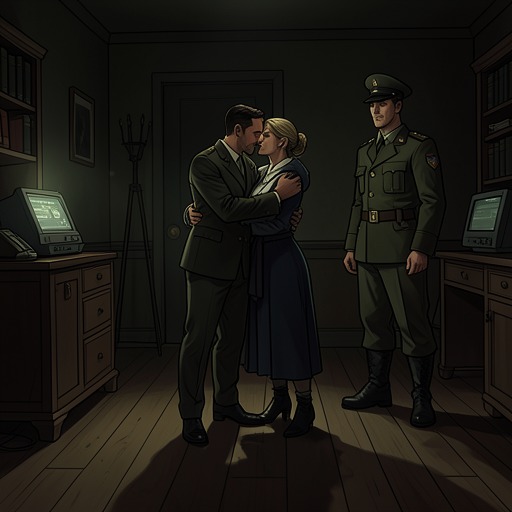
Katalin Cortege–Dean relationship
My Vampire Love (Completed)The Katalin Cortege–Dean relationship binds intimate love to obligation, command, and sacrifice. Katalin is not merely Dean’s superior within the Underworld Army, nor Dean merely her subordinate and protector in danger; they are each other’s emotional center. Their relationship becomes most fully visible when Dean takes a knife meant for Katalin, when Katalin spends half her life force to save him, and when fear of Victor forces her to dissolve Dean’s service contract even though doing so breaks them both.
Identity and Foundation
Katalin Cortege and Dean share a relationship that has developed across personal loss and institutional power. Katalin’s later confession places Dean in her life since her mother’s death and identifies him as the person she loves above all others. That history gives their attachment a depth beyond battlefield companionship: Dean represents continuity after bereavement, while Katalin’s presence gives Dean a loyalty that reaches beyond the commands of the Underworld and the Underworld Army.
Their bond also carries a formal dimension. Dean serves the Underworld Army under Katalin’s authority, and Katalin can therefore issue a command capable of determining his status. Yet the official hierarchy does not contain the relationship. Katalin’s authority is repeatedly overwhelmed by personal fear, and Dean’s obedience is repeatedly transformed into self-endangering protection. The tension between contract and affection is the relationship’s central structural pressure.
Protection and Reciprocal Sacrifice
The relationship is defined by reciprocal protection, but the two characters express that protection differently. During an attack, Dean throws himself in front of a double-edged knife intended for Katalin. The blade passes through his heart and leaves a huge gash in his chest. Even after being forced awake by Katalin, Dean jokes weakly about the pain and about her having learned to curse properly from him. His humor does not lessen the danger; it exposes the intimacy that survives inside it. Katalin responds with fear, tears, anger, and immediate care, pressing her hand over the wound while scolding him for taking a blow she could have endured herself.
Katalin’s response makes clear that Dean’s act is not accepted as ordinary military duty. She insists that he has seen her stand alone before thousands and questions why he would jump in front of a knife for her. Her anger is therefore inseparable from terror: she is furious because his loyalty has made his life vulnerable, and frightened because the injury confirms how completely he will place himself between her and death.
When Dean’s condition appears fatal, Katalin transfers command to Dina. She removes a silver chain bearing a tribal pendant from around Dean’s neck and gives it to Dina, declaring that, until Dean or Katalin makes contact, Dina commands Dean’s pack, the army, and the Underworld. She reinforces the order by giving Dina her own similar chain and warning that only Victor stands higher than Dina. This emergency delegation shows Katalin acting as a military leader even while emotionally collapsing. She can organize power, secrecy, and succession, but she cannot accept Dean’s death.
Katalin then promises Dean that she will find a way to bring him back and save him because he is too close to her heart to lose. Her promise turns care into a vow of action. She does not simply mourn the injured Dean; she commits herself to reversing the consequences of the attack, even though the evidence does not show whether that promise succeeds.
Love Under Victor’s Threat
The relationship’s crisis is intensified by Victor’s hostility. Katalin tells Dean that her father wants him dead and that, when Victor wants someone dead, death eventually follows. Victor has recognized Dean as Katalin’s weak link: Katalin is Victor’s best weapon, but Dean has revealed the point at which her loyalty can weaken her power. The danger is consequently political as well as personal. Dean is threatened not only because he is vulnerable, but because Katalin’s love for him compromises the control Victor expects to exercise over her.
Katalin explains that Dean almost died and that she had to give him half of her life force. Saving him weakened her abilities and her blood, yet she does not regret the cost. Her declaration presents love as an embodied exchange rather than a sentimental claim: Dean’s survival is purchased with Katalin’s vitality, strength, and future capacity. She understands that this sacrifice has consequences, but refuses to withdraw it retroactively.
Her confession is also an admission of dependence. Katalin says that she loves Dean, perhaps more than she should, and that she is not strong enough to say goodbye. Since her mother’s death, Dean has been all that she loves, and the thought of losing him threatens her sanity. The language joins grief, fear, and devotion without separating them. Dean is at once the person she must protect, the person who makes her vulnerable, and the person through whom her life remains emotionally intelligible.
The Forced Separation
Dean eventually reframes separation as an act of protection. He asks whether staying with him is truly what Katalin wants and offers to leave her, but not for Victor, because Victor has already taken too much from both of them. His demand is not that Katalin stop loving him; it is that she choose his departure if departure is the only way to keep him alive.
Katalin answers through the authority she has tried to avoid using against him. She says that she loves Dean and would give her life for him, and for precisely that reason he must leave. The relationship reaches its most painful paradox here: love requires physical and institutional separation, while separation itself appears to betray the love it is meant to preserve.
Dean then orders Katalin to say the command aloud. His injured hand bleeds more heavily as he clenches his fists, making the emotional violence of the scene visible in his body. Katalin sinks to her knees, sobbing and shaking, and formally declares Dean’s contract with the Underworld Army null and void. She identifies herself as Katalin Cortege of the Underworld before announcing that his service is no longer required. Dean’s shock shows that he expected love to resist the command, not become the reason for it.
The dissolution of the contract changes the terms of their bond without resolving its emotional force. Katalin can remove Dean from military service, but she cannot remove him from her heart. Dean can leave the institution, but the separation is not a clean ending: it is a sacrifice imposed by Victor’s threat and chosen through mutual recognition of what continued proximity would cost.
Relational and Narrative Significance
The relationship repeatedly moves between pursuit and withdrawal. Katalin pursues Dean’s survival by using authority, transferring command, promising rescue, and spending her life force. Dean protects Katalin by moving toward danger and later by demanding distance. Their actions appear opposed only on the surface. Both are trying to preserve the other, but each understands preservation differently: Katalin believes survival requires keeping Dean close enough to save, while Dean believes it may require removing himself from Victor’s reach.
The bond also places love beside other forms of self-destructive crisis in the surrounding narrative. Jenifer Kate Lawrence reaches moments in which exhaustion, refusal of medication, and immersion beneath bathwater turn death into an imagined escape. Eric Wilson responds to that danger with desperate declarations of love and with accusations that she has tried to kill herself again. Against that parallel, Katalin and Dean’s relationship shows a different but related pattern: devotion is expressed through promises to die, life-force sacrifice, bodily rescue, and attempts to control the conditions of survival. The text therefore presents love as powerful and protective while also showing how easily it becomes entangled with danger, guilt, coercion, and the fear of abandonment.
Katalin and Dean’s relationship is ultimately characterized by integrated contradiction rather than a simple division between devotion and conflict. Katalin loves Dean, resents the danger he accepts, fears Victor, depends on Dean emotionally, and still possesses enough authority to send him away. Dean loves Katalin, risks death for her, jokes through injury, and accepts the command to leave only because remaining could destroy her. Their deepest expression of attachment is consequently not possession but renunciation: Katalin gives up the right to keep Dean in the army so that he may live, while Dean accepts separation as the price of protecting the woman he loves.