Pure-Blood Awakening Process
My Vampire Love (Completed)The Pure-Blood Awakening Process describes the three stages through which a pure-blood vampire’s dormant inheritance becomes active. Awakening is tied to the eighteenth birthday: before that age, the vampire blood behaves as though dormant and the individual remains much like a normal human; at eighteen, the blood awakens, producing greater strength, speed, and physical capacity. For Jenifer Kate Lawrence, this biological threshold is also the moment when a concealed experiment, a political struggle, and a frightening future converge.
Definition and Political Background
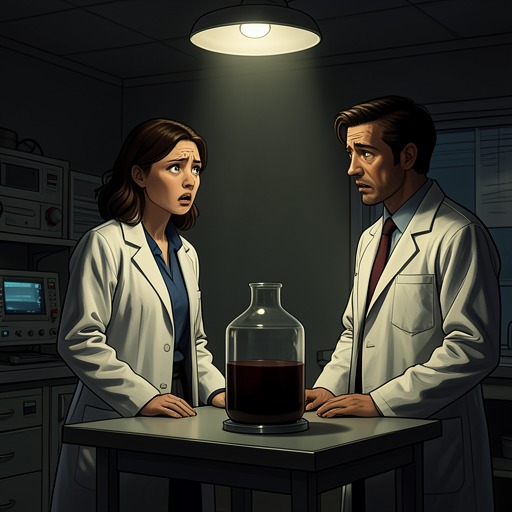
The process exists within a society governed by vampire supremacy, but that supremacy is presented as historically contingent rather than permanent. Eric Wilson explains that witches once controlled the supernatural order, until many died during a spell and vampires seized power. Because witches, shifters, and other supernatural species can gain influence through numbers, the vampires began an experiment intended to manufacture additional pure-bloods and prevent any rival species from overturning their rule.
Pure bloods are rare, making their reproduction and awakening matters of political power rather than merely personal development. The experiment has repeatedly failed: humans given the wrong amount or frequency of vampire blood have died, entered comas, or become zombie-like, while blood given too often produces a made vampire instead of a pure-blood subject. Jenifer is identified as the only living human subject of the attempted pure-blood creation process. Her survival therefore makes her awakening an event of unusual importance to Katalin and to the ruling vampire system.
The Three Stages
The first stage is compared to a human cold, but it is much more intense. It establishes awakening as an illness-like physical disturbance before the process becomes overtly supernatural. The second stage is mental and is linked to the ability the subject will possess after awakening. Eric describes it as a psychic high: the emerging ability reaches its peak strength during this phase, making the mind the site of the process’s most destabilizing revelation.
Eric’s own second stage involved the invasion of other people’s mental contents. His mind began scanning those around him, drawing their thoughts, memories, and stored experiences into his consciousness. The experience resembled having billions of distinct personalities while remaining aware of every one of them. The overload eventually caused him to lose consciousness, and that collapse marked the beginning of the third stage.
The third stage is physical and is described as the most painful. The subject falls into a sleep in which hearing and sensation remain present, even though ordinary waking consciousness is suspended. During this period, the body changes, becoming stronger, faster, and more sensitive to the surrounding world. Awakening from that state completes the transformation: the subject wakes as a vampire.
Jenifer’s Imminent Awakening
Jenifer learns that she will turn eighteen two months after her marriage to Eric Wilson and realizes that the age will bring her own awakening. The revelation changes eighteen from an ordinary milestone into a fixed biological deadline. Her future is already entangled with an arranged engagement, and the timing means that marriage and transformation are positioned close together, reinforcing how little control she has been given over either her body or her social role.
Jenifer is not prepared for the suffering Eric describes. She would prefer the simplified transformation associated with fictional movie vampires, in which becoming a vampire involves only the pain of dying, but the actual process promises prolonged mental and physical torment. Eric offers to remain with her, though the scale of the expected ordeal leaves her doubtful that even his presence will make it bearable. The process thus creates anticipation rather than immediate fulfillment: Jenifer’s awakening is a looming crisis whose emotional force comes from waiting for an inevitable change.
Her condition is also marked by uncertainty. After seeing her own eyes turn black, Jenifer is relieved to learn that the sign does not necessarily mean she is already a vampire. Eric explains that pure bloods must pass through all three stages first, distinguishing an apparent symptom from the completed state. The distinction matters because Jenifer remains between identities: she is a living experiment, a possible pure-blood, and someone approaching a transformation she does not yet understand.
Rules, Authority, and Control
The awakening process operates alongside a broader system of supernatural laws that regulate bloodline, protection, and political authority. When Eric protects Jenifer from Katalin, he invokes the law that prevents Katalin from touching him and argues that Jenifer’s blood makes harming her dangerous as well. Katalin rejects that protection by asserting superior rank as heir to the throne and by pointing out that Eric’s bloodline could continue through Christy Wilson after his death. The exchange reveals that legal protections surrounding pure-blood bodies are conditional within a hierarchy where royal authority can override ordinary restraint.
The same political logic appears in the arrangement for Jenifer’s protection. Dean and his pack are assigned to guard her specifically from Underworld matters, while Eric objects that Dean, as one of them, could turn against the vampires. He is told that he has no choice because the order comes from above. Jenifer’s awakening is therefore not treated as a private medical or spiritual passage. It attracts surveillance, competing custodians, and institutional commands, placing her body inside several overlapping systems of authority.
The contrast with werewolf awakening clarifies the process further. Werewolves are born human, but a family curse awakens and takes control during the week of the full moon, forcing them to transform into wolves and hunt. Underworld law calls them the cursed species and mandates killing them on sight because they cannot control the transformation or the resulting bloodlust. Pure-blood awakening is likewise involuntary and physically dangerous, but it leads to elevated status rather than legal extermination. The difference shows that supernatural law does not respond to loss of control consistently; it protects or condemns a body according to bloodline and political value.
Bodily Fear and Narrative Significance
The process is embedded in a narrative of fear, bodily vulnerability, and damaged control. Jenifer repeatedly experiences physical panic in enclosed darkness: she is trapped in a closet while police sirens and frightened students scatter outside, later becomes terrified when an elevator stops and the air seems to disappear, and struggles to move toward Kris after Daren’s death. These episodes do not themselves constitute awakening, but they establish the sensory language through which a future transformation will be felt: darkness, confinement, breathlessness, involuntary screaming, and the terror of being unable to command one’s own body.
Grief intensifies that vulnerability. After Daren’s death, Jenifer wakes screaming night after night, refuses her mother’s attempts to make her talk, and spends nearly three weeks avoiding the subject. She visits the old cemetery after the funeral but cannot find words for goodbye, describing herself as empty even while standing in the rain. When she finally confronts Kris, the emotional numbness breaks and she acknowledges that Daren is dead. The awakening process consequently threatens to force another rupture into a person already struggling to recover a stable sense of self.
The process is significant because it turns private maturation into an instrument of regime maintenance. Eighteen is both the age at which a pure-blood becomes stronger and the point at which Jenifer may prove whether the artificial pure-blood experiment has succeeded. Its three stages move from illness, to mental inundation, to bodily remaking, while the surrounding plot places every stage under observation by families, laws, protectors, and royal power. Awakening promises extraordinary ability, but the narrative emphasizes its cost: the body’s transformation is also the loss of ordinary human security and the latest claim made on Jenifer’s life by the supernatural order.