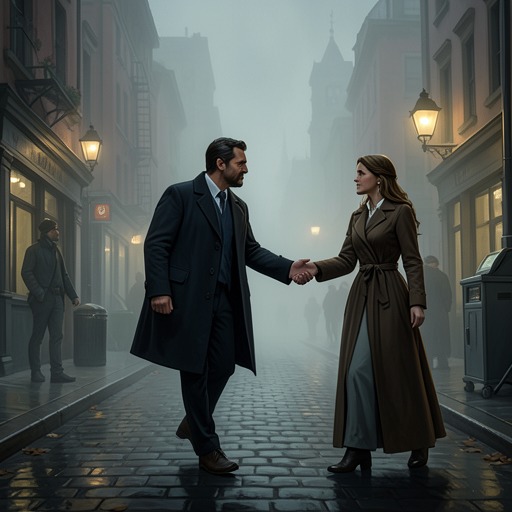
Stalking isn't romantic
My Vampire Love (Completed)“Stalking isn't romantic” is a recurring expression associated with Jenifer Kate Lawrence and Eric Wilson’s uneasy movement from suspicion toward intimacy. It first functions as a rebuke: Eric’s attention is intrusive, his knowledge of Jenifer is unsettling, and his claim that he wants to know her does not erase the imbalance created by watching and investigating her. As the relationship develops, however, the same wording returns in a lighter register, becoming an inside joke that preserves Jenifer’s independence even while acknowledging Eric’s continued fascination.
First Use as a Boundary
The expression appears after Eric notices Jenifer staring at him. He tells her to stop because her behavior is “stalkerish,” but the accusation is immediately complicated by her answer: she is not merely looking at him briefly; she is looking at him “continuously.” The exchange reverses the expected positions of watcher and watched. Eric speaks as though he controls the interaction and expects obedience, while Jenifer’s deliberately excessive reply exposes the theatrical quality of his command. The phrase that later crystallizes this tension therefore belongs to a conversation in which both characters are testing how much attention the other will admit to giving.
Eric’s conduct confirms why the expression carries force. When he greets Jenifer with a knowing, almost sad expression, she instinctively puts on her practiced emotional mask and becomes the cold, hard version of herself that she believes allows her to survive. Eric explains that he has been there for exactly five minutes because her mother sent him to collect her, although he also admits that he became distracted. Jenifer’s response, “Stalking isn't romantic,” identifies the contradiction directly: his attention may be framed as concern or attraction, but it still feels like surveillance. The line is concise because it refuses to let romantic language excuse invasive behavior.
Investigation and Repetition
The expression gains a second layer when Eric reveals that he has examined Jenifer’s books. He remembers the drawings on her old blue jeans in unusually specific detail: a slanted, upside-down red rose that seemed to be falling, a black widow, and the words “Fatal Beauty.” He has also noticed additional drawings at the backs of her books. Jenifer narrows her eyes and asks whether he went through them; Eric answers yes, without shame, explaining that he wanted to get to know her.
That explanation does not remove the violation. Instead, it makes the expression more exact. Eric’s method of approaching Jenifer is not passive admiration but the collection of private signs: clothing, drawings, and details she has not chosen to explain to him. His desire for knowledge is genuine within the scene, but the route he takes toward it is intrusive. Jenifer therefore repeats the phrase in a teasing form—“Have I ever told you that stalking is not romantic?”—which softens the confrontation without surrendering its accusation. The recurrence marks a negotiation: she permits playfulness, but she continues to name the behavior on her own terms.
From Rebuke to Shared Joke
Eric remembers that Jenifer has said this before and calmly acknowledges it. His willingness to recognize the repetition changes the line’s social function. At first, it is a defensive warning directed at someone whose presence and attention make her uneasy. Later, it becomes a shared reference that both characters understand. Jenifer is still annoyed, but not enough to ruin the mood; the expression can now carry irritation and flirtation simultaneously.
This tonal shift does not mean that the original boundary disappears. Rather, the line allows Jenifer to remain verbally in control while participating in the attraction she is beginning to feel. Eric’s persistence is rendered comic because she can answer it, expose it, and make it part of their private vocabulary. The repeated wording thus records a change in their relationship without pretending that the underlying tension has vanished.
Relational and Thematic Function
The expression’s central irony lies in the gap between its literal judgment and its later romantic context. It rejects the idea that stalking should be mistaken for courtship, yet it is spoken inside a relationship increasingly shaped by attention, memory, and pursuit. Eric’s ability to recall the rose, the black widow, the “Fatal Beauty” inscription, and the drawings hidden in Jenifer’s books demonstrates how closely he has been observing her. Jenifer’s repeated response makes that observation visible instead of allowing it to pass as an innocent sign of affection.
The phrase also belongs to a larger pattern of approach and withdrawal. Eric asks whether he may ask Jenifer something, and she jokes that he should stop asking because the question makes her want to run away screaming. He then asks why she has been distant, while she pretends not to understand what he means. These exchanges place the expression within a recurring pursuit-and-deflection structure: Eric seeks access to Jenifer’s guarded interior life, and Jenifer answers through sarcasm, evasion, or a sharply defined boundary. “Stalking isn't romantic” is the most compact version of that structure, turning surveillance into a subject the characters must consciously negotiate rather than a behavior automatically rewarded by the narrative.