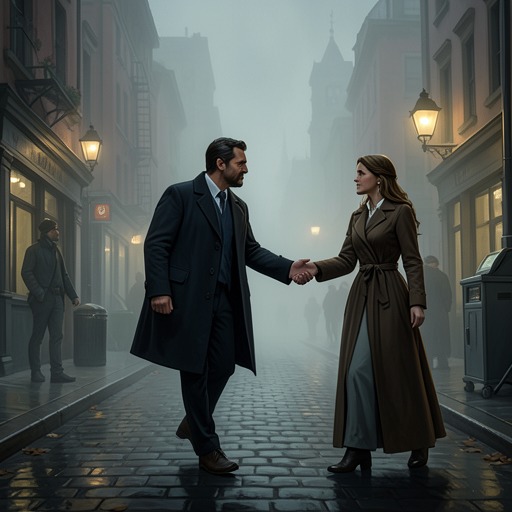
The Hawaii Trip and Eric’s Proposal
My Vampire Love (Completed)The Hawaii Trip and Eric’s Proposal is a turning point in Jenifer Kate Lawrence’s relationship with Eric Wilson. The journey initially appears to be an unexplained removal from ordinary life, but it opens into a carefully staged revelation: Hawaii resembles a place from Jenifer’s dreams, Eric’s blood has kept her alive through her medication, and her eighteenth birthday will bring an involuntary transformation into a vampire. Eric’s proposal therefore carries two meanings at once. It offers love and protection in personal terms, while also binding Jenifer more tightly to the arrangement imposed on her by the Wilson family.
Causes and Hidden Obligations
Jenifer’s marriage has already been determined by a bargain made before she could understand or consent to it. Doctors had given her only days to live, and Eric Wilson’s father supplied the medication that preserved her life on the condition that, when Jenifer reached seventeen, she would marry his son if Eric chose to do so. The arrangement converts medical rescue into a lifelong obligation: Jenifer understands that the alternatives presented to her were death in infancy or marriage to a stranger she might hate. Her parents insist that they had no choice, but the explanation leaves Jenifer feeling blank, cold, and physically threatened rather than grateful.
The pills themselves embody that bargain. When Eric gives Jenifer three small brown tablets supplied by his father, she refuses them despite his warning about what will happen. Later, alone in the bathroom, she drops three pills into the toilet; they dissolve and stain the water faint pinkish-red before she flushes them away. Her refusal is not merely a rejection of medicine. It is an attempt to reject the exchange through which her life has been purchased at the price of her future. Yet the cost is immediate: Jenifer knows that without the pills her body will begin shutting down, that a few more days may leave her bedridden, and that death might seem like an escape from pain, guilt, and heartbreak.
The Journey to Hawaii
Eric wakes Jenifer on an airplane but refuses to tell her where they are going. She arrives in a dark room beside him, then discovers the destination by opening heavy curtains. Outside lies a transparent greenish-blue ocean, warm sunlight, grass, towering trees, and a beach reached directly from the house. The setting is not simply unfamiliar; it is the house from Jenifer’s dream. Its baby-blue walls and white frames produce an intense sense of déjà vu, as though Eric has reached into her mind and reproduced a scene she had previously known only through sleep.
The dreamlike landscape temporarily suspends the ordinary world, but it does not release Jenifer from the forces governing her life. The beauty of Hawaii heightens the contrast between apparent freedom and hidden control. She has been carried across the world without being told the destination, and the idyllic house becomes the site where the most consequential constraints on her future are disclosed. The journey thus functions as both escape and enclosure: it removes Jenifer from familiar surroundings while bringing her closer to the truth about her body and her promised marriage.
The Proposal and the Choice
When Jenifer returns to the bedroom, Eric is kneeling before her with a small open teal velvet box. He tells her that he knows she is being forced into the relationship and does not yet love him, but says that he cares for her and that their first collision at school felt as though everything had fallen into place. He asks her to let him make her happy for the rest of her life and promises to love her, never take her for granted, and never hurt her.
The language of the proposal is deliberately gentler than the arrangement that makes it necessary. Eric acknowledges the coercion instead of pretending that the engagement is freely born, and he frames his own promise as an effort to transform an imposed future into a humane one. Nevertheless, Jenifer cannot experience the moment as an uncomplicated romantic choice. She is shocked, unable to move or breathe, and takes the ring from the box because she believes she has no choice. She places it on the bedside table rather than wearing it, climbs into bed, and turns away from him. Her response preserves the central contradiction of the scene: Eric offers tenderness, but the institution surrounding the offer still denies her freedom.
Blood, Awakening, and Political Stakes
The proposal becomes more intelligible after Eric explains what the medication really is. The pills contain his blood, reduced to a weaker form that heals Jenifer and keeps her alive without yet changing her. Katalin’s earlier reference to Jenifer consuming blood from one of the oldest bloodlines therefore refers to Eric. The medicine is not an ordinary treatment but a controlled form of vampire blood, making Jenifer’s survival dependent on the very supernatural system into which she is being drawn.
Eric identifies Jenifer as the first human who can be made into a true pure blood because of the illness with which she was born. That exceptional condition makes her simultaneously the most endangered human and the most protected one. She will change whether she wants to or not, and Eric explains that she must marry before she turns eighteen because that is when she will awaken as a vampire. The threat from the werewolves is consequently linked to her biological and supernatural potential: through Jenifer, stronger pureblood vampires may be produced, preserving the vampires’ position at the top of the food chain. The proposal is therefore personal only on the surface. Beneath the promise of mutual happiness lies a struggle over bloodline power, reproduction, and the future hierarchy of supernatural species.
Resistance, Reinterpretation, and Consequences
Jenifer explicitly states that she would rather be miserable and free than happy and trapped in a marriage she never wanted. This principle remains the moral pressure beneath the Hawaii scene. The trip does not erase her resistance, and the ring does not prove that coercion has become consent. Instead, the event places emotional attachment inside a structure Jenifer continues to distrust. Her later understanding changes when she recognizes that she is in love with Eric Wilson. The realization is expressed through bodily signs of attachment: she cannot sleep when he is absent, struggles to breathe when she does not know whether he is safe, and feels butterflies in her stomach. Love shifts from something imposed from outside to something she experiences as her own, even though it develops within the imposed arrangement.
The engagement is subsequently formalized through a ball announced on thick paper with elegant gold script and a black widow spider emblem. What began as a private proposal becomes a public family celebration, involving several hundred people and turning Jenifer’s disputed future into a social fact. At her eighteenth-birthday gathering, a baby-blue box and sealed letter from Daren are also presented to her; the gold hand band spelling her name in diamonds becomes a separate reminder of the attachments and losses that complicate her bond with Eric. By the wedding, Jenifer and Eric cut a ten-tier white cake, dance as husband and wife to “All My Life,” and enter the public identities of Mr. and Mrs. Eric Wilson. The Hawaii proposal is thus the scene in which the wedding’s emotional and political trajectory is set: a forced promise gradually becomes a chosen love, but never without the lingering cost of the freedom Jenifer was denied.