Vampire Blood Experiment Protocol
My Vampire Love (Completed)Vampire Blood Experiment Protocol is the governing method behind the attempt to create pureblood vampires artificially. Conceived as a response to the scarcity of naturally born purebloods, it treats blood, illness, pregnancy, awakening, and reproduction as instruments of supernatural statecraft. Jenifer Kate Lawrence is the experiment’s only living subject, and the protocol places her simultaneously in the categories of patient, protected asset, endangered human, and possible source of a future ruling bloodline.
Political Purpose and Species Hierarchy
The protocol begins with a struggle over supremacy among supernatural species. Eric Wilson explains that vampires currently rule because of the strength and authority of purebloods, but that this dominance is not permanent: power could pass to witches, shifters, or another species if the balance of numbers and force changed. The program was therefore created to ensure that vampires would remain at the top by increasing the number of purebloods, even though purebloods are ordinarily born rather than manufactured.
This objective makes the experiment more than a medical procedure. It is a population strategy intended to preserve a ruling order. The scarcity of purebloods is treated as a political vulnerability, and the creation of new purebloods as a way to make vampire supremacy durable. Jenifer’s body consequently becomes valuable not because the institutions recognize her personhood, but because it may secure the future of an entire species’ authority.
Experimental Methods and Failures
The initial attempts involved giving vampire blood directly to humans in carefully controlled quantities and at carefully controlled intervals. The procedure has sharply differentiated outcomes. Too much blood, administered too frequently, turns a human into a made vampire rather than a true pureblood. Too little may cause a coma or produce zombies. The protocol therefore depends on dosage and timing, with the danger that a small variation changes the intended result into a different form of transformation or death.
The experiment first tried to use pregnancy as the point of intervention. Mothers were injected with vampire blood while carrying fetuses, and later mothers received blood transfusions during the first three months of pregnancy. These approaches failed to produce purebloods; instead, they resulted in hybrid babies. The failures reveal that the desired transformation cannot simply be imposed from outside. The program requires a human body capable of participating in the creation of vampire blood cells while avoiding both hybridization and the ordinary consequences of excessive blood exposure.
Katalin’s decisive hypothesis was that a human who could somehow create vampire blood cells might eventually awaken once those cells became strong enough. Such a person could become a pureblood capable of full awakening rather than merely a made vampire. This changed the experiment from repeated conversion attempts into a search for a particular biological condition: a human body unable to produce its own blood cells, but able to generate vampire ones under sustained exposure.
Jenifer Kate Lawrence as the Living Subject
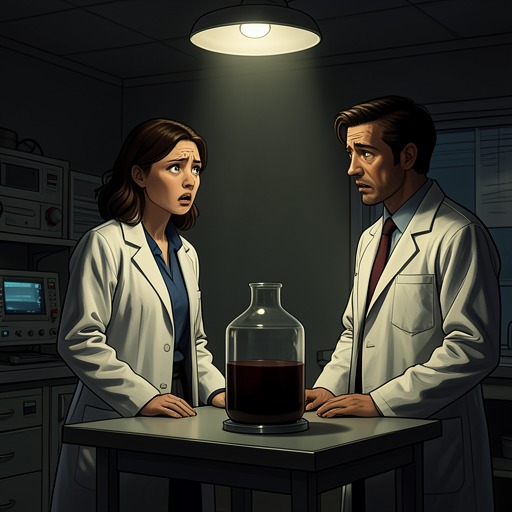
Jenifer’s severe aplastic anemia supplies the condition the experiment had been seeking. She explains that her bone marrow cannot produce blood, meaning that without her pills she could die from an ordinary infection such as the flu or bleed to death from a wound that would not normally be fatal. Her body produces neither red blood cells nor white blood cells nor platelets. What appears to be long-term medication is therefore part of the experimental system.
Eric reveals that the pills contain his blood in a reduced and weakened form. The medication has been confined to a state in which it can heal Jenifer and keep her alive, but it is not yet strong enough to transform her. Her treatment is thus also a concealed method of administering vampire blood. The distinction between care and experimentation collapses: the substance sustaining her life is the same substance preparing her body for a supernatural awakening.
Jenifer is the first living subject who fits the protocol’s requirements. Earlier human subjects died, while other procedures produced failed outcomes. Her illness made her uniquely useful because her body did not make ordinary blood cells; the vampire blood could therefore become the operative source within her system. The condition that makes her medically vulnerable also makes her politically indispensable. She is described as the most endangered human and, at the same time, the most protected one, a contradiction produced directly by the experiment’s logic.
Awakening, Marriage, and Reproduction
The protocol is tied to the pureblood awakening age. Before eighteen, the vampire blood in Jenifer’s body remains dormant enough for her to live as apparently human. At eighteen, pureblood blood awakens and produces greater strength, speed, and physical superiority. Katalin expects Jenifer to undergo this awakening, which would confirm the experiment’s intended result: the creation of a fully awakened pureblood vampire from a human subject.
This timetable explains why Jenifer must marry Eric Wilson before her eighteenth birthday. Eric’s blood already runs through her veins, and he tells her that their child would be a pureblood—the strongest and purest kind—if her awakening occurs as expected. The arranged marriage therefore operates as part of the experiment’s reproductive design. Jenifer is not merely being converted; she is being positioned to continue the bloodline and produce a successor capable of reinforcing vampire supremacy.
The same prospect makes Jenifer a target for enemies of the vampire order. Eric confirms that werewolves want her dead because her successful awakening could allow vampires to create stronger purebloods and remain at the top of the supernatural hierarchy. Her survival is consequently treated as a strategic necessity, while her future child is imagined as a biological guarantee of continued rule.
Rules, Protection, and Institutional Force
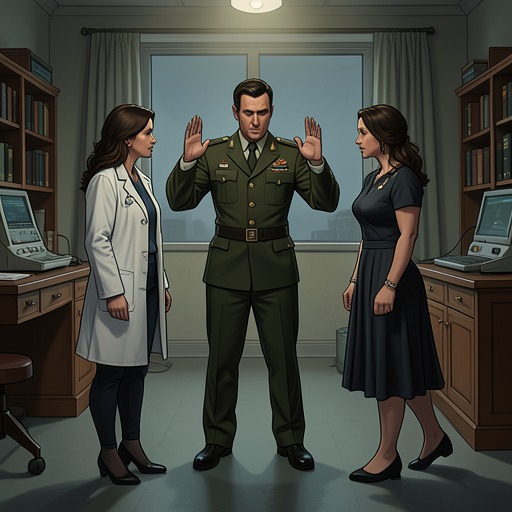
The experiment functions within several overlapping supernatural laws, but those laws do not consistently protect Jenifer. Eric tells Katalin that she is not permitted to touch him and would not dare harm Jenifer because of the blood in Jenifer’s veins. Katalin counters that her superior status as heir to the throne places her above Eric, and that Eric’s bloodline could continue through Christy Wilson even if Eric died. The exchange exposes the hierarchy that determines when law is binding and when rank overrides it.
Jenifer is also assigned protection from Underworld affairs. Dean and his pack are ordered to watch her, although Eric distrusts Dean because he belongs to the opposing supernatural group and fears that the assigned guardians could turn against them. The protection order does not grant Jenifer freedom; it makes her an object of surveillance and custody. Her safety is managed according to political priorities rather than her consent.
The treatment of werewolves illustrates the wider system of coercion surrounding the protocol. Werewolves are described as cursed humans who transform during the week of the full moon and lose control to bloodlust. Underworld law calls them the cursed species and requires that they be killed on sight. The same legal order that protects Jenifer as a valuable experimental subject authorizes the immediate destruction of another group deemed uncontrollable. In both cases, supernatural law classifies bodies and assigns them a permissible fate.
Katalin’s authority finally becomes physical at the Wilson family engagement ball. After the doors slam and the vampires bow, she uses her shield to force the room to empty, leaving Jenifer isolated with her family, Eric, and the Wilsons. Her command that everyone arise and leave demonstrates how ceremony, rank, law, and violence merge around the people responsible for the experiment. Jenifer feels caged because the protection surrounding her is inseparable from confinement.
Significance and Consequences
Vampire Blood Experiment Protocol gives the book’s supernatural politics a biological foundation. Vampire supremacy is not presented as a fixed natural order; it is maintained through controlled blood, selective breeding, experimentation, and the management of awakening. The protocol turns scarcity into a reason for intervention and turns a sick child into a solution to an imperial problem.
Its central contradiction is that Jenifer must be preserved as a person while being treated as material. Eric insists that she is someone, not something, and calls her the most important person there is, yet the surrounding institutions value her precisely because her body can produce an unprecedented pureblood result. His personal attachment does not erase the system’s instrumental logic; it instead reveals how affection and possession can coexist within it.
The protocol also transforms the meaning of medicine. Jenifer’s pills are not simply medicine, and her illness is not merely a private hardship. Aplastic anemia becomes the biological condition through which vampire blood can be cultivated, while treatment becomes a controlled path toward transformation. The experiment’s greatest consequence is therefore not only the possible creation of a new pureblood vampire, but the redefinition of illness, protection, marriage, and childbirth as mechanisms for preserving political power.