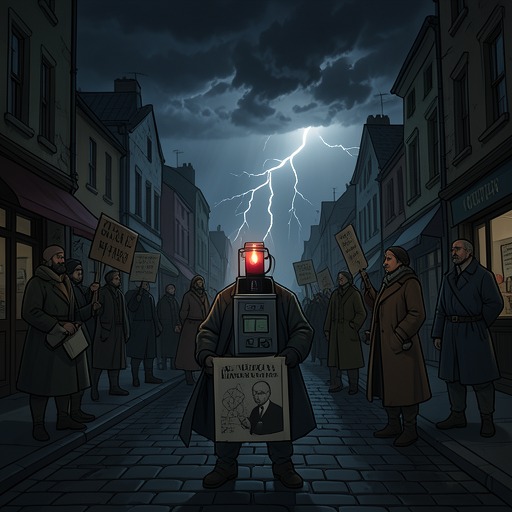
“The white folks … down here in my stomach”
Native SonBigger Thomas’s image of white people lodged inside his body gives racial oppression a private, physical form. In a conversation with Gus, he rejects the idea that white people live only across a neighborhood boundary: he strikes his solar plexus and says they are “Right down here in my stomach.” The metaphor makes segregation more than a line on a map; it registers as an inward pressure that Bigger carries with him.
First Appearance: A Boundary Turned Inward
Gus initially points east toward Cottage Grove Avenue when Bigger asks where white people live. Bigger answers by doubling his fist and striking his solar plexus. His gesture shifts the exchange from geography to bodily experience: the force of the color line is felt within him, not held at a safe distance across town. Gus looks at him searchingly, then away, apparently ashamed, before quietly acknowledging that he understands.
Bigger makes the feeling recurrent rather than momentary: “Every time I think of ’em, I feel ’em.” Gus extends the image to the chest and throat, and Bigger says, “It’s like fire.” The exchange associates the pressure with bodily intensity and constriction; Gus adds that sometimes it is hard to breathe. Bigger’s wide, placid gaze leaves the thought suspended rather than resolving it. The scene offers no detached explanation: its meaning emerges through the movement from question, to fist, to shared recognition.
From Personal Feeling to Housing Policy
The courtroom later gives this inward pressure a concrete institutional setting. In questioning Mr. Dalton, Max asks why the Thomas family and other Black families are charged more rent than white families for comparable houses. He also asks whether the company’s policy keeps Black residents in one area of the South Side. Mr. Dalton acknowledges that it works that way, while denying that he originated the policy. The exchange distinguishes individual responsibility from a housing system whose effects persist beyond any one person’s stated intentions.
Max sharpens that contrast by setting Dalton’s charitable giving beside the rents charged for unsafe housing, asking why the company does not reduce those rents and account for the difference through its charity budget. The questioning makes the earlier image newly legible as more than a private sensation: the boundary Bigger feels is maintained through material arrangements governing where Black families can live and what they must pay.
Max’s Courtroom Argument
In his plea, Max urges the court to see Bigger’s life within a larger pattern of social restriction, rather than treating the case as an isolated individual tragedy. He describes Black people being directed where to live, how much schooling they can receive, where they can eat, and what work they can do. His account connects imposed boundaries to curtailed opportunity: people are taught and encouraged to develop aspirations, then confronted with limits on acting upon them.
Max also points to segregation inside the courtroom itself. Black spectators sit together behind a railing, he argues, not because anyone explicitly ordered them there but because they know they are not wanted on the same bench as white spectators. That visible division echoes Bigger’s inward image: exclusion is both an arrangement of space and a pressure absorbed into daily awareness. Max describes Black Americans collectively as a separate, captive nation within the country, extending the case from one man’s experience to a system affecting millions.
Significance and Limits of the Image
The expression’s force comes from its compression. A question about where white people live becomes an account of how their presence is experienced; the fist makes the metaphor bodily, while the references to fire, chest, throat, and breath show its reach beyond a single phrase. Gus’s response makes the feeling partly shared, but the scene remains anchored in Bigger’s own account.
The later courtroom material does not repeat the stomach image. Instead, it supplies a public vocabulary for the pressures the image renders intimate: discriminatory rents, residential confinement, unequal access, and separation even within the court. Read together, the private exchange and Max’s argument place an embodied feeling beside its institutional conditions without making them identical. The metaphor names the felt pressure; the courtroom testimony and plea identify social practices that help produce it.