Bigger Thomas’s death-row confinement
Native SonBigger Thomas’s death-row confinement turns a court sentence into a narrowing daily reality: a fixed deadline, an isolated cell, and the effort to keep thought and feeling at bay. Although he tries to prepare himself for execution by imagining a world emptied of ordinary time, his longing to join other people remains. The confinement is therefore both physical and inward, marked by his resistance to consolation and by the human connection he cannot entirely put aside.
Sentence and Conditions
The court specifies the terms that govern Bigger’s remaining life. In case number 666–983, on an indictment for murder, the judge sentences him to die by midnight on Friday, March 3, by the method prescribed by state law. The court also records his age as twenty. The judge invokes the unprecedented disturbance of the public mind as the reason the court’s duty is clear; the sentence thus arrives not simply as a personal judgment but amid a wider public crisis. As it is pronounced, Bigger gropes for the table’s edge and clings to it. The gesture registers his immediate physical response to a future stated with bureaucratic precision.
After the sentence, the sheriff may leave with the prisoner. Bigger’s confinement is no longer an indefinite wait: it has a final hour attached to it. The date and midnight deadline organize what follows, while the state’s prescribed method makes death an institutional procedure rather than an uncertainty about the court’s decision. The narrative stays close to Bigger’s experience of that imposed timetable, showing how a legal sentence reaches into sleep, eating, memory, and anticipation.
Isolation and Self-Protection
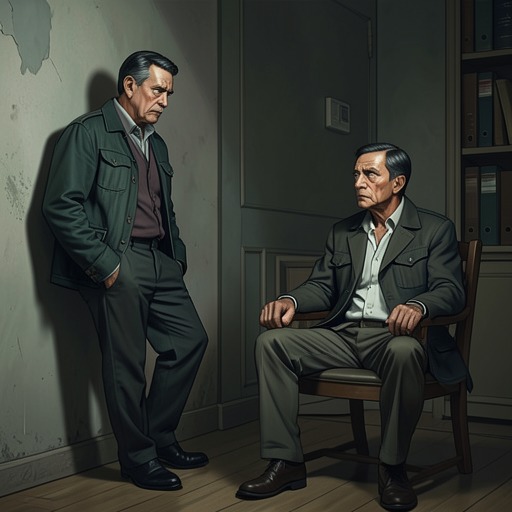
When Max’s hand leaves his arm and the steel door closes, Bigger knows that he is alone. He does not move. He lies still, crossing his hands on his chest, as if stillness might prevent him from feeling or thinking; his lips move in a whimper. His response is not composure but an effort to suspend awareness. The closed cell offers no escape from the sentence, but stillness becomes a temporary defense against taking in what it means.
He deliberately shuts the world outside his cell out of his mind. Rather than imagine the passing of night and day, the sun, moon, stars, clouds, or rain, he pictures the world beyond as a vast grey land without either night or day. Its inhabitants are strange men and women he cannot understand, yet he longs to mingle with them once before his death. The imagined landscape is both a withdrawal from ordinary life and an image of the company he still wants. His confinement intensifies this contradiction: he tries to cut himself off from the world, but cannot stop desiring a place among other people.
The sentence also disrupts ordinary routines. Bigger does not eat willingly; he forces food down to stave off hunger and dizziness. He does not sleep in a continuous stretch, but closes his eyes at intervals and resumes brooding when he opens them. He wants to escape everything that stands between him and the end, including the thought that his life may finish without meaning or resolution. His body continues to require food and rest even as he tries to reduce himself to someone waiting for execution.
Refusal of Consolation
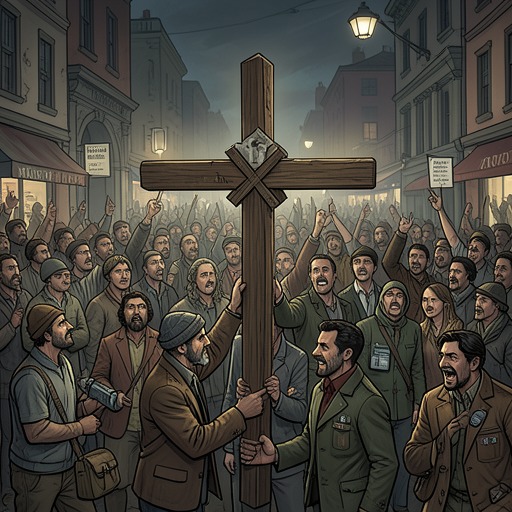
Bigger’s family visits, but he tells his mother, brother, and sister to stay home, stop coming, and forget him. The gesture cuts off contact with those closest to him, though it does not demonstrate that he has ceased to feel their absence. The Black preacher who previously gave him a cross also comes to see him, and Bigger drives him away. When a white priest attempts to persuade him to pray, Bigger throws hot coffee in the priest’s face. The priest later visits other prisoners but no longer stops to speak with him.
That withdrawal has an unexpected consequence for Bigger’s sense of himself. He understands the priest’s absence as evidence that his refusal has made the priest wonder about his motives. In being treated as someone whose rejection calls for interpretation, rather than simply as a recipient of religious consolation, Bigger feels a measure of recognition. He connects that feeling to the sense of personal worth Max had awakened during their long conversation. The episode shows that his resistance is not only a rejection of religious comfort: it also becomes, for him, a way of asserting that his choices and motives cannot be easily settled by someone else.
The Deadline and Its Approach
As the final day nears, Bigger grows thin and his eyes redden. He wants to talk to Max more than before, but cannot find words for the feeling that occupies him. The desire for a listener persists even when he believes he cannot explain what he is experiencing. On the day before his execution, a guard passes a telegram from Max through the bars. It reports that the governor has failed to act and that Max has done everything possible, while promising to see Bigger soon. Bigger compresses the telegram into a knot and throws it into a corner. The message confirms that an effort to avert the sentence has failed; his response refuses, at least for that moment, to keep the message close.
With execution expected by midnight, Bigger fixes on the remaining hours and on what he has been told will happen before he is taken away. He has heard that, six hours before the appointed time, he will receive other clothes, be taken to the barber shop, and then moved to the death cell. A guard has also described the interval between leaving the cell, receiving the black cap, and dying. Bigger treats this account as something he can endure, and forms a plan for the handling: flex his muscles, close his eyes, hold his breath, and think of nothing until the electric current ends his life. The plan turns an incomprehensible event into a brief sequence of actions he can try to control.
Yet the approach of execution defeats complete detachment. Bigger lies on his cot looking at the small electric bulb and imagines the death associated with it reaching him while he sleeps, before the planned transfer and procedure. The wish underscores the limit of his preparations: he can rehearse how not to think during the execution, but he cannot make its anticipation disappear. His confinement ends the passage with the deadline still ahead, his defenses still in place, and his longing for connection unresolved.