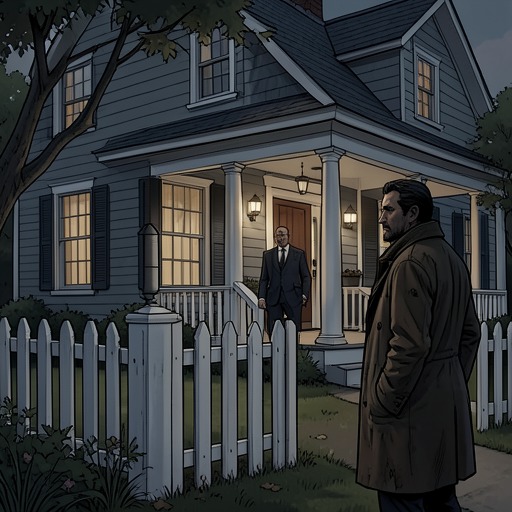
Bigger Thomas’s hiring by the Daltons
Native SonBigger Thomas’s hiring by Mr. Dalton is both a concrete offer of work and an entrance into a household whose generosity is later measured against its economic power. The job promises wages, food, and shelter, and assigns Bigger daily driving duties for the family. At the same time, later courtroom questioning connects the employment relationship to a wider arrangement in which the Dalton family’s charity coexists with high rents and the confinement of Black residents to the South Side.
The Offer and Its Terms
Mr. Dalton offers Bigger a job as the family’s driver after discussing whether he would steal if he had work. Bigger answers that he does not steal, then gives brief, respectful replies as Mr. Dalton asks whether he can drive and handle the position. The exchange presents employment as an alternative to theft, but the offer is made by a wealthy landlord and employer to a young man whose family needs income and stable housing.
The stated pay is $20 a week, but Mr. Dalton offers $25, specifying that the extra $5 is for Bigger to spend as he likes. The family will also provide the clothes he needs, meals, and a place to sleep in the back room above the kitchen. Mr. Dalton proposes that Bigger give the $20 portion to his mother so she can keep his brother and sister in school. In this arrangement, wages are divided between personal spending and the support of the family; food and lodging are supplied by the employer, rather than described as additional cash pay.
Work and Household Access
The job comes with a defined schedule and makes Bigger responsible for several kinds of driving. Mr. Dalton says he leaves for his office at nine and expects Bigger back by ten to take Mary Dalton to school. At noon, Bigger is to collect her from the University at Midway. After that, he is more or less free until evening, except when either Mr. Dalton or Mary needs a driver. Bigger works every day; on Sundays, the household’s late start usually leaves him the morning to himself unless something unexpected happens. He receives one full day off every two weeks.
Once Mr. Dalton decides that Bigger will do, he summons Peggy, identifies Bigger as the new driver, and asks her to give him something to eat and show him where he will sleep and where the car is. He also instructs Bigger to drive Mary out to the university at eight-thirty and wait for her. These practical arrangements turn the offer into immediate access to the Dalton household, its car, and its routine. The position is not merely a promise of future wages: it sets out where Bigger will sleep, what he will eat, and how his working day will be organized.
Employment and the Housing Order
The significance of the hiring changes when Mr. Dalton’s business practices are challenged at the inquest. Asked who formulates the policies of the companies, he answers that he does. The questioning then connects the Thomas family’s housing to the Dalton companies’ treatment of Black tenants: why, it asks, do Black families pay more rent than white families for similar houses? Mr. Dalton replies that he does not set the rent scales and invokes supply and demand as the regulator of housing prices.
The questioning makes the material circumstances behind the job offer impossible to separate from the household’s charitable gestures. Max points to the $8 weekly rent charged to the Thomas family for one unventilated, rat-infested room shared by four people, while also raising Mr. Dalton’s donations to Black education. Mr. Dalton’s account of the rent system and the challenge to his charitable record therefore stand side by side: the family may offer Bigger wages and meals, while the Thomas family remains a tenant paying a substantial rent for crowded accommodation.
Charity, Power, and the Event’s Afterlife
The inquest and trial retrospectively place the hiring inside a relationship structured by landlord and tenant, merchant and customer, employer and employee. Max argues that the Dalton family’s wealth and the Thomas family’s poverty are linked to that unequal relationship, and that donations do not undo its effects. He also confronts Mr. Dalton with the consequence of company policy: it tends to keep Black residents in one area of the South Side. Mr. Dalton acknowledges that the policy works that way, while distancing himself from having originated it.
That later interpretation does not erase the practical value of the original offer: the job includes wages, food, clothing, lodging, and money intended to help keep Bigger’s siblings in school. Instead, it sharpens the contrast between assistance to an individual worker and the housing system affecting his family. The hiring gives Bigger a place in the Dalton household as an employee, yet, in Max’s account, the same employer’s real-estate practices help keep him socially and spatially separate from the people for whom he works. The event thus carries two meanings at once: a real opportunity within the terms Mr. Dalton sets, and an example of how personal generosity can coexist with an unequal structure that it does not itself change.