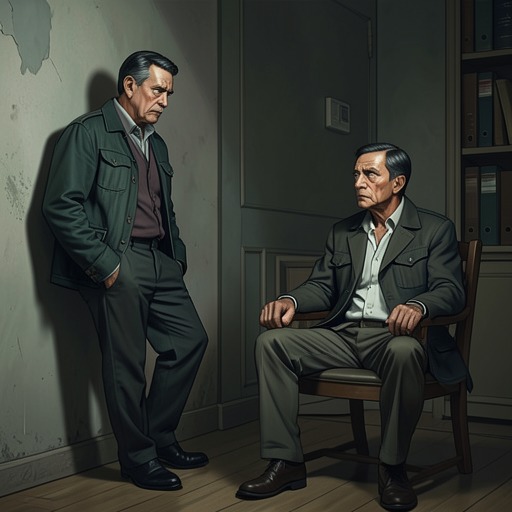
Bigger Thomas’s interview with Boris Max
Native SonBigger Thomas’s first interview with Max is a turning point in how he understands his own life: under questioning from the lawyer who will defend him, he moves from distrust and guarded silence to an account of fear, racial division, frustrated ambitions, and the brief freedom he associated with his crimes. The meeting does not resolve his guilt or promise escape from punishment. Its consequence is more unsettling: for the first time, Bigger feels that someone has recognized him as a person, and he begins to imagine a connection with others that he has spent his life fearing.
The Meeting and Its Uneasy Beginning
After his capture, Bigger is handcuffed and taken down a hall to a small room where Max is waiting. Once the handcuffs are removed, Bigger enters and the door closes behind him. The interview takes place in a confined setting: a single electric globe hangs above them, one window is barred, and the room is quiet. Max asks how he feels, but Bigger does not answer. The lawyer’s presence initially sharpens rather than relieves his uncertainty. Bigger feels that he is once again waiting for someone else to tell him what to do, and he resents his own dependence.
Max asks Bigger to tell him about himself. Bigger responds that there is no use in Max doing anything, a refusal that reveals how little he expects from help. Max persists by asking questions rather than demanding an immediate explanation. He tells Bigger that he faces a broad current of hatred like the hostility he has encountered throughout his life, and argues that resisting his destruction matters beyond his individual case. Bigger answers that he cannot win. Max then asks whether Bigger trusts him, making trust itself an issue in a conversation shaped by Bigger’s expectation of rejection.
Max also explains that he, too, is a target of hostility because he is trying to help Bigger. People have sent him letters and called him an anti-Jewish slur. This disclosure complicates Bigger’s view of the interview: Max is not presenting himself as untouched by prejudice, but as someone who risks hostility by representing him. When Max says that the State’s Attorney gave him a copy of Bigger’s confession, he asks whether it was true. Bigger confirms that it was, saying he had no other course. The interview therefore begins with the facts of the case already in view, but moves beyond the confession toward the conditions and feelings that it cannot explain on its own.
From Confession to an Account of Motive
Asked whether he had been thinking about committing such acts for a long time, Bigger says that he had not. Asked how it happened, he cannot supply a considered plan or a logical sequence; he says it simply happened. When Max asks whether he is sorry, Bigger’s answers expose a gulf between legal responsibility and the feelings he can name. He says he hated Mary Dalton, and later says that he is not sorry she is dead. These admissions do not amount to a defense of what he did. They show that he cannot make his experience fit the moral explanation Max is seeking.
Bigger says Mary Dalton did nothing to him, yet recalls that her questions and manner made him feel diminished and angry. She wanted him to describe how Black people lived and moved into the front seat of the car where he was. To Max, this behavior was an effort to treat Bigger as another human being. Bigger rejects that interpretation. In his understanding, Black and white people live apart, and the racial order makes a white woman’s approach dangerous as well as confusing: he knows that Black men can be punished for contact with women like her. Her apparent kindness therefore does not reach him as kindness. The interview lays bare a collision between Mary Dalton’s attempted familiarity and Bigger’s learned expectation that crossing racial boundaries brings danger.
As he tries to explain his response, Bigger recalls an earlier, painful episode involving his sister Vera. He sees her crying after he had shamed her by looking at her, and remembers her throwing a shoe at him. The memory does not give him a neat rationale for his hatred of Mary Dalton; instead, it shows his explanation breaking into association and unresolved feeling. Bigger recognizes that his actions do not appear logical, but he cannot replace those feelings with a coherent account. Max’s questions make that difficulty visible without making it disappear.
Restricted Possibilities and the Meaning of Action
Bigger’s account widens from the encounter with Mary Dalton to the restricted life he believes has formed him. He describes moving from one poorly paid job to another, doing work such as shining shoes and sweeping streets, without knowing when he might be dismissed. The uncertainty and low wages, as he describes them, leave him unable to hope for much and make him feel that he is working to sustain a world in which other people live freely. His complaint is not simply that he lacks a particular job; it is that other people set the limits of what he may do, while his own labor gives him little control over his future.
He remembers wanting to become an aviator. A school had been built for aviation training, but access was restricted by a boundary that admitted only people living within its designated area, keeping Black boys out. The blocked ambition gives a concrete shape to his account of exclusion: the possibility existed, but a rule about where he could live denied him entry. He also says that he once wanted to join the army, though the interview does not develop that wish further. Together, the ambitions he can name and the work he describes make clear the contrast between his imagined capacity and the narrow choices he experienced.
Max points out that Bigger did something, even while describing what he could not do: he committed crimes and killed two women. Bigger struggles to say what he thought he would gain. He explains that, for a short time, he felt free and felt that he was doing something, although he knew it was wrong. He connects his actions to being scared and angry, feelings he says had accompanied him throughout his life. After the first killing, he says, he was briefly no longer afraid. The interview thus distinguishes the immediate sensation of agency from actual freedom: crime gave him a short-lived feeling of action, but left him facing punishment and unable to undo the deaths of Mary Dalton and Bessie.
What the Interview Changes—and What It Cannot
When Max leaves, Bigger returns to his cell. Only then does he understand how much he has said. He has spoken to Max in a way he has never spoken to anyone, not even to himself, and talking has eased a heavy burden. His relief is unstable: he wonders whether Max tricked him, then recognizes that Max did not compel him to speak. Max asked questions and listened; Bigger answered from his own excitement and curiosity about his feelings. The sequence matters. The easing comes not from a promise of acquittal but from having his words received without being forced from him.
Bigger understands that Max needs facts to present to the judge, yet remembers experiencing the questions as recognition of his life, feelings, and person. That recognition briefly allows him to consider whether people who hate him might share something human with him. Max’s willingness to help, despite the hostility directed at him, and Bigger’s knowledge of Jan make the possibility more than an abstract idea. But the thought brings both hope and fear: if the people he has imagined as a vast, hostile force are individuals like himself, then connection may be possible, while the depth of his prior hatred and isolation becomes harder to face.
The interview does not erase Bigger’s responsibility or his awareness that he may die. Instead, it changes what he wants to know. He begins to want to live long enough to understand this new feeling of relation to other people, not to escape payment for his crimes. The realization arrives under the pressure of his imminent trial and death, and he recognizes that there may be too little time to test it. In the cell, he grips the bars and sobs that he does not want to die. The interview’s consequence is therefore neither simple redemption nor a settled conversion: it is a fragile, urgent desire for life and understanding, opened by a conversation in which Bigger is heard.