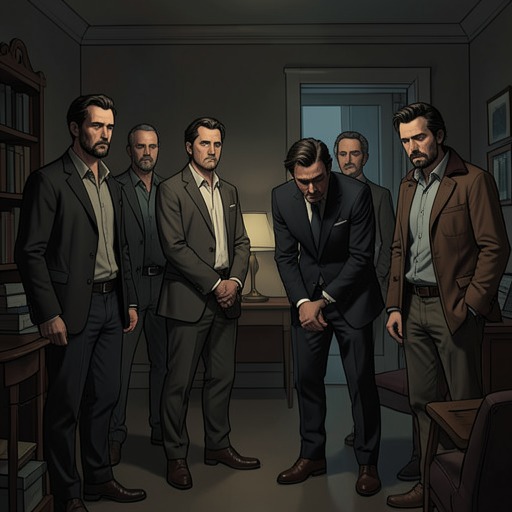
Bigger and His Gang Plan the Blum’s Robbery
Native SonBigger Thomas and His Gang Plan the Blum’s Robbery is an intended hold-up that reveals how urgent poverty, fear, and racial boundaries shape Bigger’s choices. The four young men devise a quick assault on Blum’s Delicatessen, but their preparations end without a robbery: Bigger’s attack on Gus breaks up the group before they act. The episode makes the proposed theft more than a scheme for cash. It is also a test of whether the gang will cross a line they have long regarded as dangerous, and whether Bigger can face that danger alongside his companions.
Need, Opportunity, and the Target
The plan grows out of Bigger’s immediate need for money. After counting his change, he has twenty-six cents, with fourteen cents to reserve for carfare to Mr. Dalton’s if he accepts the job. To buy a magazine and go to the movies, he would need at least twenty cents more. The movie offers an easy escape into dreams, but he cannot afford even that modest diversion. He stands watching traffic and passersby, unsure how to occupy the day without more money.
He considers meeting Gus, G.H., and Jack because their long-discussed scheme could bring in a substantial sum quickly. Their target is Blum’s Delicatessen, and their chosen window is between three and four in the afternoon, when no policeman is assigned to that block. The plan relies on timing and divided responsibilities: one gang member watches outside, one keeps Blum from calling out, another takes the cash from the box beneath the counter, and another opens the back exit. The four intend to lock Blum inside, escape through the alley, and meet an hour later at either Doc’s Poolroom or the South Side Boys’ Club to divide the money.
Bigger describes the job as one that should take less than three minutes. The stated speed and precise division of tasks make the plan sound controlled, but its apparent simplicity conceals its greater risk. The gang has previously robbed newsstands, fruit stands, and apartments; it has not held up a white shopkeeper. Earlier, its members had generally targeted Black people, believing that white police would not search as diligently for Black offenders when the victims were Black. A robbery at Blum’s would therefore depart from their established practice and invite what they understand as the full response of a hostile white world.
A Forbidden Boundary
The gang’s hesitation is not simply uncertainty about how to carry out a robbery. For months, its members have discussed Blum’s without acting, and they regard the target as a crossing into territory where white power may be brought forcefully to bear. The proposed hold-up would be their first against a white man, and Bigger presents that difference as precisely what makes the job consequential. For the young men, the theft would be both a practical attempt to get money and a symbolic challenge to the racial order surrounding them.
When G.H. asks whether Bigger has worked out the details, Bigger lays out the timing, positions, cash box, and escape route. G.H. objects that they had agreed not to use a gun and reminds him that they have never bothered white people. Bigger answers by treating the target as something larger than their previous offenses. His confidence in the plan’s mechanics contrasts with the fear the others express about its meaning. The scheme promises a kind of daring, but the gang’s own history has taught them that crossing the racial boundary may carry consequences beyond the immediate crime.
The Plan Breaks Before the Robbery
The decisive reversal comes when Bigger sees Gus approaching Blum’s. He feels sick, stiffens, and does not know what he is about to do. Gus enters, greets him, and starts toward the rear tables; Bigger turns and kicks him. The assault abruptly replaces the planned action against Blum. Bigger then laughs, first softly and then hysterically, while the others look on. Gus rises and stands quietly, his expression marked by hatred.
Afterward, Bigger confronts Doc, shuts his knife, puts it in his pocket, and leaves the poolroom. He is frightened, tense, and struggling to breathe easily. As he passes Blum’s, he looks through the window and sees Blum alone, with no customers in the store and no policeman in sight. The opportunity has not disappeared: Bigger recognizes that the gang still could have carried out the robbery and escaped. That recognition sharpens the significance of his earlier conduct. He has lied to Gus, G.H., and Jack, and the fight has prevented them from seeing what he was trying to hide.
The quarrel nevertheless gives Bigger a temporary sense of equality. He feels equal to the others and to Doc, whom he has also dared to respond to him after damaging the poolroom’s table. His apparent assertion of himself is therefore inseparable from the plan’s failure: instead of facing the shared risk of the robbery, he has disrupted the group and substituted a personal confrontation. He then turns into an alley, cries after laughing, pauses, and walks on alone, depressed. The episode closes not with money gained or a successful escape, but with Bigger returning home and sitting by the window.
The Wider Structure of Opportunity
Later testimony about the Thomas family’s housing gives the episode a wider economic context. During the hearing, questions put to Mr. Dalton draw attention to the rent charged to Black families: the Thomas family pays eight dollars a week for one unventilated, rat-infested room shared by four people. Mr. Dalton attributes rent prices to supply and demand, while the questioning also raises his real-estate company’s role in keeping Black residents concentrated on the South Side. These facts do not establish that the rent directly caused the robbery plan, but they show the material conditions surrounding Bigger’s scarcity and the sharply unequal choices available to the two families.
In his later courtroom argument, Max links the Daltons’ housing practices to the separation between Bigger and Mary Dalton: the family rents to Black people in the Black Belt while refusing to rent to them elsewhere, keeping Bigger within a restricted world and Mary a stranger to him. He also sets Mr. Dalton’s philanthropy against the profits and conditions produced by that arrangement. Read beside the failed Blum’s plan, this argument clarifies the contrast between personal acts of daring and the larger structures that circumscribe them. The robbery is imagined as a brief crossing into white-controlled territory; the gang’s fear, Bigger’s rupture with his companions, and the enduring housing boundary reveal how little a single planned act can alter the conditions in which it arises.