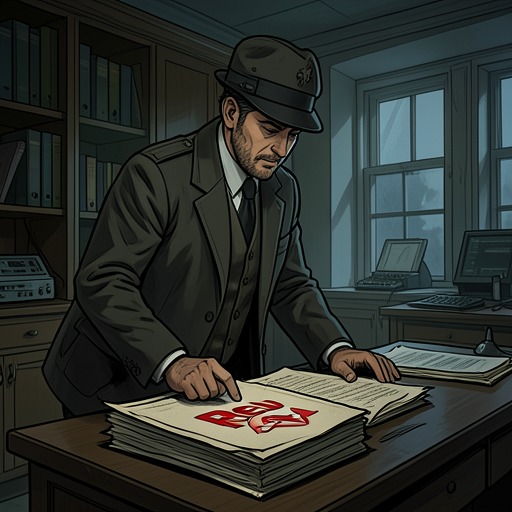
Bigger's gun
Native SonBigger's gun is at first hidden close to Bigger and treated as a safeguard against being proved responsible; later, when he encounters Jan, it becomes an unmistakable threat that makes Jan stop and retreat. Its movement from shirt to pillow and back into Bigger's hand traces a shift from private concealment and imagined security to open coercion. In the available scenes, the gun does not fire: its force lies in what Bigger believes its concealment can protect and what its display makes Jan fear.
Physical Presence and Concealment
After returning home, Bigger feels something heavy sagging in his shirt and takes the gun out. It is warm and wet. The description gives the weapon a blunt material presence: it is not an abstract possibility but a weight against his body, something he must remove and decide where to put. Bigger shoves it under the pillow, then slips into bed beside Buddy and falls asleep. The sequence places the gun within the ordinary, crowded intimacy of the sleeping household, concealed close at hand rather than carried away or openly displayed.
The concealment is a deliberate action, but it does not make the gun disappear from Bigger's awareness. Its weight first interrupts his attempt to undress; putting it beneath the pillow gives it a new place in the room, close to the bed where he lies. That shift from shirt to pillow marks a change in how the object is kept, not an end to its presence. It remains available while the family sleeps, and the ordinary act of going to bed occurs alongside the hidden weapon.
A Guarantee Against Proof
The thought accompanying the concealment gives the gun a second function. Bigger tells himself, “They can’t say I did it. If they do, they can’t prove it.” The statement is not a claim that the weapon will establish his innocence; rather, the gun's hidden presence belongs to his effort to imagine that accusation cannot be made effective. The confidence is provisional, expressed as a private assertion while he places the object under the pillow. Concealment seems to offer control over what others can establish, though it does not undo what has happened or remove the weapon from his immediate surroundings.
The contrast between the statement and the action is telling. Bigger has to handle the gun, feel its weight, and choose a hiding place; his attempt to make it unavailable to others begins by bringing it directly into view for himself. The object therefore complicates his imagined security. It can be concealed, but the act of concealing it keeps its danger and significance close to him. His prompt sleep follows, yet the gun remains under the pillow rather than being put aside beyond reach.
The Encounter with Jan
Later, while leaving the house with plans to send the kidnapping note, Bigger sees Jan standing in a store doorway. He stops and whirls, reaching inside his shirt for the gun. In the falling snow beneath a street lamp, the two face one another; Bigger keeps his hand on the weapon as Jan approaches. The gun has returned from its hiding place to the space between them, although at first it remains inside Bigger's clothing. Its concealed status now carries an immediate threat: Jan cannot see it plainly at first, but Bigger's hand is already positioned to use it.
When Jan comes forward again, Bigger draws the gun. Jan stops, and his face whitens. That response makes the weapon's effect visible without any shot being fired. Bigger orders Jan to leave him alone, repeating the demand until his voice rises to a scream; Jan backs away. The encounter thus turns on the gun's display and on the retreat it produces. The object changes the balance between the men: Jan's effort to approach and talk is halted, while Bigger uses the weapon to enforce distance.
Concealment, Threat, and Narrative Function
The gun links two different forms of Bigger's attempt to control events. At home, he hides it and privately imagines that it can help keep others from proving his responsibility. In the street, he exposes it and uses the possibility of violence to keep Jan away. In both instances, the weapon is bound to Bigger's fear of what other people may do or discover; but its functions differ. Hidden beneath the pillow, it is part of a private defense against exposure. Drawn in front of Jan, it becomes an instrument of intimidation with an immediate effect on another person.
The transition also gives the object a recurring physical logic. It is first felt through the shirt, then placed under the pillow, and later reached for and drawn during a face-to-face confrontation. Each change of position alters what the gun can do in the scene: concealed, it sustains Bigger's belief in protection; held beneath his clothing, it prepares a threat; displayed, it makes Jan stop and retreat. The gun's significance rests not only in its capacity for injury but in this passage from hidden possession to visible force—and in the precarious security Bigger seeks to obtain through both.