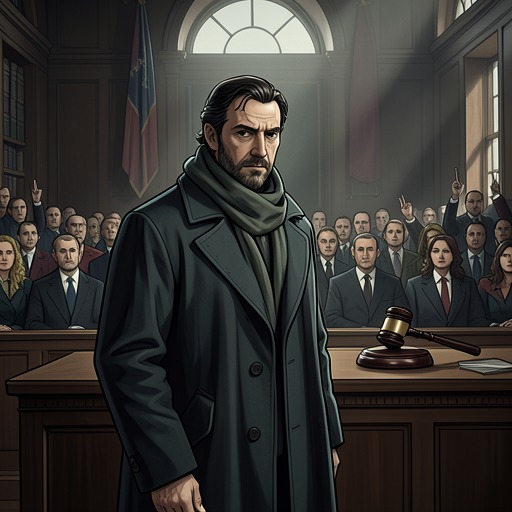
Bigger's signed confession
Native SonBigger's signed confession turns Bigger's account of his actions into an official document that can be carried, displayed, and used against him. Its importance lies not only in what it records, but in the divide between the events it traces and the feelings Bigger cannot put into words. First signed after his capture, the papers later appear among the collected evidence and are invoked by the prosecution in court.
Formation and Content
After Bigger is brought in, Buckley takes him by the arm, seats him, and asks him to tell what happened. The questioning begins with a concrete point in the chronology: whether Bigger went to Mr. Dalton's home at five-thirty that Saturday. Bigger answers briefly, then recounts his actions in response to Buckley's questions. The resulting account follows the outward sequence of what he did, rather than conveying the inner experience he wishes he could explain.
Bigger wants to describe how Jan's gesture affected him, how Mary Dalton's questions about Black life made him feel, and the excitement he experienced during his time in the Dalton home. Yet, as the account presents it, he cannot connect those feelings to the bare actions he narrates. The confession therefore carries a pronounced limit: it gives the authorities a traceable sequence of conduct, while the meanings Bigger associates with that sequence remain unexpressed. The document's later authority rests on a record that is legible to officials, not on a complete account of Bigger's consciousness.
Signing Under Pressure
Bigger speaks listlessly and pauses at Buckley's questions. With white men watching and waiting for his answers, the feelings he hoped to communicate seem to vanish; he experiences a similar loss of feeling to the one he had experienced in the car with Jan and Mary Dalton. When he finishes, he feels more lost than he did when captured. The confession is thus made in a setting where his words are elicited through questioning and where he experiences himself as unable to make those words convey his understanding.
A second white man rises and holds out the papers for Bigger to sign. Bigger thinks that he is guilty, that he is lost, and that he will be killed; he sees no one who can help him. The men stand over him, waiting, as his hand shakes and he signs. These circumstances do not erase the fact of his signature, but they shape the scene in which that signature is given: it follows his spoken account, amid fear and a sense of helplessness, rather than arriving as a confident declaration. Buckley folds the papers and puts them in his pocket. His remark that signing was easier than he expected, followed by the other man's assessment that Bigger had complied smoothly, contrasts their composure with Bigger's uncertainty.
Display as Evidence
At the coroner's inquiry, the signed confession is visible among the objects assembled on a table. Bigger sees it beside the kidnapping note, the remains, the trunk in which he had concealed Mary Dalton's body, and other evidence. The papers are no longer merely the account he gave in response to Buckley's questions: placed in public view with material objects from the investigation, they become one part of an official case presented to witnesses and jurors.
The coroner later gives the jurors the opportunity to inspect the collected evidence. They examine the kidnapping note, purse, blood-stained knife, blackened hatchet blade, Communist pamphlets, rum bottle, trunk, and signed confession. The document is therefore considered alongside objects that evoke different parts of the investigation: the purported kidnapping, the destruction of evidence, and the concealment of Mary Dalton's body. Its association with this array gives it evidentiary weight, while also making it one item in a larger material presentation rather than an isolated narrative.
Use at Trial
When the State begins presenting its case, Buckley says that the witnesses, the confession made and signed by Bigger, and the physical evidence will establish the crime. He places the confession within a three-part prosecution argument: testimony from other people, Bigger's own signed account, and material objects offered to the court. In this setting, the signature allows the State to present Bigger's account as evidence bearing his authorization, even though the narrative has shown how little his spoken account could express of his feelings.
The confession's role shifts accordingly. In the questioning scene, it is the endpoint of Bigger's halting attempt to recount events; at the inquiry, it is an exhibit among other collected objects; at trial, it becomes a prominent element in the prosecution's summary. Its movement from Bigger's hand to Buckley's pocket and then into the public evidentiary record marks a transfer of control over his account. The document gives the authorities a fixed version of his actions, while the experience that Bigger cannot articulate remains outside the paper. That tension makes the signed confession both an instrument of proof and a sharply limited representation of the person whose signature it bears.