Buckley
Native SonBuckley, the State’s Attorney in Bigger’s case, represents the force of prosecution in Native Son: he insists that the evidence is already sufficient, urges Bigger to speak despite warning him that his words may be used against him, and ultimately demands execution. His formal appeal to law and public safety stands against Max’s effort to show how racial segregation and restricted opportunity shaped the conditions in which Bigger lived. Through that conflict, Buckley becomes more than an individual opponent: he gives institutional authority to a public narrative that treats Bigger as a danger to be eliminated.
Identity and Introduction
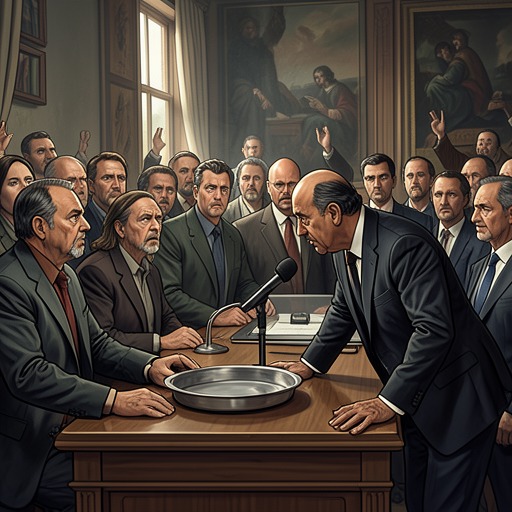
Buckley first enters the case as a recognizable public figure. When he arrives where Bigger is being held, Bigger recalls having seen his face on a billboard pasted up by workmen a few mornings earlier. The recognition connects the State’s Attorney’s public presence to the immediate reality of the prosecution. His appearance is imposing, and the atmosphere among the men in the room is already marked by hostility. Max and Jan stand to one side while Buckley confronts them, and Bigger watches a clash between people whose competing claims will shape what happens to him.
Buckley identifies himself as the State’s Attorney and approaches Bigger at his cot. He presents himself as offering advice: Bigger need not answer him, and anything he says may be used in court. But the warning is immediately coupled with the assertion that Bigger is caught, that the authorities know what he has done, and that he might as well talk. The exchange shows how a formally stated right can coexist with pressure to surrender it. Max intervenes, saying that Bigger will decide with him, and the two men face one another over who will control the interrogation.
Conflict with Max and Jan
The confrontation quickly becomes political as well as legal. Buckley derides Max and the Communist defense, questioning why Communists would involve themselves on behalf of a Black defendant. Jan answers by suggesting that Buckley fears the case might not be concluded before the April elections if Max’s side handles it. That is Jan’s accusation, not an established account of Buckley’s motive; its force in the scene comes from making the timing and public stakes of the prosecution explicit.
Max replies that Buckley’s tactics have made the defense necessary. In Max’s account, the prosecution has brought the Communist Party into the murder case, while Bigger took the idea for signing the party’s name to the kidnapping note from newspaper coverage. Max says that he is defending Bigger because he believes men like Buckley helped make him what he is, and because the public must understand why Bigger acted as he did. Buckley’s response keeps attention on the note and the apparent evidence against Bigger; Max tries to widen it to the conditions surrounding the crime.
Bigger experiences the dispute as more than a disagreement between lawyers. He had been close to accepting the friendship offered by Jan and Max, but Buckley’s presence makes that friendship seem small beside the multitude Buckley represents. The hope he had begun to feel drains away under Buckley’s gaze. The scene therefore establishes the unequal scale of the conflict as Bigger perceives it: individual offers of help confront an institution, a public audience, and the threat of state punishment.
Prosecution and Public Order
Buckley also enters Max’s exchange with Mr. Dalton about responsibility for social conditions. When Max turns the discussion toward fundamental change, Buckley loudly calls it Communism and redirects attention to the fact that Bigger is about to stand trial and that his own job is to enforce state law. The interruption makes visible the competing definitions of what the case concerns. For Buckley, discussion of social structure threatens to distract from the immediate criminal proceeding; for Max, that structure is essential to understanding the defendant and the case.
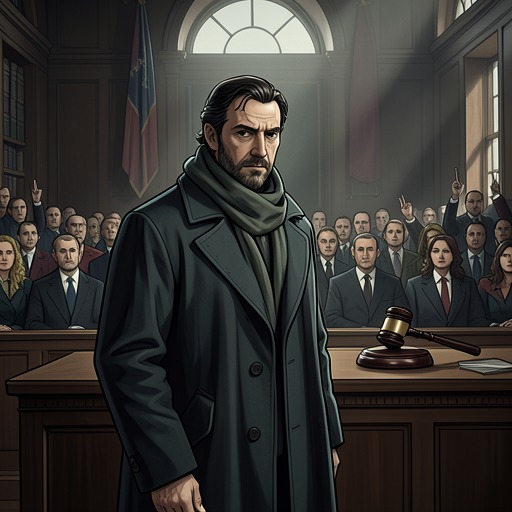
At trial, Buckley presents the death penalty as the necessary expression of law and the will of the people. He argues that the maximum punishment is required for society’s protection, invoking homes, loved ones, public safety, and the preservation of social order. He claims to speak for the families of Mary Dalton and Bessie, as well as for the wider body of law-abiding citizens. The breadth of that claimed constituency transforms the prosecution from a case about two deaths into a demand made in the name of the whole nation.
Buckley’s closing appeal intensifies that framing. He describes Bigger as an exceptional and dangerous criminal, recounts the prosecution’s account of Bessie’s death, and demands that Bigger die so that others will be deterred. He portrays the city as paralyzed by fear and insists that the public awaits the court’s response. These are arguments made by the prosecutor, not a neutral description of the evidence: their rhetorical effect is to make execution appear to be the condition of collective safety. His appeal thus echoes the wider anti-Black panic surrounding the case, even as it presents itself as ordinary law enforcement.
The Counterargument and Buckley’s Significance
Max’s defense directly challenges the assumptions Buckley’s case depends on. In court, Max argues that Bigger’s life was formed within a system that restricted where Black people could live, what schooling they could receive, and what work they could do. He points to racial separation in the courtroom itself and argues that the court should consider the social conditions behind Bigger’s actions rather than treating punishment as the only question. Buckley’s demand for the law’s full penalty and Max’s explanation of the conditions that shaped Bigger consequently offer opposed accounts of responsibility and public safety.
That opposition also clarifies the limits of Buckley’s presentation of Bessie’s death. During the inquest, Bigger recognizes that Bessie’s body is being introduced as evidence in Mary’s case and fears that it will be used to strengthen the case for his execution. He understands that her death is receiving attention in a context where, in his view, the killing of a Black woman would not otherwise command comparable concern. This is Bigger’s perception of the proceedings, and it exposes a racial inequality that Buckley’s broad claim to represent both women’s families does not resolve.
Buckley’s role is therefore defined by the tension between legal form and unequal consequence. He acknowledges Bigger’s right not to answer, yet presses him to speak; he presents his demand for execution as impartial duty, yet frames the defendant through language of public danger and collective fear. Against Max’s structural argument, Buckley insists on punishment as the means of restoring order. The novel uses their courtroom conflict to show how a prosecutor’s appeal to neutral law can coexist with, and help intensify, a racialized account of whose lives and safety the law is understood to protect.