Chicago police
Native SonChicago police are the central law-enforcement force in the search for Bigger Thomas after Mary Dalton’s remains are discovered in the Dalton family furnace. Their pursuit becomes more than an effort to locate a suspect: as the search expands through the Black Belt, it is accompanied by racialized public claims, vigilante participation, and collective punishment of Black residents. The novel presents the police response through newspaper accounts and Bigger’s frightened reading of them, making the gap between evidence and public accusation part of the force’s narrative significance.
Role in the Investigation
After reporters discover bones in the furnace, newspaper coverage reports that police believe Mary was killed by Bigger and suggest a sexual motive. The coverage presents that suggestion as suspicion, not established fact, yet it helps define the public meaning of the case before Bigger has been apprehended. A separate report says police have not accepted Jan Erlone’s account and suspect he may have been an accomplice, despite reporting that his fingerprints were not found in the Dalton home. The allegation that the crime was too elaborate to be the work of a Black man both implicates Jan and reproduces a racist assumption about Black intelligence.
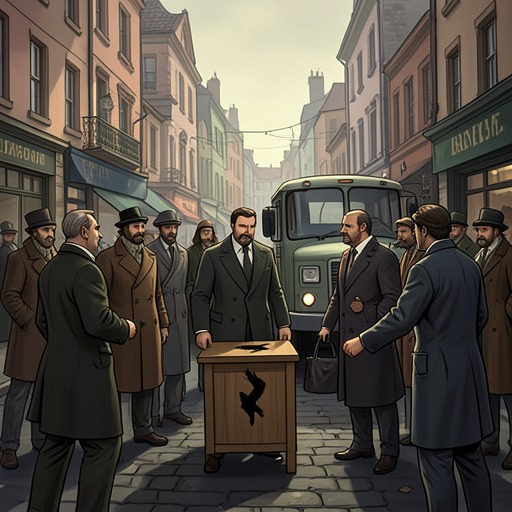
The reporting describes an enormous search operation. Five thousand police are said to surround the Black Belt, while more than three thousand volunteers augment them; later coverage describes eight thousand armed men searching cellars, abandoned buildings, and more than one thousand Black homes. Police and vigilantes carry rifles, tear gas, flashlights, and photographs of Bigger. Transit leaving the South Side is stopped and searched, and the report says that a blanket warrant is being used to search Black homes. The distinction between police and volunteers remains visible, but their combined presence makes the search a shared campaign of state and civilian force.
The Manhunt and Its Effects
The newspapers Bigger reads make the scale of the operation tangible through maps of the South Side. One map marks areas already covered by police and vigilantes; in a later account, the searched territory closes in from both ends of the Black Belt, leaving a small unshaded area where Bigger believes himself trapped. The map turns the neighborhood into a narrowing field of pursuit, while the accompanying reports describe roads blocked by snow and vehicles stopped for searches. As the search advances, the possibility of simply leaving Chicago recedes.
The campaign also reaches beyond the effort to find one suspect. Newspaper reports describe smashed windows in Black neighborhoods, Black men beaten in other districts, and white vigilante groups offering assistance that the police chief says will be accepted. They report that several hundred Black residents resembling Bigger have been detained for investigation and that hundreds of Black workers have lost their jobs. These consequences are reported amid public fear and official appeals for order; they show how suspicion attached to an individual spreads to people who have not been shown to be connected to the crime. The racialized sexual-crime accusation intensifies that spread by presenting Bigger as a threat to white children and women before the allegations have been tested.
Capture and Public Spectacle
The manhunt ends with Bigger captured and brought to the Cook County Morgue, where a crowd of reporters and photographers surrounds him under bright lights. The scene is not presented as a courtroom proceeding, but Bigger senses that those gathered have already assigned his death a public meaning: they regard him as a symbol of the Black world they fear and want to control. The capture therefore leads not into a neutral pause in the search but into another display in which the accused is made to stand for a whole population.
The police operation is not the sole cause of the crowd’s response, and the account does not identify the men who seize Bigger as police officers. Still, the surrounding search has made his capture the culmination of a vast public campaign. The organization’s presence in the narrative is inseparable from the newspapers, volunteers, and white public whose actions and fears accompany its work.
Institutional and Racial Significance
Max’s courtroom argument places the case within the conditions that precede the manhunt: Black residents are restricted in where they may live, work, study, and eat, while racial separation persists even inside the courtroom. His argument does not establish that every police action is individually motivated by prejudice. Rather, it challenges a system in which the pursuit and punishment of Bigger occur against a background of racial confinement and collective fear. The inquest’s treatment of Bessie’s death sharpens that inequality: her killing is introduced as evidence against Bigger, while his expected punishment is understood to be driven chiefly by Mary’s death.
Through this contrast, Chicago police function both as the force searching for an accused murderer and as part of a public order whose response exposes unequal protection and suspicion. The press’s unsupported or unconfirmed claims, the mass searches, and the participation of vigilantes blur the boundary between investigation and racialized public retaliation. The novel makes that boundary central to how the city sees Bigger—and to how the manhunt turns one criminal case into a spectacle directed at the Black community.