Christian salvation and religious faith
Native SonChristian salvation and religious faith in Native Son are presented as promises of spiritual comfort that Bigger Thomas cannot accept as an answer to the conditions governing his life. The novel sets the preacher’s teaching of love and eternal life against Bigger’s distrust of religion, his approaching execution, and the public display of a burning cross. Faith is neither simply affirmed nor dismissed: its meaning shifts between personal consolation, social accommodation, and a symbol caught in racial violence.
Religious upbringing and worldly happiness
Bigger Thomas says that his parents attended church regularly, but that he stopped going because its singing, shouting, and prayers seemed to bring his family no material improvement. He measures religious assurance against the unequal distribution of earthly security: white people, in his view, possess what Black people are denied. His objection is not just that church fails to make him feel happy. He wants happiness in this world, not a promise that relocates it to an afterlife.
When Max asks whether church might have offered a place free of mutual hatred, Bigger rejects that possibility as inadequate. He believes white people prefer Black people to be religious because faith makes it easier for them to continue exercising power. Religion, from this perspective, risks asking the oppressed to endure conditions that should instead be changed. This is a judgment about religion’s social use as Bigger understands it, rather than a settled declaration that God does not exist: when Max asks whether his references to divine punishment mean that he believes in God, Bigger says he does not know.
The preacher’s cross and the burning cross
Reverend Hammond brings Christian teaching into Bigger’s cell through an account of Jesus, love, and the cross, and gives Bigger a cross to wear. The religious image initially carries a meaning of meekness and spiritual devotion. Bigger recalls that the preacher’s words made him feel awe and wonder, and brought to mind kneeling and weeping. The cross is thus associated with an appeal to love and a model of suffering that promises significance beyond immediate worldly power.
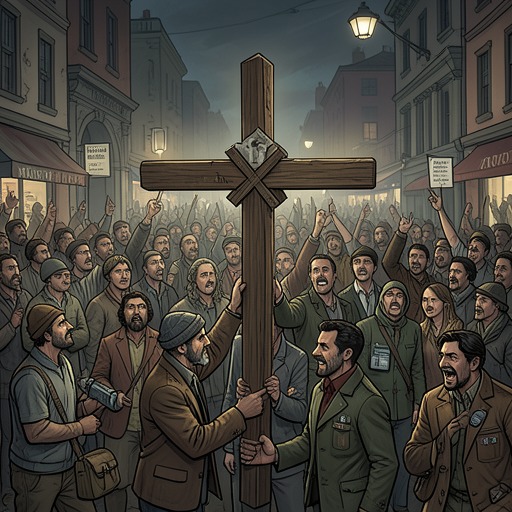
That meaning is violently altered when Bigger sees a cross burning above the crowd gathered against him. He first recognizes that the burning cross has something to do with him, but cannot reconcile it with the cross Reverend Hammond had described. The difference is not merely between two objects of the same shape. The preacher’s cross had represented love and humility; the flaming one belongs to a scene of hostility and threat. Bigger’s response changes accordingly: the first had drawn him toward reverence, while the second provokes fear and anger. The cross around his neck makes the contradiction physically present, placing a sign of Christian consolation against the image of racial intimidation.
Faith, constraint, and social power
Bigger’s refusal of religious consolation is sharpened by his awareness of the sentence awaiting him. He knows that killing a white woman carries the penalty of death, and says that at the time he felt Mary Dalton was killing him. Asked whether he would welcome religious happiness, he refuses: death is close, and religion would not make his present life different. The exchange does not establish that he has a complete or consistent theology. It shows instead that the promise of salvation does not answer the immediate question of how to live under danger and constraint.
Max’s courtroom argument places religious faith within a wider account of the conditions shaping Bigger’s life. He asks the court not to reduce the case to an appeal for sympathy or to treat Bigger only as an unfortunate victim; he argues for recognition of a distorted social order and of the forces it produces. In describing the constraints imposed on Black people, Max names restrictions on where they may live, how much schooling they can receive, and what work they can do. He also argues that religion, gambling, and sex drain their energies into channels harmful to them and profitable to others. In this analysis, religious practice can function as one of the outlets that diverts attention from blocked opportunities rather than changing the rules that block them.
The material evidence of segregation gives this argument a concrete setting. During questioning, Max presses Mr. Dalton about charging Black families higher rents for comparable houses and about company policies that keep them concentrated on the South Side. These exchanges do not make religious faith the cause of housing discrimination. They set faith’s consolations beside the institutional arrangements that shape daily life, clarifying why Bigger distrusts promises of spiritual happiness when the barriers around him remain intact.
A contested promise
The novel distinguishes between the preacher’s sincere message and the social function Bigger attributes to religion. Reverend Hammond offers a language of love and endurance; Bigger sees no reason to accept endurance as a substitute for worldly happiness or freedom. Max’s argument, in turn, calls for understanding the conditions producing fear and hatred rather than relying on moral condemnation or consolation alone. The narrative therefore leaves faith present but unresolved: Bigger’s uncertainty about God remains, while his refusal to treat religion as a sufficient answer is unmistakable.
The cross motif gathers that tension into a single image. One cross is offered in a cell as a sign of love and a path toward eternal life; another burns over a hostile crowd, turning the same form into a threat. Their contrast exposes the distance between a religious promise of universal love and the racial order in which Bigger must confront arrest, public hatred, and death. Christian salvation remains a possible language of mercy, but the novel insists that it cannot be separated from the question of whether people are willing to confront the earthly conditions that make such mercy seem remote.