Communist Party
Native SonThe Communist Party in Native Son represents an organized challenge to economic and racial inequality, but its presence in the novel is repeatedly distorted by fear and political opportunism. It gives Jan Erlone and Max a language for opposing the treatment of people as disposable, while Bigger Thomas’s false kidnapping evidence makes the Party appear connected to crimes it did not organize. That tension between political commitment and public accusation shapes the Party’s role in both the plot and the novel’s broader account of power.
Political and Intellectual Background
Communism was a major force in Richard Wright’s life during the first significant stage of his literary career, from 1933 to 1940. In Chicago, Wright was pursuing the possibility of becoming a writer even as a career in the post office seemed available to him. In 1933 he joined the recently formed Chicago branch of the John Reed Club, a nationwide organization founded by the Communist Party to attract writers and artists. The club offered a community of people with shared interests; the Party, amid the Great Depression, offered writers a sense of political and ideological purpose as well as international connections.
The novel’s political thinking also draws on dialectical materialism, which understands identity and consciousness as shaped chiefly by economic, social, political, and historical conditions. That emphasis stands in tension with the existentialist concern Wright also felt: the two perspectives do not explain human identity in the same way. In Native Son, this intellectual context matters because the Party’s analysis directs attention away from isolated personal failing and toward the circumstances that constrain people’s choices. Its ideas make structural forces discussable, although the novel does not present Party members as infallible or their politics as a simple solution to the crisis it depicts.
Members and Political Aims in the Novel
The Communist Party enters the story through characters rather than through a detailed account of its organization. Jan Erlone is a member, and Mary Dalton sympathizes with the cause. Jan explains to Bigger that the Party is fighting the treatment of people in the way he has witnessed and asks whether collective action might change such conditions. His approach is earnest, but the novel characterizes his paternalism and naivety as part of the circumstances that help precipitate tragedy. Political sympathy, in other words, does not automatically overcome the barriers between people or make an attempted alliance perceptive.
Max supplies a more analytical and explicitly political presence. He is presented as a Communist lawyer, and his defense of Bigger connects individual actions to the conditions that shape life in Chicago. His questions to Mr. Dalton place the family’s philanthropy beside its real-estate practices: he challenges the higher rent charged to Black families for comparable housing, the eight dollars a week taken from the Thomas family for a single unventilated, rat-infested room shared by four people, and the policy that keeps Black residents in one area of the city. He also asks whether charitable giving returns part of the profit extracted from those tenants without changing the conditions that produce their hardship. The Party’s analysis thus appears not only as a declared belief but as a method for exposing the gap between benevolent reputation and material arrangements.
The Party as Evidence and Accusation
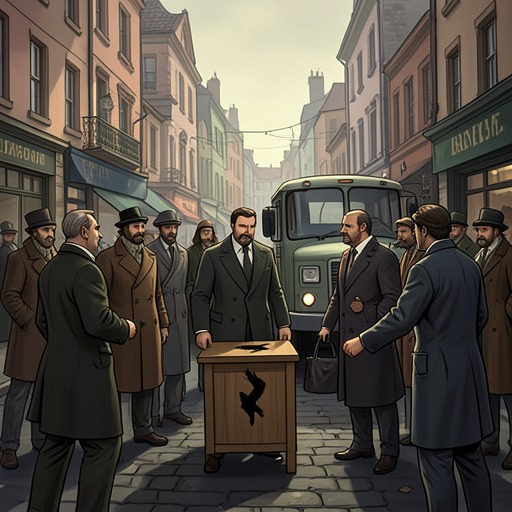
The Party’s public visibility grows through Bigger’s invented kidnapping scheme. Mr. Dalton announces that the note carries a scrawled hammer-and-sickle emblem. He says he is not positively blaming anyone and hopes the announcement will inform both the public and the supposed kidnappers that he has received the message. Yet the emblem immediately encourages suspicion. At a police discussion, one participant points out that the available clues—a found letter, Jan’s impending release, the signature Red, and the Party symbol—do not amount to a coherent explanation. The gap between symbol and proof is apparent even as the investigation treats the symbol as politically charged evidence.
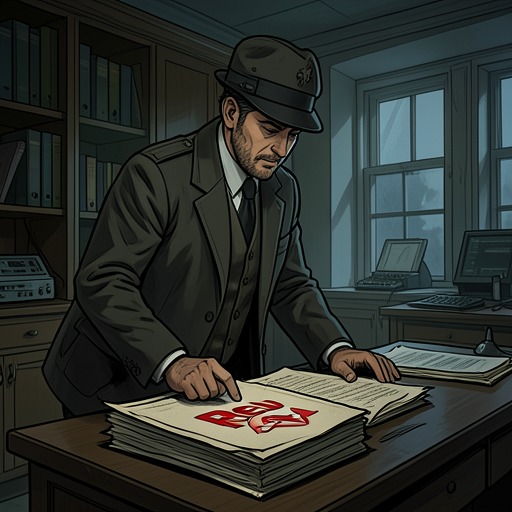
Britten intensifies that association when he displays the Communist pamphlets Jan had given Bigger. The men photograph them, and their excitement makes the pamphlets function as spectacle as well as evidence. A political text that might have expressed an effort to understand or change social conditions is recast as an incriminating object. The sequence shows how a name, emblem, or pamphlet can be detached from its original context and made to support a story of conspiracy.
The accusation has consequences beyond the investigation. Max tells Bigger that he is present because Bigger dragged the Party’s name into the murder. The prosecutor likewise points to the Party signature on the kidnapping note. Later, an official account characterizes Bigger’s alleged attempt to blame Communists as a sign that he may be hiding other crimes. These statements differ in purpose, but together they show how the Party becomes a convenient interpretive frame: instead of clarifying what happened, its supposed involvement is used to suggest hidden guilt and widen suspicion.
Trial, Race, and Class
At the trial, Max’s association with the Communist Party informs his defense without reducing it to a claim that Bigger is innocent of every charge. Max explicitly distinguishes his argument from a request to treat Bigger simply as an unfortunate victim of injustice. He describes the restrictions imposed on Black life—where people may live, how much schooling they can receive, where they can eat, and what work they can do—and argues that these arrangements have denied them a full life of their own. His account connects the immediate case to a larger system rather than treating the accused as detached from his environment.
Max also points to racial separation inside the courtroom, where Black spectators sit together behind a railing because they know they are not wanted on the same bench as white spectators. The scene gives physical form to the divisions his argument describes. The Party’s presence in court therefore has two sharply different meanings: its name is invoked by authorities as part of a supposed criminal conspiracy, while Max uses a structural analysis to challenge the racial and economic order surrounding the prosecution. The contrast does not make his defense a triumph over that order; it makes visible how political explanation and institutional accusation compete to define the case.
Narrative Significance and Reception
The novel places the Communist Party among several forces on the American stage as Wright frames it: capitalism is associated with Mr. Dalton, liberalism with Mrs. Dalton and Mary, and the Party with Max’s cold, analytical, but fallible political understanding. Jan’s warmth does not erase his paternalism, just as Max’s analysis does not make him omnipotent. This characterization prevents the Party from becoming a flawless authorial answer. Its ideas expose conditions that individual charity leaves intact, while its members remain limited by their own judgments and by the political crisis around them.
The Party’s most consequential appearance is consequently a double one. It offers a vocabulary for interpreting inequality, but its emblem and materials can be appropriated to create a false account of criminal responsibility. That conflict links Wright’s own engagement with organized political purpose to the novel’s distrust of explanations that conceal material conditions. The Party is neither merely a plot device nor the agent behind the crimes: it is a real political commitment in the novel’s intellectual background, a fragile attempt at solidarity in its character relationships, and a target onto which public suspicion is redirected.