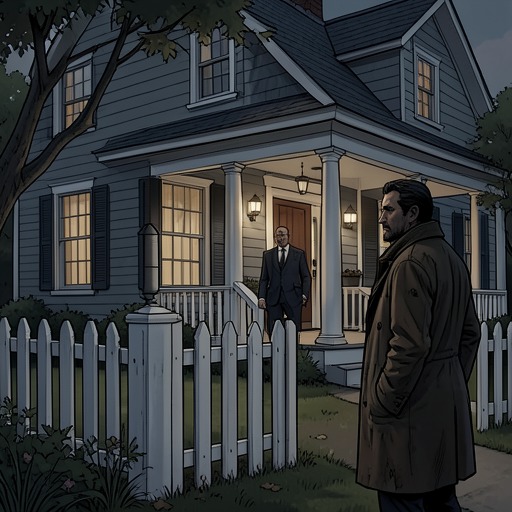
Dalton family residence
Native SonThe Dalton family residence at 4605 Drexel Boulevard first appears as the destination of Bigger Thomas’s new job and soon becomes the place where the limits of that employment are made physically palpable. From its spacious, quiet white neighborhood to its locked driveway, high iron fence, and dark bedroom, the house is a setting of comfort and guarded access. For Bigger, approaching it means entering a world he has imagined from a distance but experiences in person as a source of fear, anger, and constraint.
Address and Setting
Bigger learns that the family he is going to work for lives at 4605 Drexel Boulevard. As he sets out, the address connects an anticipated job to a particular household: the opportunity is not abstract employment but entry into the home of Mary Dalton’s family. Walking through the neighborhood, he finds that its reality differs from the image he had formed from the movies. The houses are huge, their windows softly lit; the streets are empty except for an occasional car passing quickly. What might have seemed alluring at a distance feels cold and remote on arrival.
The residence belongs to a landscape Bigger reads as both affluent and inaccessible. Its quiet streets and guarded houses suggest confidence and privacy, while his own passage through them makes him conscious of being an outsider. The setting therefore does more than locate the family. It establishes the unequal social distance between a Black job seeker and the white household that will employ him, before he has even reached its door.
Boundary and Entrance
At the address, a high black iron picket fence interrupts Bigger’s approach. He stops before it feeling constricted, and the movie-inspired sense of mystery gives way to fear and emptiness. The barrier is not merely decorative: it forces him to work out how he is permitted to enter. He walks along the fence looking for a path to the rear, but finds none. The driveway is securely locked; the front gate is the only available way in.
That simple problem carries a threat beyond the property line. Bigger worries that a police officer might see him wandering in a white neighborhood and assume he intends to rob or rape someone. He resents having come for the job and thinks he could have stayed among his own people, beyond this particular fear and hatred. Yet he also reasons that entering cannot get him killed; the family can only refuse to hire him. Timidly, he lifts the gate’s latch, walks to the steps, and waits for someone to challenge him. The entrance turns a routine visit into a test of whether he can cross a racial and social boundary without being treated as a danger.
Rooms and Domestic Interior
Once inside, Bigger rings the doorbell and hears a soft gong. The threshold briefly leaves him uncertain whether anyone is home; when the door opens, he sees a woman’s face. The house’s interior later becomes harder to navigate when he carries Mary, who is too drunk to guide him reliably, toward what she indicates is her room. He wonders whether he has found the correct door or might open the room belonging to Mr. and Mrs. Dalton. In the dark, he feels along the wall for a light switch but cannot find it. Winter light from a window only faintly reveals a white bed at the far end of the room.
This sequence makes the residence feel less like a space Bigger can command than one he must negotiate by touch and inference. He brings Mary into the room, closes the door softly, and remains uncertain about where he is and who might enter. The house’s ordinary domestic features—a door, a switch, a bed—become consequential because he is moving through them in darkness, carrying an intoxicated employer’s daughter while fearing the consequences of a mistake.
Exposure and Narrative Significance
The bedroom’s privacy proves fragile. After Bigger places Mary on the bed and leans over her, a creak at the door makes him turn. Mrs. Dalton stands there, silent and ghostlike in his perception; he experiences her presence as a sudden terror. Although he knows that she cannot see him, he fears that Mary might speak and lead her to the bedside, where she could touch and discover him. The same house that has admitted him as an employee now surrounds him with the possibility that his presence will be exposed and misread.
Across these scenes, the residence’s meaning shifts from a promised workplace to a site of constriction and danger. Its fence makes access visible; its unlit room makes movement uncertain; Mrs. Dalton’s appearance turns a closed door into a point of immediate risk. The house’s material arrangement and Bigger’s position within it are inseparable: the home offers him entry on the condition that he serve the family, but does not erase the fear attached to his presence in white domestic space. The address thus concentrates the novel’s conflict between employment and exclusion, apparent hospitality and guarded access.