Discovery of Mary Dalton’s remains
Native SonThe discovery of Mary Dalton’s remains in the furnace at the Dalton home ended the uncertainty surrounding her disappearance and gave investigators physical evidence of her death. The remains’ discovery also set the stage for the trial, where the furnace and other recovered items were displayed as evidence.
Discovery and Public Confirmation
At the trial, a newspaperman testified that smoke from the furnace had led to the discovery of Mary’s bones. The account connected an observable sign at the Dalton home to the decisive finding: Mary had not simply disappeared. For Bigger Thomas, the report was no longer an abstract detail in the case but part of a public record assembled before the court.
Physical Evidence and the Courtroom Reconstruction
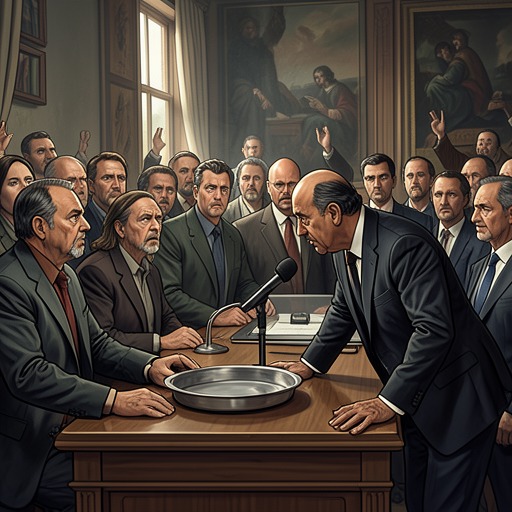
The trial turned the investigation’s objects into a public demonstration. David A. Buckley presented the knife and purse Bigger had hidden in a garbage pail, explaining that the city dump had been searched for four days to recover them. The exhibits also included the brick used to kill Bessie Mears, a flashlight, Communist pamphlets, Bigger’s gun, a blackened earring, a hatchet blade, Bigger’s signed confession, the Kidnapping note, Bessie’s clothes, stained pillows and quilts, Mary’s trunk, and an empty rum bottle found in the snow beside a curb. Mary Dalton’s remains were brought into the courtroom, where women began to sob. Then twelve workmen carried the Dalton family furnace into the room piece by piece and assembled it on a large wooden platform; the judge ordered the spectators, who had risen to look, to sit down. Buckley used an iron shovel from the Dalton basement to demonstrate how the remains had been removed and argued that the furnace could hold and burn Mary’s body. The display made the furnace more than the setting of the concealed crime: exposed before the court alongside the scattered objects, it became a material reconstruction of the prosecution’s account.
Press Coverage and Political Framing
The discovery also entered the story through a newspaper Bigger reads in his cell. A guard lends him the paper and says that his lawyer is bringing clothes, but Bigger is absorbed in the headlines: they identify him as a killer, report his confession to two murders, and describe the remains found at the inquest. He searches the articles for some indication of his fate. The brief kindness of the man who lends him the paper stands in sharp contrast to the paper’s certainty about his guilt and its prediction of the harshest penalty.
The coverage turns the case into a political instrument as well as a criminal proceeding. David A. Buckley attacks the Communists defending Bigger and suggests that investigating their activity would uncover other crimes. When reporters ask whether the trial will affect the coming election, Buckley waves them away with a laugh. The remains’ discovery has therefore become not only evidence of Mary Dalton’s death but also material for a public narrative shaped by sensational reporting and electoral ambition.
The Prosecution’s Reconstruction
At trial, the discovery was turned into a physical demonstration of the prosecution’s account. David A. Buckley had a girl of Mary Dalton’s size enter the furnace to show that it could hold a body; he then used an iron shovel from the Dalton basement to illustrate how the remains had been removed. The demonstration presented the discovery not merely as confirmation that Mary was dead, but as part of a specific explanation of how her remains came to be in the furnace.