Flight and Constrained Freedom
Native SonFlight and Constrained Freedom describes the tension between Bigger Thomas’s longing to move freely through the world and the racial and economic barriers that restrict his choices. An airplane and a pigeon lift his gaze from the city’s hard, mechanical surfaces, but neither image offers a route he can actually take: flight appears as possibility in the sky and confinement on the ground.
The Airplane and the Shape of Possibility
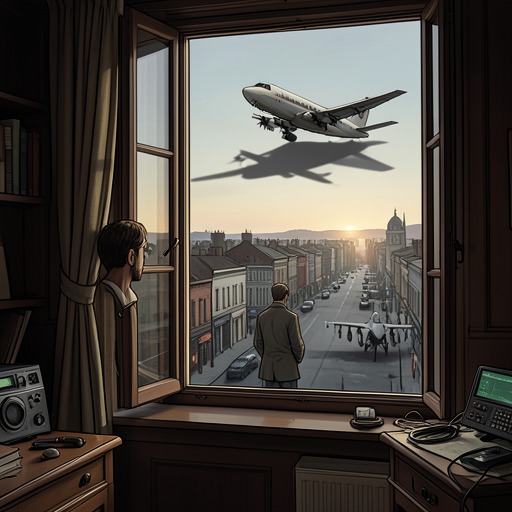
Bigger first encounters flight as a sight that interrupts the ordinary landscape. He stretches his arms, yawns, and watches the sharply defined world blur before it becomes distinct again. Then a slender streak of white appears against the blue. The plane is so distant that sunlight can blank it from view, yet its vapor trail makes it seem to write across the sky. The scene grants the aircraft a visibility and reach that Bigger himself does not possess: it can rise above the city and leave a message in a space he can only look up at.
The words written by the plane sharpen the contrast between aspiration and ordinary material life. A tiny ribbon of vapor spells out “USE…,” and later the plane writes “GASOLINE….” Bigger slowly repeats the words, then says he would like to fly in the sky. The writing belongs to an airplane he cannot approach, while his wish is immediate and personal. The scene thus places the language of an advertisement beside a desire for freedom: the aircraft is not merely an abstract dream but a conspicuous presence whose use and access remain beyond his reach.
Bigger’s response is wonder before it is argument. He says the plane looks like a little bird, and he imagines that he could fly one if he had the chance. That qualification matters. His wish is not framed as a lack of interest or ability; it is framed as a possibility held back by conditions outside his control. The distance between the plane and the observer becomes a measure of the distance between imagining a life and being permitted to pursue it.
The Conditions of Exclusion
Gus gives the wish its blunt social explanation: Bigger could fly if he were not Black, had money, and were allowed to attend aviation school. These are distinct barriers, not a single vague obstacle. Race, economic access, and institutional permission combine to make the imagined occupation unavailable. Gus’s statement turns a moment of looking into a diagnosis of restricted opportunity, naming the material and social gates that separate Bigger from the sky he admires.
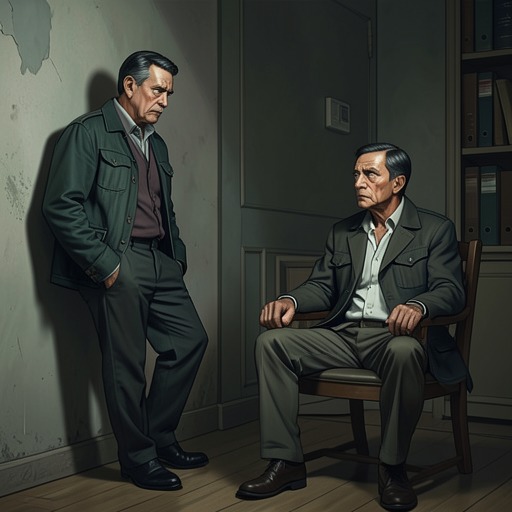
The exchange also carries the weight of deference. Gus pulls down the corners of his lips, steps away from the wall, squares his shoulders, removes his cap, bows, and answers with mock politeness. His performance makes the demand for racial submission visible as a bodily act. Bigger repeats the fantasy of flying, while Gus’s exaggerated bow supplies the social posture that the world expects from them. Their laughter follows, but it does not erase the conditions they have just identified.
Bigger asks why white people treat them as they do, and Gus answers that it is better for the situation to be funny. The joke is a way of responding to a reality they cannot readily alter, not evidence that the reality has become harmless. Bigger soon names the limits more directly: he asks why they must live in one corner of the city and why they are not allowed to fly planes or run ships. His image of flight therefore belongs to a wider demand for access—to space, work, and activity—not simply to fascination with aircraft.
Imagination, Retaliation, and Fear
Bigger’s fantasy of flying also turns toward violence. He jokes that perhaps white people are right not to want him in a plane, because he would take bombs up and drop them. The line is a retaliatory image spoken during an exchange in which the boys laugh; it is not an account of an actual plan or action. Its force comes from the reversal it imagines: someone denied power over his own movement pictures himself commanding a machine and directing destructive force from above.
That reversal does not resolve the restriction. The plane continues on its course, writing commercial words into the sky, while Bigger remains below. His imagined control appears only as a threat voiced in conversation. Against the ordinary exclusions Gus has named, the bomb fantasy gives Bigger a momentary language of counterpower, but the scene offers no evidence that he can convert that fantasy into practical freedom. Aspiration and anger occupy the same exchange without becoming the same thing.
The conversation’s laughter also sits beside a more serious recognition of danger. Bigger says that whenever he thinks about being Black while white people are white, and about being here while they are there, he feels that something awful is going to happen to him. Gus replies that Bigger cannot change the situation and that white people make the laws. The words locate his fear within an unequal social order rather than in the airplane itself. Flight draws his attention upward, but the barriers that govern his life remain on the ground around him.
The Pigeon and the Grounded Observer
A pigeon brings the scene’s contrast back to street level. It swoops onto the steel car tracks, struts with ruffled feathers, and rises as a streetcar rumbles forward. Bigger can see sunlight through the taut, translucent tips of its wings as it wheels out of sight over a roof. The bird’s movement is brief and observed at close range, unlike the plane, which is tiny and intermittently erased by glare. Yet both images leave Bigger watching rather than traveling.
The pigeon makes flight look less like a distant technical achievement and more like an ordinary capacity of movement. Bigger responds, “Now, if I could only do that.” He then says that he reckons they are the only things in the city unable to go where they want or do what they want. The comparison gives the bird’s effortless escape a sharp human counterpoint: the pigeon crosses the tracks and disappears over the roof, while Bigger describes his own movement as bounded by the city’s arrangements.
Gus tells him not to think about it, but Bigger answers that he cannot help it. That final insistence establishes the concept’s central tension. Looking up does not remove the barriers, and imagining flight does not grant it; still, the sight of the plane and the bird makes those barriers legible. Flight is both a figure for a freedom Bigger desires and a measure of the racial, economic, and spatial restrictions that keep that freedom beyond his immediate reach.