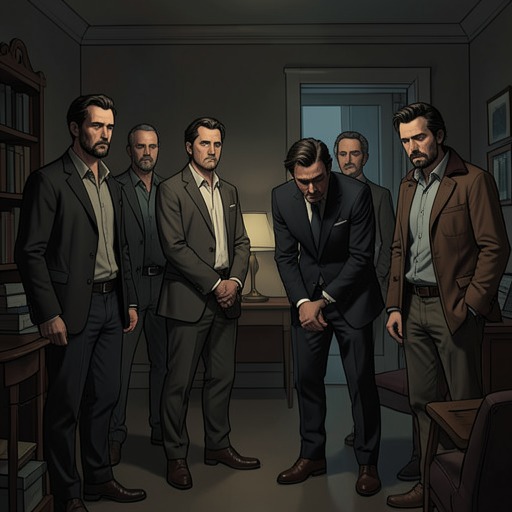
G.H.
Native SonG.H. is a companion of Bigger and a participant in the poolroom conversation about robbing Blum's Delicatessen. His few recorded actions place him at a crucial point in the plan’s discussion: he tests whether Bigger has thought through the operation, then gives a conditional assent that leaves Gus as the lone holdout.
Entrance and Place in the Group
G.H. arrives at the poolroom with Jack and walks with him to the rear. The group is already gathered there, and Jack asks what the others are doing; Bigger replies that they are playing pool and invites them to join. G.H.’s entrance brings another member of the group into the conversation in which Bigger is pressing his robbery proposal.
Questions and Conditional Agreement
After Bigger has argued that robbing the white shopkeeper would be easy, G.H. asks, “You say you got it all figured out?” The question directs attention to the practical details of the plan rather than simply accepting Bigger’s confidence. Bigger answers with a step-by-step account: the store would be nearly empty between three and four, one person would watch outside, and the others would handle the shopkeeper, the cash box, and the back door for a quick escape.
When Bigger demands that somebody speak, Jack renews his agreement. G.H. then says, “I’ll go if the rest goes.” His assent is explicitly conditional on the others’ participation; the passage does not present it as an independent initiative or as proof that he is eager to rob the store.
Effect on the Scene
G.H.’s agreement contributes to the group’s emerging consensus, but it does not resolve the confrontation. Gus remains silent, leaving three companions against him, just as Bigger had wanted. The resulting pressure sharpens the scene: Bigger is afraid to rob a white man, yet he also fears that Gus may agree and thereby leave him no excuse to avoid carrying out the plan. G.H.’s role is therefore defined by a brief question and a conditional commitment, while Bigger’s account of the moment makes clear how the group’s consent intensifies his conflict rather than dispelling his fear.