Hammer and sickle
Native SonThe hammer and sickle enters Native Son not as proof of a political conspiracy but as a symbol appropriated for Bigger Thomas’s fabricated ransom scheme. Its appearance on the note gives the false kidnapping a politically charged signature, helping redirect suspicion toward Jan Erlone and exposing how a familiar emblem can be made to serve a misleading public story.
Appearance on the Ransom Note
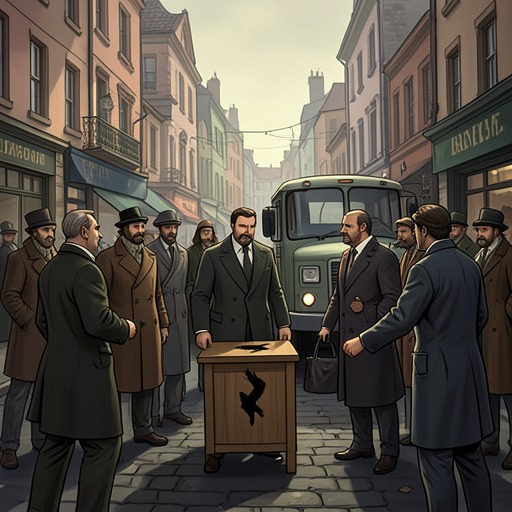
When Mr. Dalton tells the men gathered in the basement that the note bears a scrawled Communist Party emblem, the room falls silent. Several men leave at once to telephone their stories in. The emblem transforms the note from a demand for money into apparent evidence of political involvement, even though the disclosure establishes only what is drawn on the paper, not who is responsible for Mary Dalton’s disappearance.
A False Political Trail
The next newspaper account pairs the hammer and sickle with the note’s signature, “Red,” and its demand for $10,000 for Mary Dalton’s return. It reports that the Dalton family is seeking Jan Erlone’s release, presenting him as a Communist leader held in connection with the disappearance. The emblem thus helps connect the invented kidnapping to Jan in the public account, although that connection rests on the note and the family’s demand rather than proof that Jan or the Communist Party carried out a kidnapping.
The Symbol’s Source and Consequences
During his confrontation with Buckley, Max acknowledges that Bigger signed the Communist Party’s name to the note, then argues that Bigger got the idea from newspapers. In this explanation, the emblem’s use is an imitation of public political language, not evidence that the Party directed the crime. The symbol has been borrowed to make a false story look plausible; its appearance nonetheless brings Communist suspicion into a case already shaped by sensational reporting.
Narrative Significance
The emblem’s force comes from the gap between what it depicts and what the public takes it to mean. A few marks on a ransom note become a prompt for a political interpretation, and that interpretation helps make Jan part of the case’s public narrative. By later identifying the emblem as part of Bigger’s deception, Max challenges the leap from visible sign to presumed conspiracy, while also arguing that the newspapers supplied the model for that deception. The hammer and sickle therefore functions in the novel as both fabricated evidence and a measure of how readily political symbols can be recruited to frame events.