Ku Klux Klan
Native SonThe Ku Klux Klan is presented in Native Son as a force of racial terror whose violence helped enforce Black political and social exclusion after the Civil War. In the novel’s present-day action, its burning cross becomes a direct threat to Bigger Thomas, sharply opposed to the Christian cross offered to him in prison. The Klan thus connects a history of coercion to the continuing power of racist violence and its symbols.
Historical Role and Political Purpose
The novel’s historical account describes the Ku Klux Klan as central to the violent reversal of Black freedom after the Civil War. Through arson, pillage, and killing, the Klan helped drive newly freed Black people out of political institutions, including the United States Senate, the House of Representatives, and state legislatures, as well as out of the South’s public, social, and economic life. That terror had a political purpose. In parts of the American South, Black people outnumbered white people on fertile plantation land; if Black citizens could vote, they could influence control of that land and the region’s political and economic future. The struggle after the Civil War therefore appears not simply as scattered racial hostility but as a contest over power, extending across thirteen states and affecting millions of people. The account also places Klan violence within a larger structure of coercion. Terror was supplemented by restrictions on education, exclusion from police forces and local national guards, and residential segregation. The Klan’s violence and these restraints worked toward the same end: preventing Black neighbors from exercising political power or challenging the racial order. The novel presents the Klan as a decisive agent in this history, while showing that racial control also depended on rules and institutions beyond the organization itself.
The Burning Cross and Bigger Thomas
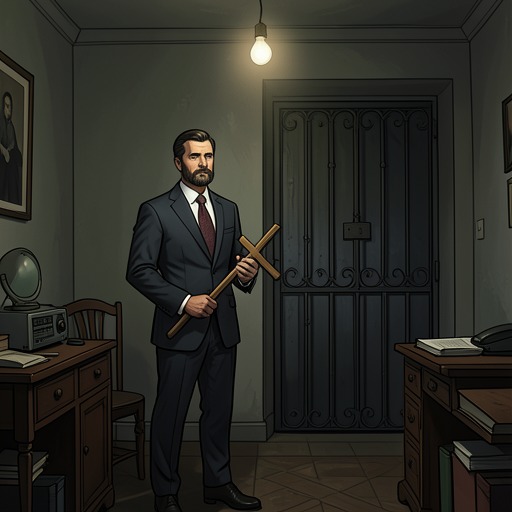
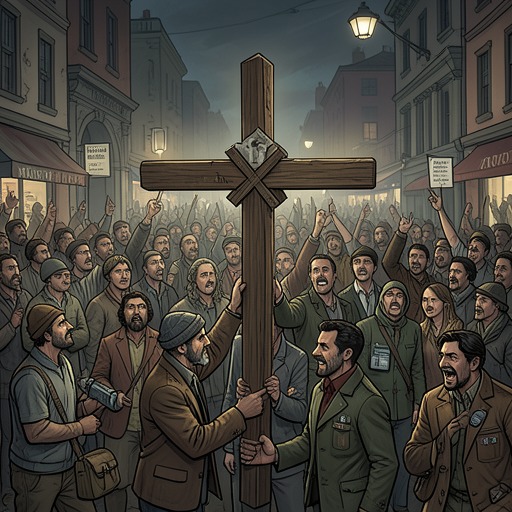
The Klan returns as a present threat when Bigger Thomas, in police custody, sees a flaming cross above a building across the street. The hostile crowd and the burning symbol make the danger immediate, but the cross also prompts him to recall the preacher who had recently spoken to him in his cell about Jesus and salvation. The contrast is stark. The preacher’s cross had represented meekness and spiritual consolation; the burning one, Bigger Thomas understands, is the Ku Klux Klan’s sign of hatred. The same religious image is made to carry opposite meanings: one offers salvation, while the other announces racial menace. Faced with the burning cross, Bigger Thomas feels betrayed by the religious symbol around his own neck and, after he is locked in a cell, tears it away and throws it aside.
Meaning in the Novel
The burning cross makes racial terror visible at the moment Bigger Thomas is already surrounded by public hostility and state custody. It is not merely an emblem of an organization’s past: in the scene, it functions as a threat directed at him. The novel’s historical account gives that threat a longer reach, linking the spectacle of the cross to the postwar use of violence to suppress Black political participation and restrict Black life. At the same time, the novel distinguishes the Klan’s terror from the broader systems that sustain racial inequality. Its account describes direct violence alongside housing segregation and limits on education and public authority; the symbol concentrates the fear of racial violence, while the surrounding history shows that coercion also operates through everyday restrictions. Together, these elements make the Ku Klux Klan a sign of both organized terror and the wider racial order its violence helped enforce.