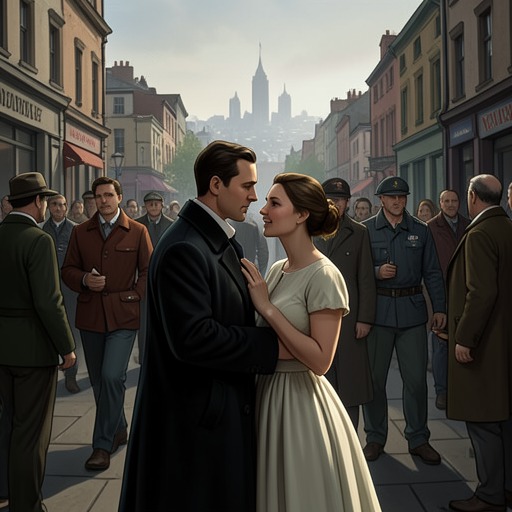
Mary Dalton and Jan Erlone’s Romantic Relationship
Native SonMary Dalton and Jan Erlone’s Romantic Relationship is both an intimate partnership and a political bond. The novel first presents Mary and Jan to Bigger Thomas through a newsreel that turns their romance into a public spectacle; he later encounters them together and sees their closeness for himself. Their affection unfolds alongside Mary’s growing commitment to the Communist Party and her wish to act against injustice. After Mary’s death, Jan’s connection to her becomes entangled with the investigation, and Bigger’s knowledge that Jan is innocent sharpens the difference between their actual relationship and the suspicions imposed on it.
Public Image and First Encounter
Before Bigger meets Jan, he sees Mary represented in a movie-theater newsreel. The report identifies her as the daughter of Henry Dalton and describes her as rejecting wealthy suitors from La Salle Street and the Gold Coast for the attentions of a radical she met in Florida. Its images turn their courtship into a suggestive entertainment: Mary and Jan kiss, run together on the beach, and are framed by a commentator’s teasing narration. The newsreel’s account is not a private exchange between the couple but a public story about a rich young woman defying expectations and choosing a political outsider.
That image shapes Bigger’s anticipation when Mary tells him she is going to meet a friend who is also his friend. He does not know whom she means, and her description leaves him uncertain about what kind of encounter to expect. When Mary returns from the building with Jan, Bigger recognizes him as the man from the newsreel. Jan approaches with an open palm, but Bigger’s body tightens with dread. The contrast is immediate: the film has made the couple’s intimacy a spectacle, while their face-to-face introduction places Bigger inside a situation he finds difficult to interpret.
Affection in the Night Out
During the drive, Mary and Jan sit together in the back seat while Bigger drives. He sees Mary resting in Jan’s arms, an unforced sign of closeness that confirms the newsreel’s romantic account through an ordinary shared moment. Their familiarity also appears in their affectionate way of addressing one another. The relationship is not presented as a formal declaration or a plan for marriage; the evidence instead shows a couple comfortable in each other’s company and physically at ease together.
Their outing also connects their relationship to Mary’s choices and the limits around them. Mary asks Bigger to take her small trunk to the station the next morning because she is leaving for Detroit, and Jan pays the bill before they return to the car. The scene places their intimacy within a larger night shaped by travel, work, and political activity, rather than isolating the romance from the social world around it. Mary’s next-day departure is a practical detail of the evening, not evidence that the relationship has ended.
Political Commitment as a Shared Bond
Jan identifies himself as a member of the Communist Party and describes its purpose as opposing the treatment of people as inferior. Mary sympathizes with the cause. When Jan asks whether people could work together to stop injustice, Bigger does not offer agreement; Mary and Jan’s political language therefore marks a shared commitment that Bigger is not yet prepared to join. Their relationship brings together romantic affection and a common political outlook without making those commitments identical: Jan is already a party member, while Mary expresses sympathy and a desire to become more active.
That desire becomes concrete in her conversation with Jan. She tells him she feels helpless and useless and wants to do something, then says she intends to join the Party after leaving school in the spring. Jan welcomes the decision. Mary also asks whether he knows many Black people because she wants to meet them. Jan replies that she will meet them through the Party, while Mary speaks of the emotion she sees in Black people and the possibility of collective action. The exchange shows her trying to move from sympathy toward participation, while also exposing how little direct contact she has had with the people she hopes to encounter. Their political partnership is therefore aspirational as well as affectionate: Mary is looking to Jan both as her lover and as a guide into organized activity.
The conversation also makes the couple’s bond consequential beyond their private lives. Jan’s politics help define what Mary hopes to do, and her readiness to act is affirmed within their relationship. The scene does not show whether she carries out her plan to join the Party; it establishes her intention and the support she receives from Jan. Their shared outlook is real, but the novel leaves that intended future incomplete.
Relationship Under the Pressure of Mary’s Death
After Mary disappears and her remains are found in the Dalton household furnace, news reports place Jan inside the public account of the case. One report says the Communist leader has proved an alibi, while other coverage notes that Jan’s fingerprints were not found in the Dalton home and that he remains in custody. The contradictory pressure of these details shows how his association with Mary and his political identity become material for suspicion, even when the reports also carry information that points away from his involvement.
Bigger knows Jan did not help him. Reading that the authorities still consider Jan a possible accomplice, Bigger wants to tell the police that Jan had nothing to do with the crime and that he alone is responsible. That impulse contrasts with Bigger’s earlier fear and hostility when Jan first extended his hand. By the time Mary’s death has become a public case, Bigger can recognize Jan’s innocence even as the investigation continues to draw him into suspicion. The relationship’s aftermath is thus filtered through a crime Jan did not commit and a public narrative that cannot be trusted to distinguish association from guilt.
Narrative Significance
Mary and Jan’s partnership links romantic intimacy to political dissent, while the newsreel and subsequent reporting show how easily private relationships are converted into public images. The newsreel packages their courtship as a scandalous beach romance; the later investigation recasts Jan as a possible accomplice because of his connection to Mary and his politics. Against both representations, the scenes of their shared drive and conversation supply more specific evidence: they are affectionate partners, and Mary is considering political action with Jan’s encouragement.
The relationship also brings Mary’s stated wish to meet Black people into contact with Bigger’s experience of racial distance and fear. Her intention is sincere in the conversation, but the scene does not establish that she understands the conditions under which Bigger lives. The difference between wanting solidarity and already sharing another person’s circumstances remains unresolved. Mary’s death cuts short her stated plans, while Jan is left exposed to suspicion and Bigger becomes the one who knows he is innocent. Their romance consequently matters not only as a private bond, but as one of the relationships through which the novel shows the collision of affection, political idealism, racial division, and the distortions of public accusation.