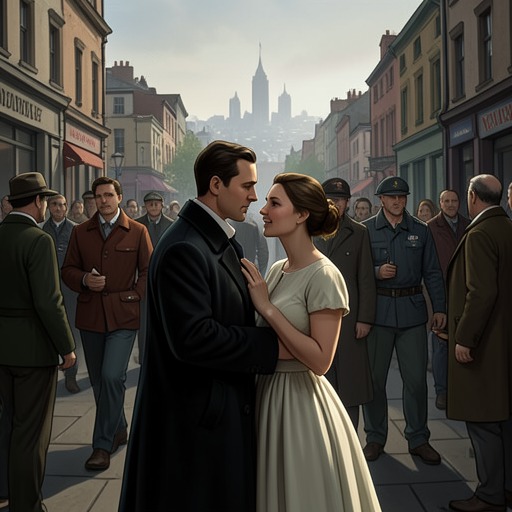
Mary Dalton’s intoxication
Native SonMary Dalton’s intoxication is a gradual but decisive loss of physical control during the night drive with Jan Erlone and Bigger Thomas. By the time Bigger takes her toward the Dalton home, she is glassy-eyed, unsteady, and unable to manage the entrance alone. The narrative makes her impaired condition concrete through successive failures of balance and movement, while setting those visible signs against Bigger’s uneasy mixture of fear, hostility, excitement, and assistance.
The Night Drive and the Onset of Impairment
Mary’s condition develops during a drive through a dark park. Bigger has also been drinking Rum; he hears the half-empty bottle gurgle as he steers slowly around the park’s sloping curves. His perception of the ride grows detached and unsteady: he feels the alcohol spreading through him and imagines himself floating rather than actively driving. In the mirror, he sees Mary lying on her back in the rear seat while Jan bends over her. He hears them whisper and sigh, and understands them to be kissing. The scene thus places Mary’s intoxication within a shared night of drinking, but filters its details through Bigger’s alcohol-affected attention and observation.
After a long time, Jan sits up and Mary says it is one o’clock and that she should go in. Jan leaves by streetcar, while Bigger drives Mary toward Drexel Boulevard. In the front seat, she slumps and sighs, her legs sprawled apart; Bigger’s head is spinning. She tells him he is nice, then giggles at his reply. The change in setting and seating does not bring her back to control: the ride away from the park carries her impaired state toward the practical problem of getting into the house.
Visible Signs and Failed Movement
The narration identifies Mary’s condition through what Bigger sees and what she cannot do. Her face is pasty white, her eyes glassy, and she is very drunk. When she tries to rise, she slips back into the seat. She reaches toward Bigger and asks him for a lift, describing herself as wobbly. Her dress has ridden up, and Bigger pauses to look at her; she meets his gaze and laughs. The physical detail registers both her loss of coordination and the charged, uncomfortable way Bigger watches her.
Mary nevertheless attempts to walk up the front steps. She manages the first few firmly, then stumbles loudly on the wooden porch. Bigger starts toward her but freezes with his hands outstretched, afraid that she will wake everyone. She ends up bent over, supported on one knee and one hand, and looks back at him in amused astonishment. She pulls herself upright, uses the railing, and sways in front of him. Her own acknowledgment that she is drunk accompanies actions that demonstrate the degree of her impairment: she cannot reliably stand or proceed without risking another fall.
Bigger’s Response and the Route Inside
Bigger’s reaction is not simple sympathy. He fears that if Henry Dalton sees him there with Mary, he will lose his job. He considers calling Henry or Peggy, then rejects the idea because it would expose Mary’s condition. At the same time, he feels hostility toward her because she is white, even as he recognizes that she seems not to hate him in the way he associates with other white people. The narration also records his excitement as he watches her and his helplessness at having to manage a situation whose consequences he fears. Her impairment therefore sharpens, rather than resolves, the racial and personal tensions shaping his response.
When Mary sways toward him with her eyes closing, Bigger catches her. She asks to go by the back way, expecting that the front entrance will make her stumble and wake everyone. He supports her with one hand as he leads her down to the basement and switches on the light. She says she had not realized she was so drunk. He then guides her up the narrow stairs toward the kitchen door, his arm circling her waist as she leans increasingly heavily against him. Her need for physical support is not a single moment of unsteadiness: it determines the route they take and continues through the approach to the kitchen.
Narrative Significance
The episode measures Mary’s intoxication through an accumulating chain of observable limits: she slumps in the car, cannot rise without slipping back, asks for help, stumbles on the porch, needs the railing, and finally leans on Bigger as he guides her inside. That progression gives the condition immediate practical force. A routine return to the house becomes a concealed, difficult passage because Mary cannot manage it unaided and Bigger fears the household discovering them together.
The scene also distinguishes Mary’s own light treatment of her drunkenness from the gravity Bigger assigns to its consequences. She laughs, speaks of being drunk, and tries to walk; he watches for the risk of waking the household and for the danger to his employment. Her impairment is therefore not presented only as a bodily state: it reorganizes their movements and exposes the unequal stakes they attach to being seen together. The evidence establishes her vulnerability and dependence in this passage, while leaving her intoxicated remarks and gestures insufficient to support any broader claim about her intentions.