Mary's trunk
Native SonMary's trunk is a container Bigger Thomas tries to use to conceal Mary Dalton, but its physical limits redirect his plan. It then becomes part of his effort to make the events at the Dalton home appear ordinary: he carries it to La Salle Street Station and treats the delivery as an errand Mary had requested. Later questions about why it was taken that way bring the trunk back into view as an object whose movement and handling invite scrutiny.
The Trunk and the Failed Plan
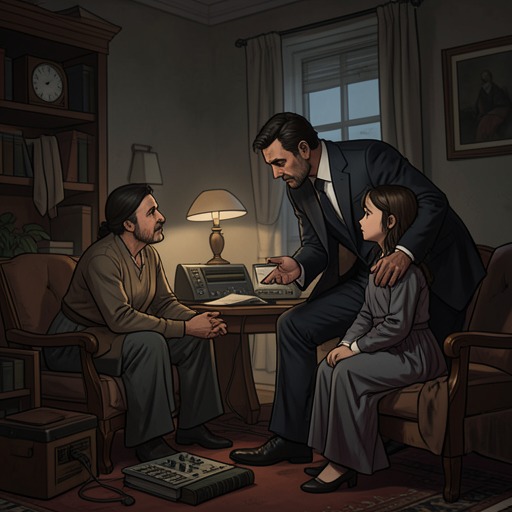
In the basement, Bigger stoops to place Mary in the trunk and looks toward the door, still alert to the possibility of being seen. The trunk does not accommodate her: when he turns her and tries to arrange her inside, her legs are too long. This practical failure matters to the plot. The container is not an invisible extension of Bigger's plan; its capacity imposes a limit that he cannot overcome by rearranging what he is trying to conceal.
The scene makes the trunk conspicuous through that mismatch between intended use and material capacity. Bigger's attention moves between the door and the task, while the trunk's inability to serve as planned forces a change of method. Rather than solve the problem by continuing to use the container, he turns to the furnace. At four o'clock, he considers whether there is enough coal, puts the paper he used into the furnace, and operates its lever. The trunk therefore marks a failed stage in concealment, followed by an attempt to remove the body through another means.
From Basement to Station
The trunk does not disappear from the sequence after that failure. At eight-twenty, Bigger returns to the basement, drags it to the door, lifts it onto his back, carries it to the car, and fastens it to the running board. He waits for Mary to come out, then goes to the side door to ask for her. The contrast is stark: an object involved in the hidden events of the basement is now moved through the household's ordinary entrance and attached to a car for transport.
Bigger takes the trunk to La Salle Street Station, where he pulls the car to a platform, backs into a narrow space between other cars, lifts the trunk out, and waits for a man to issue a ticket for it. He imagines that the Daltons might be notified if nobody claimed it, but decides to wait and see. In his reasoning, Mary asked him to take the trunk to the station, so he has done his part. That explanation gives the delivery the shape of routine employment, even as the reader knows the trunk has already been part of an attempted concealment.
Handling, Explanation, and Suspicion
Bigger's account of the station trip depends on presenting the trunk's movement as an assigned task. The claim does not erase what preceded it; instead, it places an ordinary explanation over a sequence that the trunk's earlier use makes dangerous. The station ticket provides a concrete endpoint for the errand, but Bigger's own uncertainty about whether anyone will claim the trunk shows that delivery does not settle what will happen next.
The trunk returns in a later exchange. Mrs. Dalton wants Bigger to pick it up at the station, and a question is raised about whether Mary told him to take it as it was. Bigger answers that nobody did. The exchange draws attention not only to the trunk's location but to its condition and to the story attached to its handling. It does not, on the evidence here, establish what ultimately happens to the trunk after the request; it does show that the station errand has not made the object irrelevant.
Narrative Significance
The trunk's role turns on a repeated contrast between what Bigger intends an object to do and what others can observe it doing. In the basement, its dimensions thwart his immediate plan. On the journey to the station, its movement can be described as a normal errand. Once Mrs. Dalton asks for it back and its handling is questioned, that practical explanation becomes vulnerable to renewed attention.
As a plot object, Mary's trunk links concealment to exposure without itself revealing the full truth. It moves from a private space in which Bigger tries and fails to use it, to a public station where he deposits it, and back into household concern through Mrs. Dalton's request. Each change in setting alters its meaning: failed container, transported baggage, then an object whose treatment calls for explanation. Its significance lies in this unstable passage between utility and evidence, and in the way a material limit and a seemingly routine delivery shape the concealment's course.